
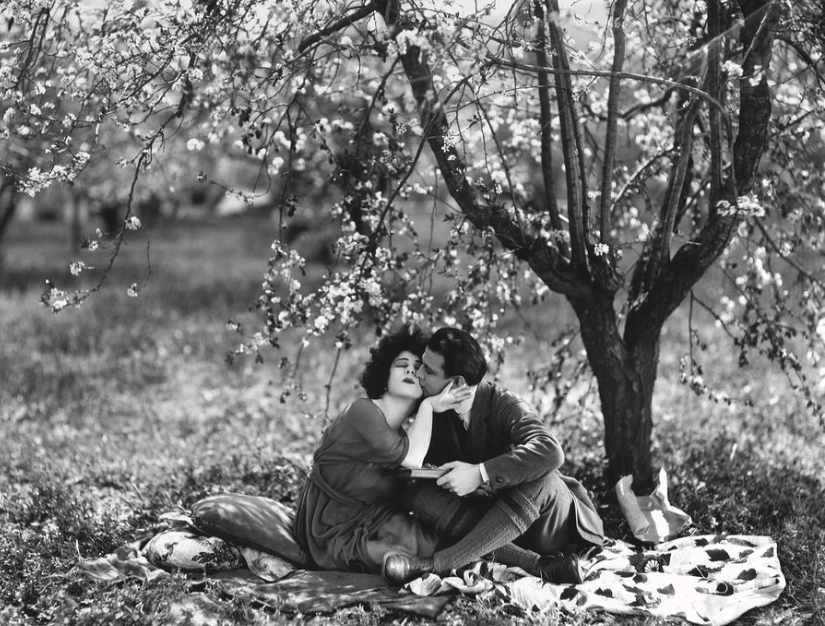
The picnic episode in Roy Smallwood’s Camille: A Modernized Version is not present in Alexandre Dumas, fils’s La Dame aux Camélias. According to Smallwood’s cinematic logic, however, a romantic scene played out in a natural setting is a sure audience winner. So when Marguerite, the Lady of the Camelias, is recovering from tuberculosis, she meets her lover Armand in an orchard beneath blooming apple trees. Cuddling and kissing, the screen legend tells the obvious, “Love is the greatest doctor.”
For entertainment, Armand brings along Manon Lescaut, a tragic romantic novel about an unhappy love affair in which Manon, a courtesan (like Marguerite), dies. Overcome by sadness because the story is too close to reality, Marguerite asks Armand to stop. “I could never chain you to my past, Armand,” the screen legend tells us, “and drag you down—never!”Not to be deterred,
The picnic is a tender and indelible moment, and in Marguerite’s dying moments, she remembers it and says, “Let me sleep—let me dream—I am happy,” and dies.
There is no food or drink at the lover’s picnic.
Featured Image: Alla Nazimova as Marguerite and Rudolph Valentino as Armand
There is a picnic in Fred Niblo’s Camille: A Modern Version (1927), but not in George Cukor’s Camille (1936) or Desmond Davis’s adaptation(1984)
See: Roy C. Smallwood. Camille: A Modernized Version (1921). Screenplay by June Mathis based on Alexander Dumas, fils’ novel and play; Alexandre Dumas, fils. La Dame aux Camélias (1848) and the dramatization in 1852; J. Gordon Edwards. La Dame aux Camelias (1917). Screenplay by Adrian Johnson. There is a picnic in Fred Niblo’s 1927 Camille; A Modern Version (1927), but not in George Cukor’s 1936 Camillle, or Desmond Davis’s 1984 Camille; Dumas’s source for his story, Antoine François Prévost’s Manon Lescaut (1731) does not have a picnic.