
Themes
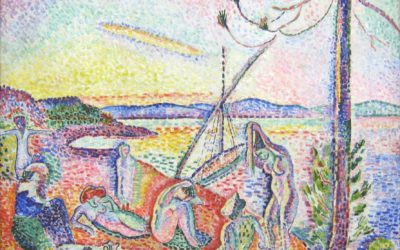
About PicnicWit
PicnicWit is a hybrid collection of picnics, some of which are from life, but most from literature, drama, film, painting, graphic arts, sculpture, music, ballet, opera, food and cookbook writers. For millennia, what we call a picnic was not a picnic, but an unnamed outdoor social or celebratory entertainment. Now that we have a name, […] read more
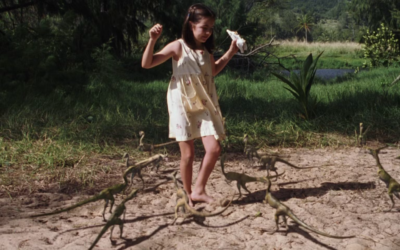
Michael Crichton’s Jurassic Park: The Lost World (1990)
Michael Crichton’s The Lost World is set six years after Jurassic Park failed and the dinosaurs were supposedly destroyed does briefly describes a picnic lunch for the Bowman family, who have been traveling by Range Rover over Costa Rica’s bumpy roads to a deserted beach in search of adventure. But what begins leisurely is undercut […] read more
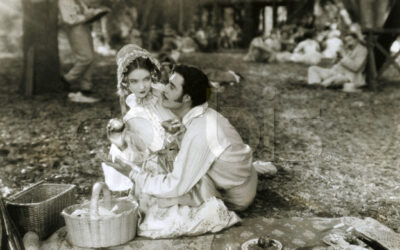
Silent Film Picnics
The first picnic episode in film history is Segundo de Chomón’s comedy of “horrific” errors in Une excursion incohérente, which is sometimes translated as The Panicky Picnic or The Travellers’s Nightmare. It’s a silent film sequence of two minutes in an eight-minute film, one of several hundred silent films Chomón produced in Paris and Italy. […] read more
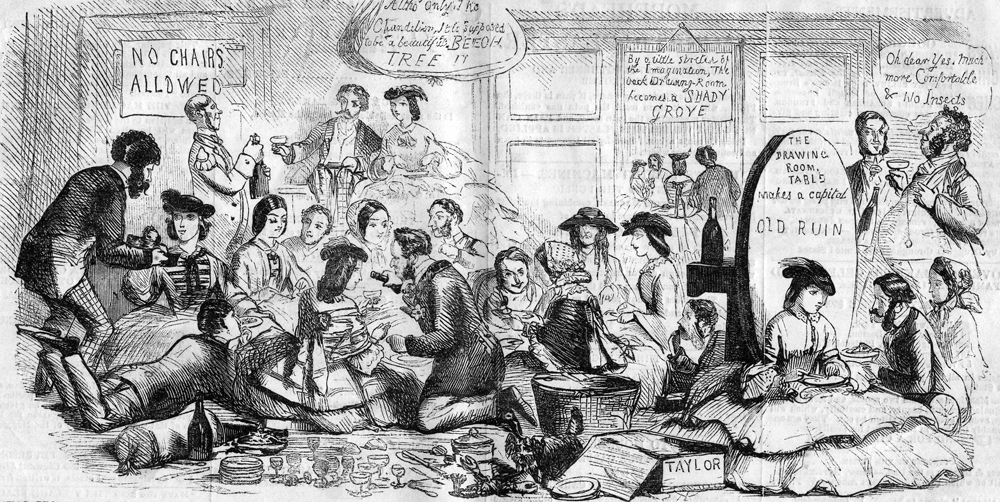
Picnic Aphorisms and Witticisms
Aphorism: a concise statement of a principle, a terse formulation of a truth or sentiment, a witty observation or statement, sometimes serious or humorous. “I hope it doesn’t rain tomorrow,” said Scarlett. “It’s rained nearly every day for a week. There’s nothing worse than a barbecue turned into an indoor picnic.” […] read more
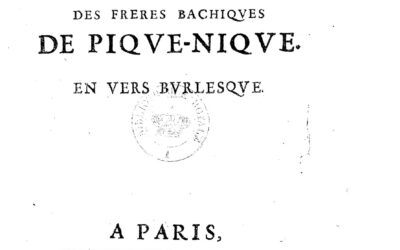
1649: Pique-Nique is the name of a French Soldier
Pique-Nique was originally a man’s name. It was coined in 1649 by an anonymous author satirizing a French soldier and his cohorts who gave up their martial duties for the pleasure of drinking and gourmandizing. Since 1694, we have supposed that piquenique is a word without a source, a mystery defined in the lexicographer, Gilles […] read more
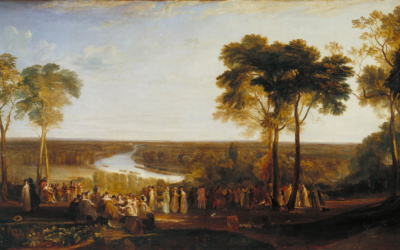
Picnic Birthdays and Name Days
Birthdays and Name Days, celebrations of the name of a saint associated with an individual, are often a cause for picnicking. Originally, Name Days were linked to Catholic tradition, but the celebration has been largely secularized. Not everyone has a Name Day, but everyone does have a birthday. Notably, J.M.W. Turner used picnics in two […] read more

Glum Film Picnics
Five Glum Film Picnics tells that picnics are not always. We expect picnics to be happy and vivacious, but this expectation is sometimes upended. In these instances, filmmakers depict the characters’s moodiness as exhibited at a picnic. Ordinarily, there is an expectation of joy and congeniality, but glum picnics turn that expectation topsy-turvy. Susanna […] read more
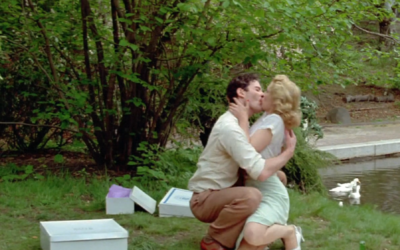
Alan J. Pakula’s Sophie’s Choice (1982)
Alan J. Pakula’s Sophie’s Choice includes two picnics: one in Prospect Park’s Vale of Cashmere and the other on the porch roof of their rooming house. Both are missed opportunities, especially because of Styron’s description of how Sophie Zawistowska’s picnics mask her despair and try to blot out the horror of her time in Auschwitz. […] read more
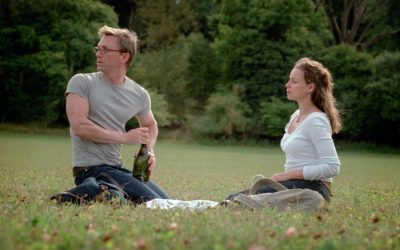
Roger Michel’s Enduring Love (2004)
Food is untouched, and wine is untasted when Joe and Claire’s picnic is interrupted by a runaway balloon. Michell’s adaptation of Enduring Love makes a show of champagne, but the food is unspecified. McEwan’s novel includes an expansive menu for the novel consisting of a picnic of black olives, mixed salad, mozzarella, focaccia, and white […] read more
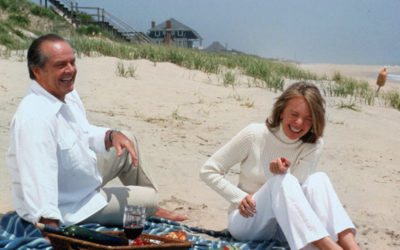
Nany Meyers’ Something’s Gotta Give (2003)
Suds. Hamptons, New York, and Paris. Money. Two middle-aged beauties find romance and love. Perfect beach house. Perfect weather, Perfect wine. Aw shucks. “Erica and Harry sit on a blanket on a cloudy day, having a picnic lunch. Harry is telling Erica a story, and she screams with laughter.” Then it rains. The run to […] read more
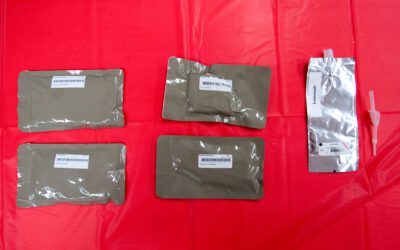
Paul Theroux’s O-Zone (1986)
Paul Theroux’s O-Zone is a sci-fi satire of the decline of American civilization caused by environmental degradation. It opens as a New Year’s Eve celebration in the degraded O-Zone, a no-go area contaminated by radiation, noxious chemicals, and inhabited by savage survivors of the environmental holocaust. Gathered in the O-Zone, or Outer Zone, are eight […] read more
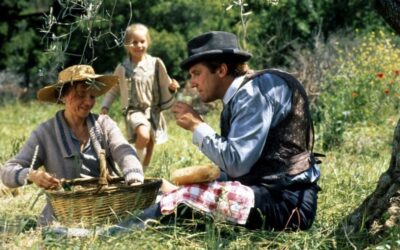
Claude Berri’s Jean de Floret (1986) (1986)
The setting is Provence, where Jean Cadoret and his family try to make a go of living on a property his wife Aimee inherited. Cheated, betrayed, and bankrupted, the project fails. This picnic is one of the family’s happier moments. See: Claude Berri. Jean de Floret (1986). Screenplay by Claude Berri, Gérard Brach, and Marcel […] read more
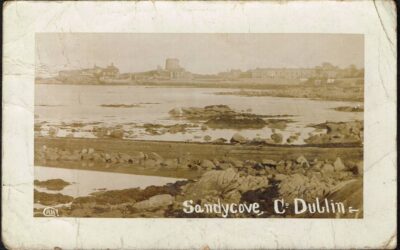
John Banville The Drowned (2024)
Phoebe Quirke has asked St.John Strafford to a picnic. It’s not the best weather for a picnic. It’s October, the days are cool, and the sky is usually partly sunny. They have been awkward lovers; partly because Phobe is diffident and Strafford is taciturn. They have made love three times, and now Phoebe is pregnant, […] read more
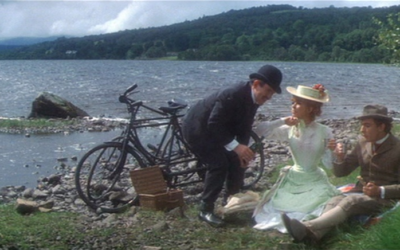
Billy Wilder’s The Private Life of Sherlock Holmes (1970)
Billy Wilder’s The Private Life of Sherlock Holmes is mostly a comedy comprised of mismatched episodes, the second of which concerns a search for a secret British laboratory in Scotland and an attempt by a German spy to seduce Holmes. The search leads Holmes, Watson, and Gabrielle Valldon (the spy as yet unmasked) to Loch […] read more
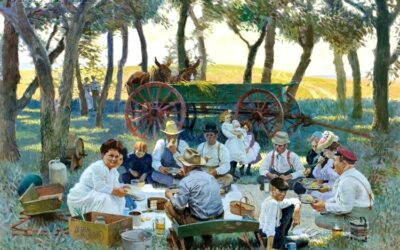
John Philip Falter’s Prairie Grove Picnic (1977)
Falter was a commercial artist and illustrator mostly known for his Saturday Evening Post magazine covers. Featured Image: John Philip Falter Prairie Grove Picnic. Oil on Linen (1947) read more
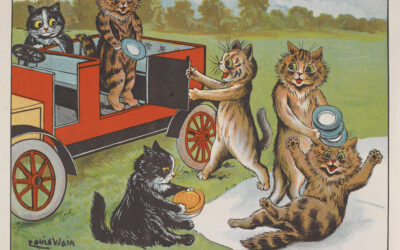
Louis Wain’s “Pussies Preparing for a Picnic” (1919)
These clever Pussies have come for a picnic in a motor car, they are on their very best behaviour, and have brought a tablecloth and plates with them, and one thing I am certain, their plates will be quite clean when the have finished dinner, because they are sure to like them until they are […] read more
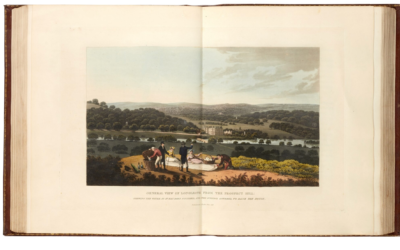
Humphrey Repton’s Fragments (1816)
Humphrey Repton was Britain’s preeminent landscape architect. His Fragments on the Theory and Practice of Landscape Gardening, coauthored with his son John Adey Repton,b includes his very particular notions of landscape gardening on a large scale. The text includes images by Repton illustrating his text, such as Picnic at Longleat, which is embellished with picnickers. read more
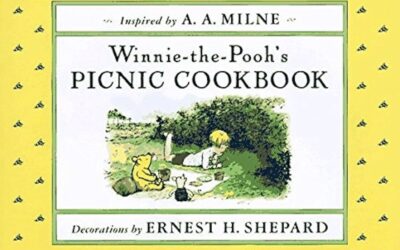
Winnie-the-Pooh’s Picnic Cookbook, Inspired by A. A. Milne (1997)
Winnie-the-Pooh’s Picnic Cookbook, Inspired by A. A. Milne, purports to be for is a tongue-in-cheek adult cookbook masquerading in kid’s clothing. Picnics are loosely linked to Milne’s Pooh stories, and the picnics suggested are the likes of: “Expotition Picnic,”; Birthday Party Picnic; Kid’s Picnic; and Beach Picnic.” For adults, suggested menus require sophisticated assistance, and […] read more
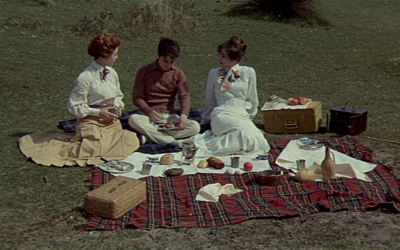
Francois Truffaut’s Les deux Anglaises et le continent (1971)
François Truffaut’s title Les deux Anglaises et le continent refers to two English girls, Muriel and Anne Brown, and their lover, Claude Roc, a Frenchman. It’s a confusing title until it is explained that the girls affectionately call Claude “le continent.” Even so, it’s a ditsy commentary on their relationship that is a jumbled ménage […] read more
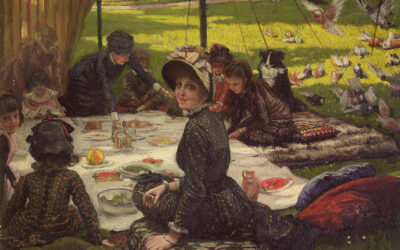
James [Jacques] Tissot’s Picnic on the Grass (1881/82)
Elizabeth Newton and her children enjoy a birthday party in Tissot’s garden in St. John Wood, London. The partygoers sit on cushions beside a picnic cloth laden with food and drinks prominently placed in the immediate foreground. The children are of secondary importance. Tissot was in love with Newton, and they were partners for five […] read more
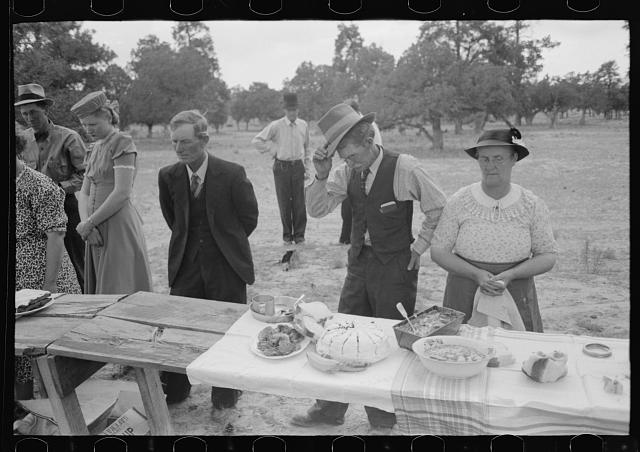
Russell Lee’s The Blessing at Dinner on the Grounds at the All-Day Community Sing, Pie Town, New Mexico (1940)
Featured Image: Russell Lee. The Blessing at Dinner on the Grounds at the All-Day Community Sing, Pie Town, New Mexico (1940). Courtesy Library of Congress. LC-USF33- 012785-M5 [P&P] Also, Dinner on the Grounds, Nell Choate Jones. Church Supper (1945) Greenville Museum of Art Greenville, SC; Edna Lewis’s The Taste of Country Cooking \ (1977); Paul […] read more
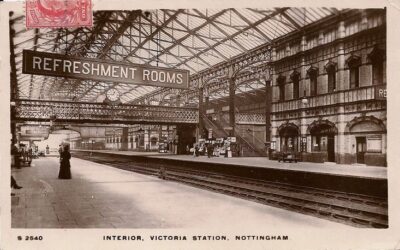
Charles Dickens. “The Boy at Mugby Junction” and the “Universal French Refreshment Sangwich” (1866)
Dickens vented his distaste for English travel food, especially sandwiches served in cold, comfortless train stations. The Boy at Mugby Station working in h Refreshment Room gleefully tells anyone who will listen (or not) how awful the refreshments (if they can be called refreshments are: “You don’t know what I mean? What a pity! But […] read more
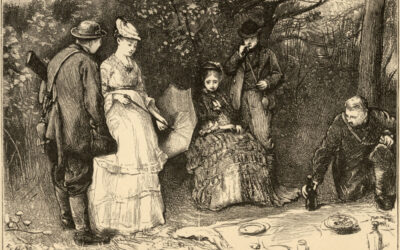
Anthony Trollope’s Phineas Redux (1874)
Trollope’s Phineas Redux is the fourth book in the Phineas Finn Series. It was among his most popular novels. Numerous hunt scenes and references suggest Finn’s plight evading his enemies. A halt during a fox hunt provides the opportunity for a simple picnic lunch in the field. Featured Image: Frank Holl’s illustration caption is “You […] read more
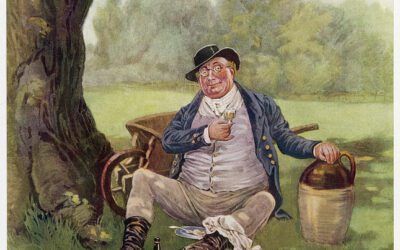
Fred Barnard’s Mr. Pickwick’s Picnic in The Pickwick Papers (1870c)
Pickwick’s picnic on a hunt in Dingley Dell is part of an abortive hunting expedition. It’s famous for Pickwick getting drunk and Sam Weller’s discussion of veal pies, pronounced “weal” in Weller’s Cockney accent. This picnic is served under the welcome shade of an old oak to make it easy for Pickwick, who suffers from […] read more
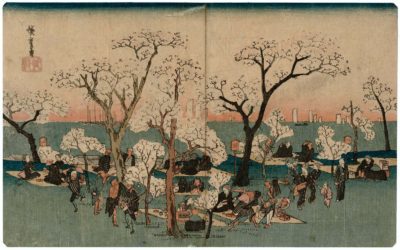
Hiroshige’s Picnic at Gotenyama (1833)
Hiroshige aims to depict activity relevant to the moment in a specific landscape. In this respect, his scenes in Japan correlate with J.M.W. Turner’s picturesque landscapes of the United Kingdom. While picnicking under the blooming cherry trees at Gotenyama, too much food and sake instigate a drunken brawl. Compare this with the rowdy sailors at […] read more
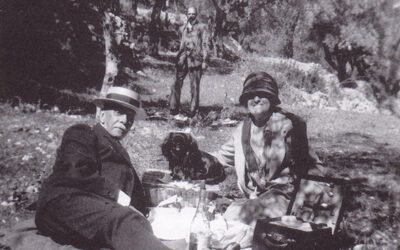
Percy Lubbock’s Description of Edith Wharton Picnicking (1947)
Lubbock’s Portrait of Edith Wharton is definitive: “Edith settled, the strapped hampers (which she likes to think of as ‘corded bales’) set side by side, the rugs spread, the guests ‘star-scattered in their places: poetic allusion is never amiss at these symposia. Nobody at this point is to help her; she unpacks, distributes, and apportions […] read more
Arthur Conan Doyle’s “No picnic at Vaalkranz.” in The Great Boer War (1900)
Doyle was knighted for his service during the Boer War (1899-1902), in which he served as a medical doctor. Much of Doyle’s The Great Boer War was written in hospital tents where he treated the wounded and diseased. The memories are a nationalistic view of a war unpopular in Britain, making the case that war […] read more
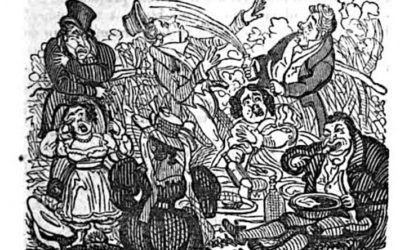
The Pic-Nic Song (1829)
Corny picnic satire was in vogue among English music before Gilbert and Sullivan’s 1871 Thespis, or The Gods Grown Old. Typical “The Pic-Nic” is sung to the air of “Here’s the Maiden of Bashful Fifteen” from Sheridan’s The School for Scandal. Its inclusion in Arliss’ The Melodist, a collection of popular songs, suggests opportunities for […] read more
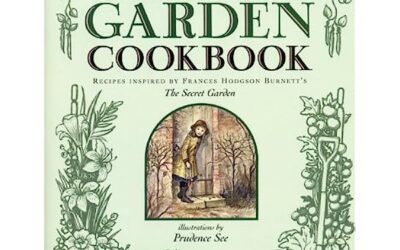
Amy Colter’s The Secret Garden Cookbook (1999)
Colter’s The Secret Garden Cookbook is mainly a collection of high calory, sugary and fatty foods. She starts with Burnet’s essential food path and never wanders far off. “You can trifle with your breakfast and seem to disdain your dinner,” Burnet writes, “if you are full to the brim with roasted eggs and potatoes and […] read more
Jan Miel’s La Merienda and Hunters at Rest (1640s/50s)
Miel’s halt on the hunt and repas de chasse depicts hunters stopped by a rustic inn. In the Prado’s La Merienda, hunters have spread a cloth beside their horses and are settling in to relax. This is a perfunctory meal of sliced ham, cheese, bread, and wine. Unlike Watteau’s fashionable hunters and their ladies in […] read more
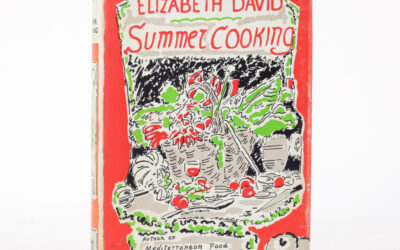
Elizabeth David’s “Indian Picnics: Picnic at Kutub Minar” (1955)
David’s “Indian Picnics: Picnic at Kutub Minar” is an anecdote related in Summer Cooking (1955). This moonlight picnic is held at Kutub Minar, a leaning tower (238 feet) now in ruins just outside Delhi. David says that if the picnic was wrong from the start, it was not the moonlight or the food, but the […] read more
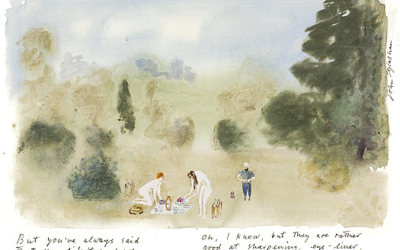
John Glashan.’s Picnic Cartoon
John Glashan. “What’s that you’ve brought with you?” The Spectator, 1 July 1995 read more
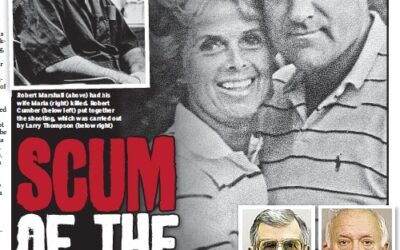
Joe McGuiness’s Blind Faith (1989)
McGinnis’s’ Blind Faith is dramatized reportage of a New Jersey murder case in which Rob Marshall was accused of hiring hitmen to free himself to marry his flamboyant mistress. According to McGuiness, when Marshall thought something was wrong with one of his tires, he pulled off the Garden State Parkway into a pitch-black, deserted picnic […] read more
Harry Hoffman’s Harvest Moon Walk (1912c.)
Hoffman’s Harvest Moon Walk is a masquerade picnic where revelers dress as vegetables. According to the Griswold Museum, “Hoffman’s eccentric depiction of strangely clad figures captures one of the Lyme Art Colony’s most festive rituals. On an October evening, merrymakers arrived at Florence Griswold’s house imaginatively costumed as fruits and vegetables. The marchers, a mix […] read more
Norman Lindsay’s and The Picnic (1944) and The Duke’s Picnic (1945)
Two picnics engage viewers to admire Lindsay’s unmistakable style. The Picnic, done in 1944) is a joke that upends expectations. Half of the women picnickers are naked. The Duke’s Picnic (1945) is a typical picnic where all the guests are clothed. Viewers are discouraged from finding the picnic feast. Featured Image: The Duke’s Picnic (1945), […] read more
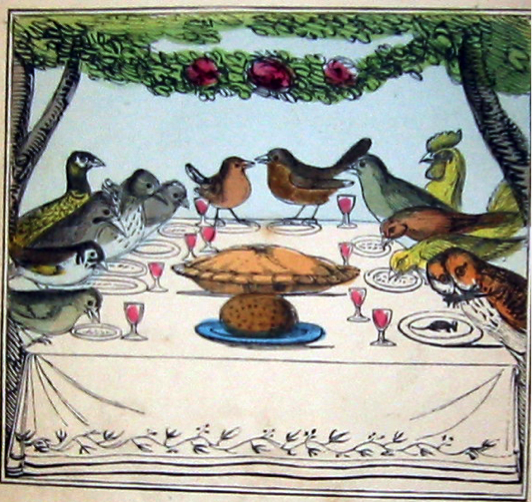
John Harris’s Pic Nic Dinner of Cock Robin and Jenny Wren (1806)
The Courtship, Marriage, and Pic Nic Dinner of Cock Robin. To Which is Added, Alas! The Doleful Death of the Bridegroom is the first outdoor dinner named a picnic in the modern sense. When John Harris retold the old story of Sparrow’s fateful murder of Cock Robin, he named the birds’s outdoor wedding party a […] read more
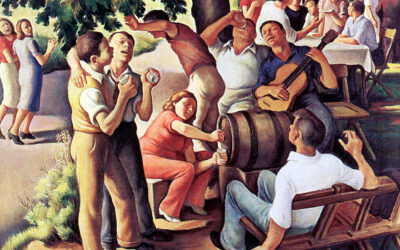
Daniel Celantano’s Picnic (1945c.)
Celentano’s painting Picnic depicts working-class people happily at leisure. The picnic is simple without frills or elegance. A family picnic in the country. the picnic blanket is spread out under a tree. Seems to be several families, and they all cluster on or around the blanket: in the center, a woman, her head back and […] read more
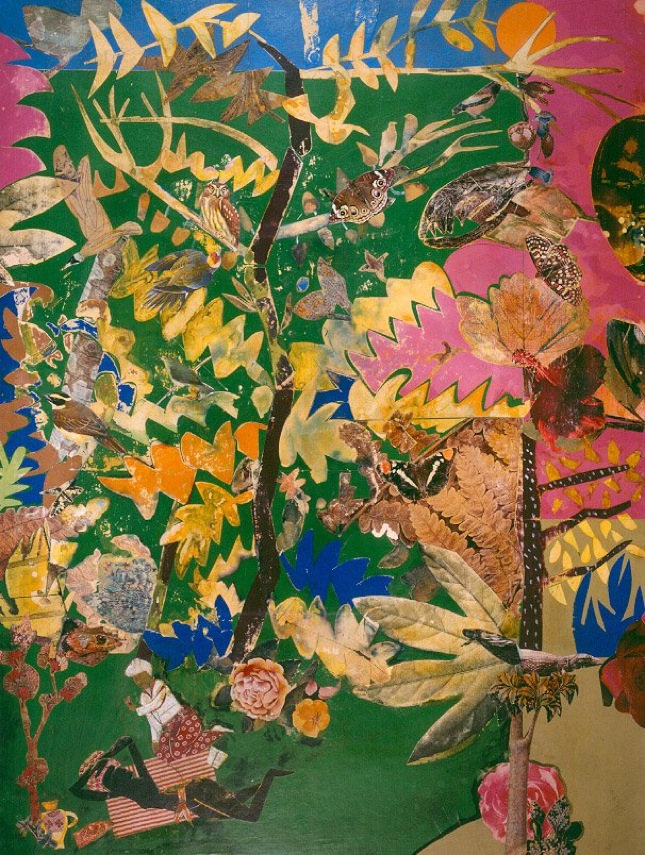
Romare Bearden’s Khayam and the Black Girl (1971)
Bearden transports Omar Khayyám’s Persia to the Tropics for his take on “Quatrain XI” from The Rubáiyát of Omar Khayyám. But the man is Persian and the woman is black. Though the poem suggests sensuality, Bearden presents the poet clothed but the woman naked, except for a body sash and a head turban. It’s still […] read more
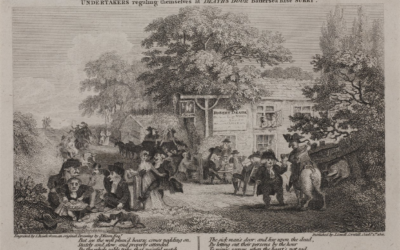
John Nixon’s Picnics
John Nixon was an amateur painter who flourished between 1784 and his death in 1818. Nixon’s burlesque Undertakers Regaling Themselves at Death’s Door, Door, 1801, was copied by Thomas Rowlandson and renamed Undertakers Regaling. Death’s door is a pun on the tavern owner Robert Death. English Country Life, undated, shows the popularity of picking as […] read more
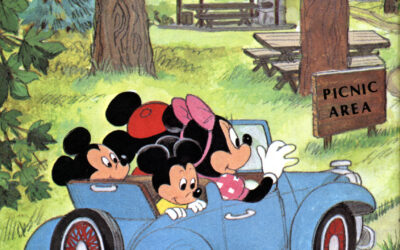
Walt Disney A Picnic in the Woods (1983)
Among the best picnics, adult or otherwise, A Picnic in the Woods sets an example of optimistic picnic fun. It begins with the usual refrain: “It’s a beautiful day for a picnic!” as Mickey Mouse, Minnie Mouse, and Mickey’s nephews Ferdy and Morty cram into the blue convertible for a day in the country. Soon, […] read more
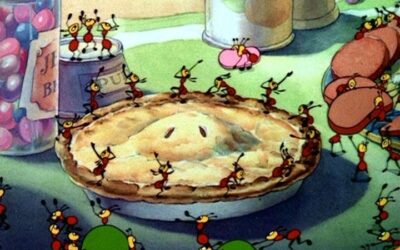
Walt Disney’s Donald Duck Beach Picnic (1939)
Donald Duck’s beach picnic makes a joke of expectations. Intending a pleasant day at the beach, Donald is upset and bedeviled with turmoil. Especially the ants, dressed in war paint like “Native Americans,” steal Donald’s picnic. The idea is meant to be comic. Ants at a picnic are always fun, but in this instance, masquerading […] read more
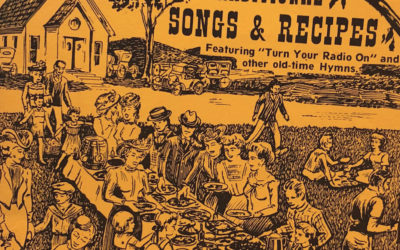
Albert E. Brumley’s All-Day Singin’ and Dinner on the Ground[s] (1972)
Camp meetings are an American tradition, the first of which seems to have been organized by James McGready (c.1760–1817) based on the Scottish Presbyterian outdoor revival meetings. These meetings were introduced to England in 1807, especially by the Methodists. The camp meetings were marathons that lasted several days. A short version of the camp meeting […] read more
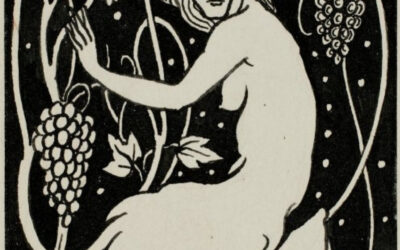
Foster, E. M. “The Curate’s Friend” (1904)
“The Curate’s Friend” is one of two of Forster’s coming-out stories published in The Celestial Omnibus. In “The Story of a Panic,” Pan appears in a whirlwind and rapes a young boy. In “The Curate’s Friend,” a Faun enamors Harry the Curate and becomes a life-long friend. Telling this story long after, Harry leaves the […] read more
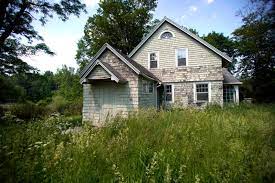
Edith Wharton’s Summer (1917)
Wharton’s Summer is the story of a summer romance doomed to failure that begins with seduction at a picnic. When Charity Royall, a small-town girl of seventeen, falls for Lucius Harney, a socially upscale architect, she loses her innocence at a picnic. The outing and picnic lunch are critical moments in the narrative suggesting the […] read more
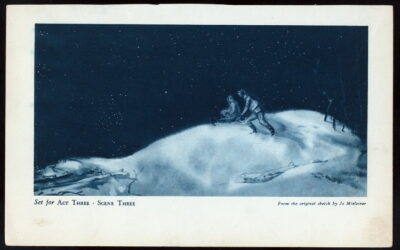
Edith Wharton’s Ethan Frome (1911)
An exception to the unremitting cold in Wharton’s Ethan Frome is a summer church picnic when Ethan and Mattie Silver first feel love for one another. When Mattie is forced to leave, Frome drives her to the train station. Along the way, they stop by the frozen Shadow Pond and look out on the frozen […] read more
Beryl Bainbridge’s The Bottle Factory Outing (1974)
Bainbridge’s idea of picnic fun is a biting satire of an English company picnic during which everything that can go awry does, including murder. Two friends, Brendass and Freda, organize a picnic for the employees at an Italian wine and spirits shop on Hope Street in London. An ulterior motive is Freda’s dreamy intention of […] read more

Booker T. Washington’s “All Day Meeting” (1911)
Washington’s “all day meeting” is also known as “dinner on the grounds.” It agrees with versions of meetings by William A. Clary, Edna Lewis, Bebe Meaders and maya Angelou. I’ve cited Washington’s whole passage because it’s so full of detail and energy In Macon County, Ala., where I live, the coloured people have a kind […] read more
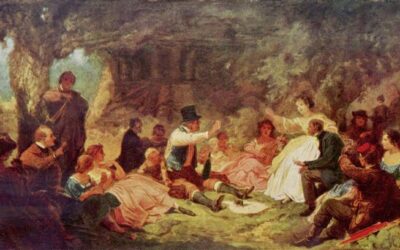
Carl Spitzweg’s Déjeuner sur l’herbe (1864c.)
Spitzweg’s Dejeuner sur l’herbe, Das Picknick, aka Luncheon on the Grass, is a happy middle-class person in the country. They sit, relaxing and enjoying each other’s company. The central figure, a portly man, toasts a woman in white, perhaps a bride. The company rises to the occasion. Largely forgotten now, he was an important German […] read more
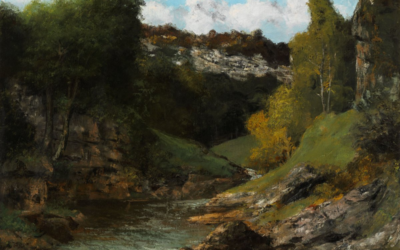
John Fowles. The Cloud (1973)
John Fowles’s The Cloud takes its title from Shakespeare’s Two Gentlemen of Verona (Act 1, Scene 3): “O, how this spring of love resembleth The uncertain glory of an April day, Which now shows all the beauty of the sun, And by and by a cloud takes all away! As a group of English, five adults […] read more
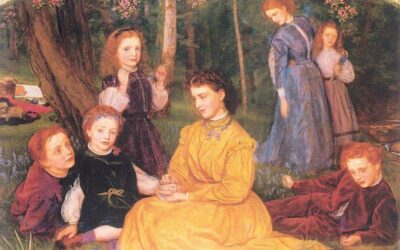
Arthur Hughes’s A Birthday Picnic (1867)
Hughes used a picnic as a theme for a family portrait of the Pattinson family. The title he gave was A Birthday Picnic – Portraits of the children of William and Anne Pattinson of Felling, near Gateshead. A red table with food in the left background, but it is unclear whose birthday is being celebrated. […] read more