
1900-1949
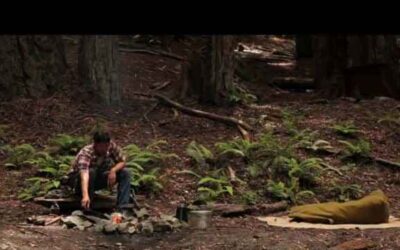
Ernest Hemingway's "Big Two-Heated River, Part Two" (1925)
It resembles a picnic; it’s recreational, but it’s lunch on a trout-fishing excursion on Michigan’s Upper Peninsula. In Ernest Hemingway’s story “Big Two-Hearted River, Part Two,” Nick Adams breaks to have a sandwich. Nick is depressed and trying desperately to get over his war memories and a nagging injury. Fishing for trout in a cold […] read more
J.V. Davidson-Houston's "Siberian Picnic" (1939)
In August 1939, Russia and Germany signed a non-aggression pact. The following October, Major Davidson-Houston was spying for the British Army, and “Siberian Picnic” is his public account of his 5,772-mile Trans-Siberian “Hard Class” train ride in late October 1939, which was long, dirty, and cold was no picnic. Curiously, Davidson-Houghton took careful notes of […] read more
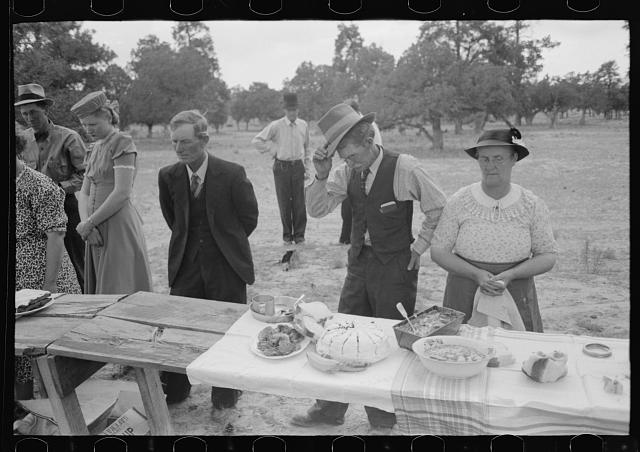
Russell Lee’s <em> The Blessing at Dinner on the Grounds at the All-Day Community Sing, Pie Town, New Mexico</em> (1940)
Featured Image: Russell Lee. The Blessing at Dinner on the Grounds at the All-Day Community Sing, Pie Town, New Mexico (1940). Courtesy Library of Congress. LC-USF33- 012785-M5 [P&P] Also, Dinner on the Grounds, Nell Choate Jones. Church Supper (1945) Greenville Museum of Art Greenville, SC; Edna Lewis’s The Taste of Country Cooking \ (1977); Paul […] read more
Jacques Lartigue’s <em>Chou Valton at la Garoupe, Cap d’Antibes, July 1932</em>
Sunbathing on the beach with champagne. Lartigue’s shadow is seen in the lower left corner. See Jacques Henri Lartigue. Chou Valton at the plage de la Garoupe, Cap d’Antibes, July 1932. Silver Gelatin Print. read more
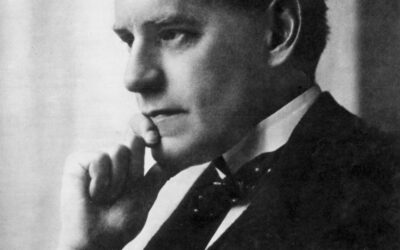
John Galsworthy's "The Apple Tree" (1916)
Galsworthy’s is a moral tale about the “deeply buried” guilt. What is supposed to be a romantic picnic celebrating a silver anniversary turns achingly poignant. Ashurst’s past is vividly recalled when inadvertently picnicking with his wife, Stella, next to the grave of his first love, Megan David, a simple farm girl. They were to be […] read more
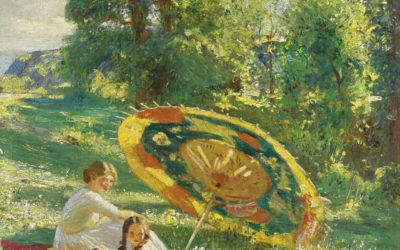
Georgina Battiscombe’s <em>English Picnics</em> (1949)
Georgina Battiscombe’s 1949 English Picnics is a study of English picnics in literature and art that has become a go-to standard because it was the first of its kind. Her writing is distinctive, authoritative voice and her examples and explanations usually first-rate. Though, alas, she does not reveal her sources. Battiscombe asserts the English picnicker […] read more
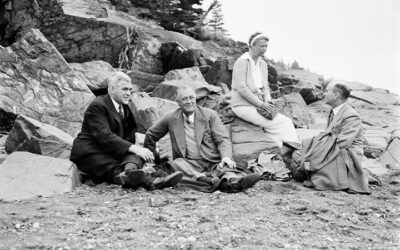
Eleanor Roosevelt on Campobello Island (1931)
During the first summer of FDR’s presidency, the Roosevelts hosted a Fourth of July picnic at their vacation home on Campobello Island, New Brunswick [about a half mile off the coast of Lubec, Maine]. Formality ruled, and men and women dressed in a causal style, the men in light-colored suits and the women in light-colored […] read more
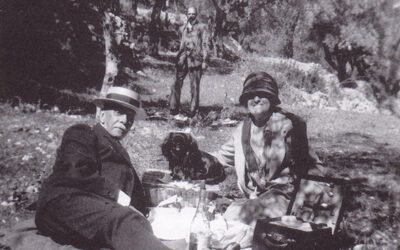
Percy Lubbock's Description of Edith Wharton Picnicking (1947)
Lubbock’s Portrait of Edith Wharton is definitive: “Edith settled, the strapped hampers (which she likes to think of as ‘corded bales’) set side by side, the rugs spread, the guests ‘star-scattered in their places: poetic allusion is never amiss at these symposia. Nobody at this point is to help her; she unpacks, distributes, and apportions […] read more
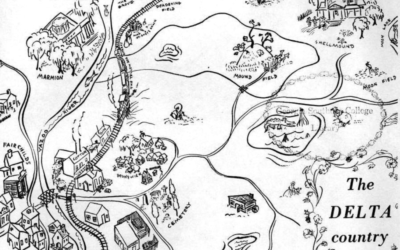
Eudora Welty's <em>Delta Wedding</em> (1946)
Under a magical starry sky, Welty’s picnic at the Grove calms the frayed edges of family life after a momentous wedding. Though it is held at night, the air is cool and still summery warm, the stars twinkles as shooting stars burst across the sky, and the sound of the horse and wagon is reassuring. […] read more
Arthur Conan Doyle’s “No picnic at Vaalkranz.” in <em>The Great Boer War</em> (1900)
Doyle was knighted for his service during the Boer War (1899-1902), in which he served as a medical doctor. Much of Doyle’s The Great Boer War was written in hospital tents where he treated the wounded and diseased. The memories are a nationalistic view of a war unpopular in Britain, making the case that war […] read more
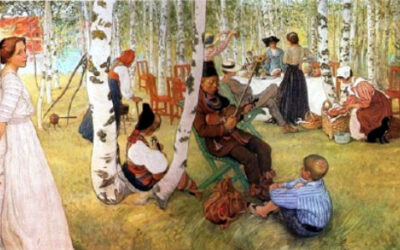
Carl Larsson’s <em>Breakfast in the Open</em> (1910)
Larsson’s outdoor breakfast is among his favorites. It’s set in a birch grove away from the family house.. Food is packed in a big hamper by a servant. The table, covered with a white cloth, has wooden chairs. In the center foreground is a man playing a fiddle, and a girl plays a lute or […] read more
A.A. Milne”s <em>Winnie-the-Pooh</em> (1926)
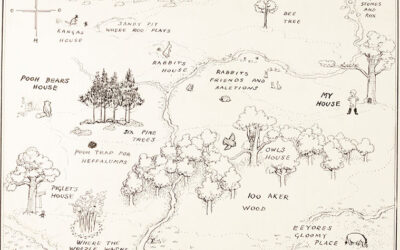
A.A. Milne’s picnics in Winnie-the-Pooh (1926) are happy and leisurely held in “The Hundred Aker Wood.” It’s a location just above the “Sandy Pit where Roo Plays” with a sign that says “a Nice Place for Piknicks.” No doubt, where Christopher Robin holds a formal picnic party for which Pooh agrees to attend because pink […] read more
Harry Hoffman's <em>Harvest Moon Walk</em> (1912c.)
Hoffman’s Harvest Moon Walk is a masquerade picnic where revelers dress as vegetables. According to the Griswold Museum, “Hoffman’s eccentric depiction of strangely clad figures captures one of the Lyme Art Colony’s most festive rituals. On an October evening, merrymakers arrived at Florence Griswold’s house imaginatively costumed as fruits and vegetables. The marchers, a mix […] read more
Kjeld Abell’s <em>The Melody that Got Lost</em> : <em>Melodien der blev væk </em> (1936)
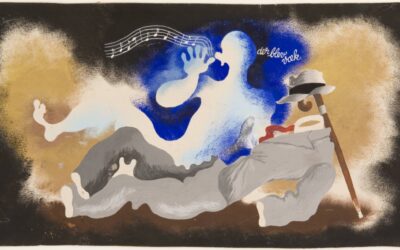
Abell’s The Melody That Got Lost is a surrealistic drama with music that severely critiques modern conformity to middle-class values and the insipid qualities of middle-class imagination with a picnic filled with trash. The picnic scene begins when a typically boring Sunday dinner fades into an outdoor setting with a hiking song: “Over hill, we […] read more
Marcel Proust's <em>Within a Budding Grove</em> (1914)
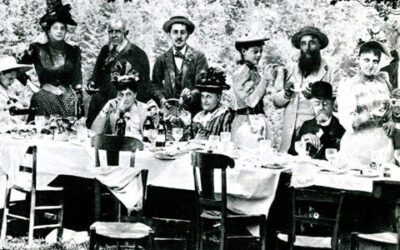
Proust’s Within a Budding Grove [aka In the Shadow of Young Girls in Flower] is sometimes remembered for young Marcel’s picnics on the bluffs at Balbec, a fictional town in Normandy. (Proust does not use pique-nique because this is an outdoor meal.) With a “little band” of teenage friends, Albertine, Andrée, Delphine, and Rosemonde, Marcel […] read more
August Escoffier’s “Crêpes Suzettes” in <em> The Complete Guide to the Modern Art of Cookery</em> (1903)
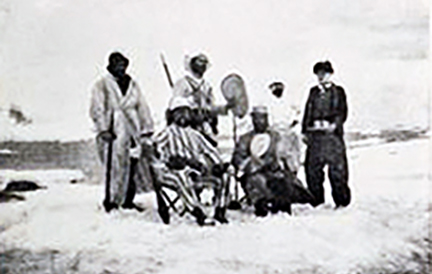
For all we know, Jean-Baptiste Charcot’s chef on the Pourquoi Pas! Used this recipe for Crêpes Suzette when the crew celebrated Mardi Gras in Antarctica. 2450— SUZETTE PANCAKES Make these from preparation A, flavoured with cura9oa and tangerine juice. Coat them, like Gil-Bias pancakes, with softened butter, flavoured with curaçao and tangerine juice. 2403— PREPARATIONS FOR […] read more
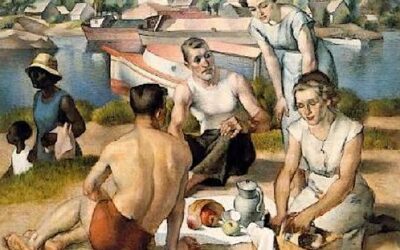
Simka Simkhovitch’s <em>The Picnic</em> (1930s)
Simkhovitch’s The Picnic is a day of leisure for a group that seems mirthless. They sit on bare earth, and each is unsmiling and subdued. There is no picnic joy as a small picnic cloth is spread around which they all gather. A man in a bathing suit reclines, his back to the viewer. Behind […] read more
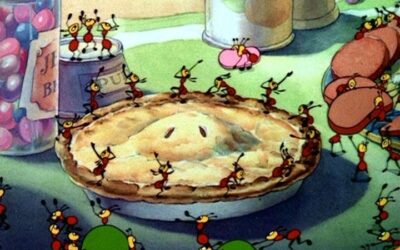
Walt Disney’s <em>Donald Duck Beach Picnic</em> (1939)
Donald Duck’s beach picnic makes a joke of expectations. Intending a pleasant day at the beach, Donald is upset and bedeviled with turmoil. Especially the ants, dressed in war paint like “Native Americans,” steal Donald’s picnic. The idea is meant to be comic. Ants at a picnic are always fun, but in this instance, masquerading […] read more
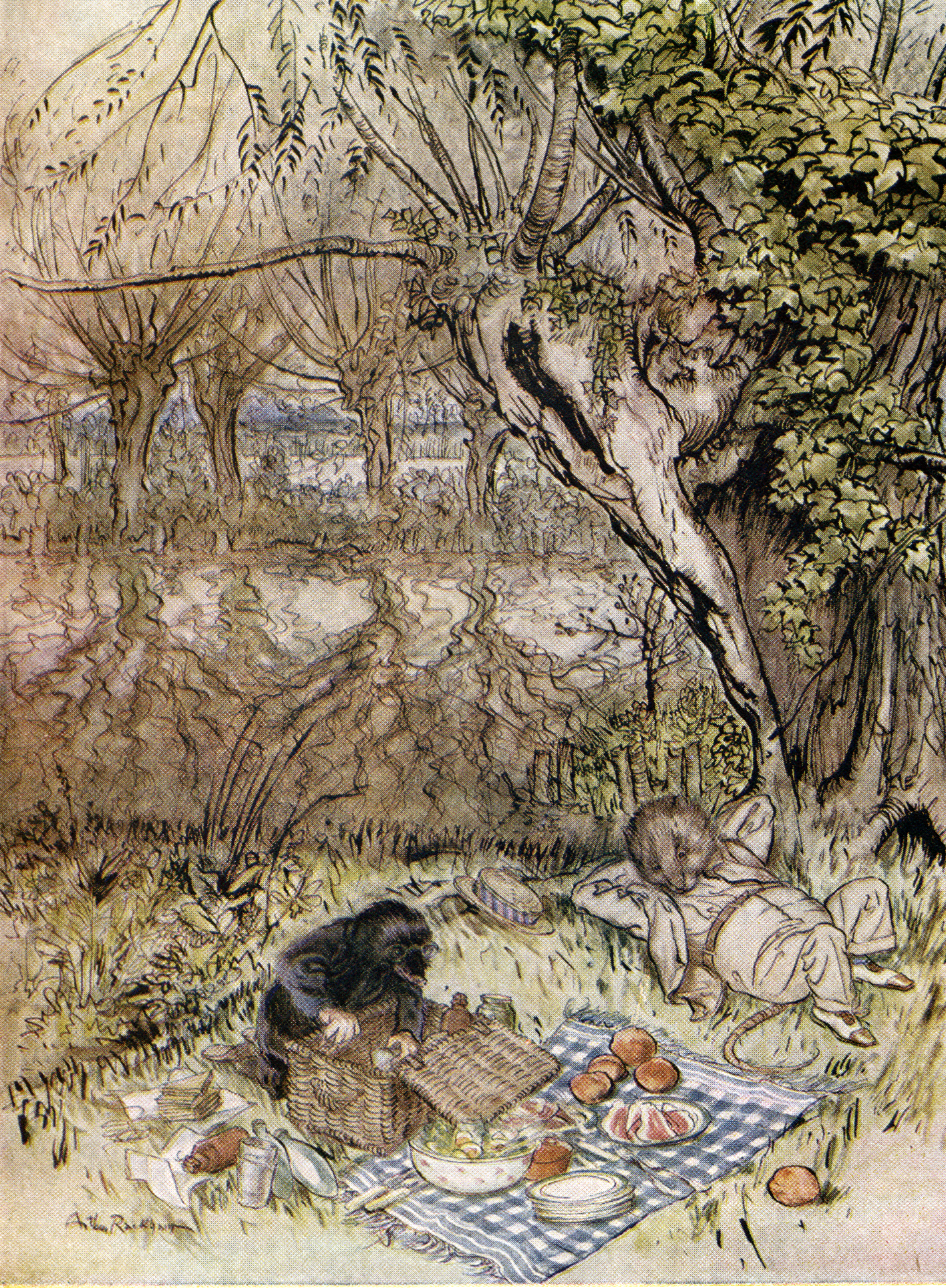
Arthur Rackham’s “The Mole begged as favour to be allowed to unpack” in <em>The Wind in the Willows </em> (1931)
“The Mole begged as a favour to be allowed to unpack it all by himself,” In Wind in the Willows by Kenneth Grahame. New York: Scribner’s Sons, 1931. read more
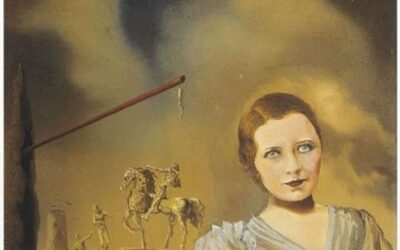
Caresse Crsby's Picnic in Ermenonville (1934) and Elsewhere
When Mary Phelps Jacob was nicknamed Polly, when she married her first husband, she became Mary Phelps, Jacob Peabody. Harry Crosby, her second husband, renamed her Caresse Crosby. He liked the alliteration and the pun on caress. When Harry died a suicide in 1929, Caresse carried on with the Black Sun Press and the support […] read more
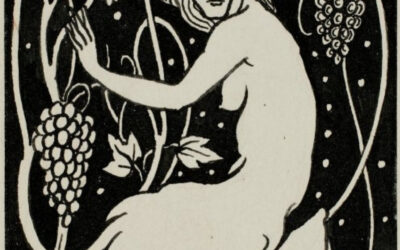
Foster, E. M. "The Curate's Friend" (1904)
“The Curate’s Friend” is one of two of Forster’s coming-out stories published in The Celestial Omnibus. In “The Story of a Panic,” Pan appears in a whirlwind and rapes a young boy. In “The Curate’s Friend,” a Faun enamors Harry the Curate and becomes a life-long friend. Telling this story long after, Harry leaves the […] read more
Constance Spry and Rosemary Hume’s Recipe for Sausage Rolls in <em>The Constance Spry Cookery Book</em> (1937)
In “Picnics and Outdoor Meals,” Spry writes, “The nicest outdoor meals are those cooked on the spot,” and among the best are barbecues.” She does not like “grand picnics,” the kind for which everything is transported and served by staff. “This is not the best way to enjoy a picnic,” she asserts. Paradoxically the recipe […] read more
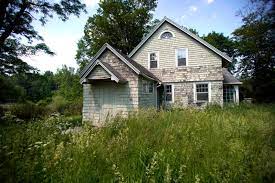
Edith Wharton's <em>Summer</em> (1917)
Wharton’s Summer is the story of a summer romance doomed to failure that begins with seduction at a picnic. When Charity Royall, a small-town girl of seventeen, falls for Lucius Harney, a socially upscale architect, she loses her innocence at a picnic. The outing and picnic lunch are critical moments in the narrative suggesting the […] read more
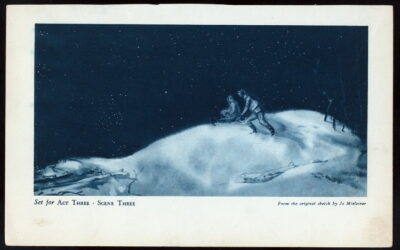
Edith Wharton’s <em>Ethan Frome</em> (1911)
An exception to the unremitting cold in Wharton’s Ethan Frome is a summer church picnic when Ethan and Mattie Silver first feel love for one another. When Mattie is forced to leave, Frome drives her to the train station. Along the way, they stop by the frozen Shadow Pond and look out on the frozen […] read more
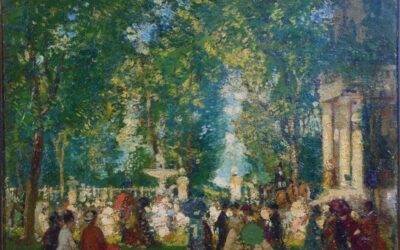
Clifford Beal’s <em>The Garden Party </em> (1920)
Beal was an important American artist in the first half of the 20th century. He’s now almost forgotten. See Gifford Beal. The Garden Party (1920), oil on canvas. The Phillips Collection, Washington, D.C. read more
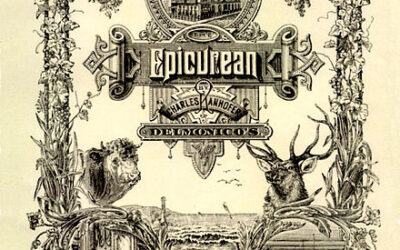
Charles Ranhofer’s <em>The Epicurean </em>(1920)
This recipe is Ranhoffer’s response to Dickens’s Pickwick Papers and Sam Weller’s description of “weal pies.” Dickens dined at Delmonico’s in New York City while Ranhofer was chef de cuisine, but this item was not on the menu. Veal Tart or Pie Suppress all the fat and sinews from a kernel of veal; cut […] read more

Booker T. Washington's <em>"All Day Meeting"</em> (1911)
Washington’s “all day meeting” is also known as “dinner on the grounds.” It agrees with versions of meetings by William A. Clary, Edna Lewis, Bebe Meaders and maya Angelou. I’ve cited Washington’s whole passage because it’s so full of detail and energy In Macon County, Ala., where I live, the coloured people have a kind […] read more
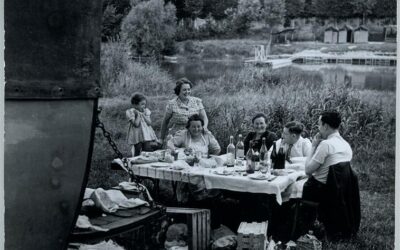
Brassai’s <em>Picnic on the Edge of the Marne</em> (1937c.)
Brassaï’s Picnic on the Edge of the Marne is a snapshot of a group at leisure. It’s a typical picnic with mounds of food and six bottles of wine for five adults. Compare Brassaï with Henri Cartier-Bresson’s Sunday on the Banks of the Marne [Dimanche sur les bords de la Marne, France] (1938). See Brassaï [Gyula […] read more
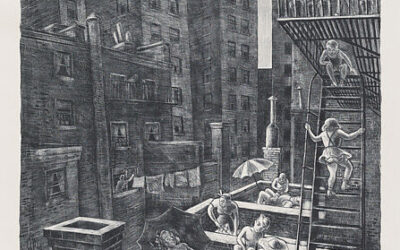
Carlos Anderson’s <em>Sunshine Canyon</em> (1943c.)
Anderson’s rooftop is an example of the urban version of tar beach. For another example, see Ringgold’s Tar Beach. See Carlos Anderson Sunshine Canyon (1943c.) read more
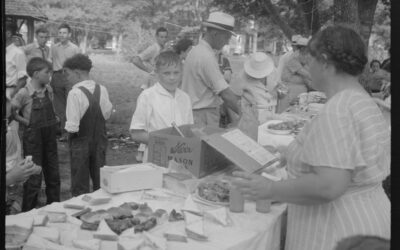
Ben Shahn’s <em>Sunday School Picnic </em> (1937)
Shahn’s Sunday School Picnic, Ponderosa Homesteads, North Carolina (1937); http://www.loc.gov/pictures/resource/fsa.8a17327/ For a contrast, see The Bad Seed. read more
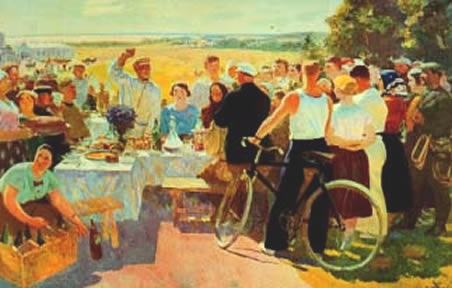
Aleksandr Gerasimov’s <em>Collective Farm Harvest Festival </em> (1937)
Gerasimov’s celebration of a very abundant harvest is propaganda. Soviet farms were not producing well, and the nation suffered chronic harvest shortages. Stalin’s propaganda program deemed otherwise, and the artists and writers were instructed to portray a land of plenty and prosperity according to the rules of Social Realism. Gerasimov’s farmers are happy and well-fed […] read more
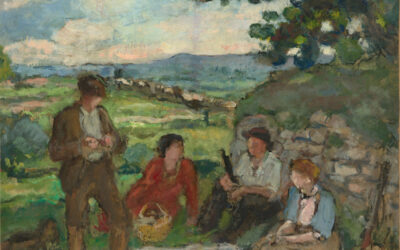
André Albert ‘s <em>Le repos des chasseurs</em>(1946)
Albert’s Le repos des chasseurs, aka Hunters’ Rest is a scaled down version of the Halt on the Hunt. The simple menu is bread ,fruit, and wine. read more
Somerset Maugham’s <em>Of Human Bondage</em> (1915)
During a luncheon on the grass at a suitably sylvan in Fontainebleau, Philip Carey, the protagonist Of Human Bondage, suffers a momentary fear that love will pass him by. It does in this instance, but after much hardship and bondage in an unrequited love affair, he is fulfilled. “One Sunday, they had all gone with […] read more
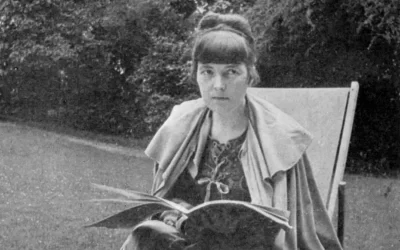
Katherine Mansfield's "The Garden Party" (1922)
Mansfield’s “The Garden Party” describes the Sheridan family’s Wellington, New Zealand, summer picnic garden party. The day is early summer, the weather ideal, the air warm and windless, and the blue sky has a veil of gold: “They could not have had a perfect day for a garden party if they had ordered it—Windless, warm, […] read more
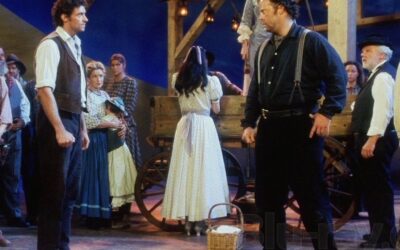
Richard Rodgers and Oscar Hammerstein II's <em>Oklahoma!</em> (1943)
The box social auction, aka picnic basket auction, is Rodgers and Hammerstein II’s original to their production of Oklahoma! It’s a substitute for lovers’ combat. Instead of knights in armor, the good-hearted cowboy Curley and black-hearted farmhand Jud Fry bid for Laurey’s picnic basket. Each man knows the winner is entitled to picnic with Laurey. […] read more
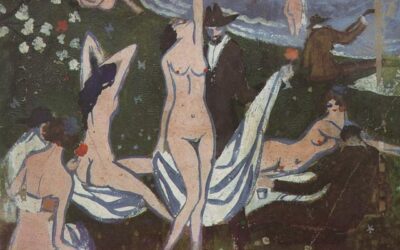
Salvatore Dali ‘s <em>The Picnic</em> (1921)
The location of this early painting, The Picnic on the Grass, is unknown. read more
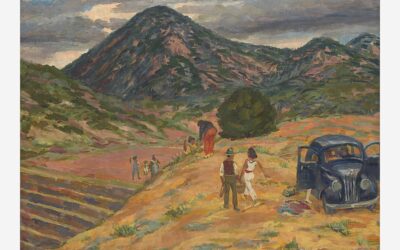
Marion Post Wolcott’s <em>Table in picnic grove set for St. Thomas Church supper near Bardstown, Kentucky, August 7, 1940, </em>
Wolcott’s tables for St. Thomas’s Church picnic is similar to Nell Choate Jones’s 1945 Church Supper but differ from William Clary’s picnic on the grounds in Valentines, Virginia. See Marion Post Wolcott. Table in picnic grove set for St. Thomas Church supper near Bardstown, Kentucky, August 7, 1940 (1940). Library of Congress Prints and Photographs […] read more
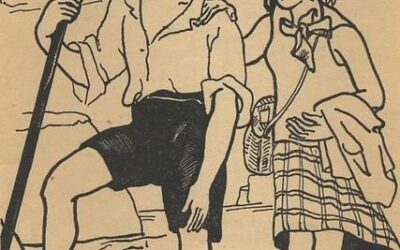
Colette’s <em>The Ripening Seed</em> (1923)
It’s a momentous picnic for a young couple to understand they are courting in Colette’s The Ripening Seed. With the summer half gone, Phil Adebert (sixteen and a half) and Vinca Ferret (fifteen and a half) pack their picnic baskets and walk down the rocky cliffs like “explorers, to eat out of doors in one […] read more
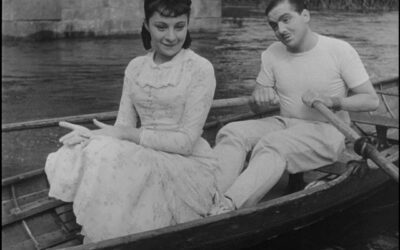
Jean Renoir’s <em>Partie de Campagne</em> (1946)
Renoir’s close adaptation of Guy de Maupassant’s Partie de Campagne is about the sad romantic consequences of a family picnic. Even the menu is Maupassant’s: fried fish, stewed rabbit [fricassee], salad, beer, claret, and coffee. However, Renoir substitutes white wine for the claret. Sated and a little drunk, Cyprian Dufour and his daughter Henriette’s fiancé […] read more
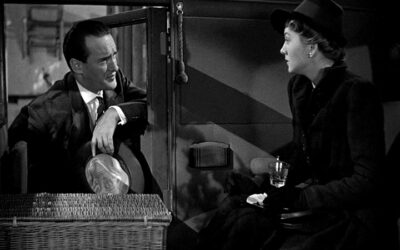
Alfred Hitchcock's <em>Rebecca</em> (1940)
Hitchcock added a picnic to the screenplay of Rebecca to reveal Jack Flavell’s intention to blackmail Max De Winter for the murder of his deceased wife, Rebecca. Flavell’s disquieting revelation occurs on the day of the inquest regarding Rebecca’s death in de Winter’s Rolls. Because current Mrs. De Winter has not eaten breakfast and is […] read more
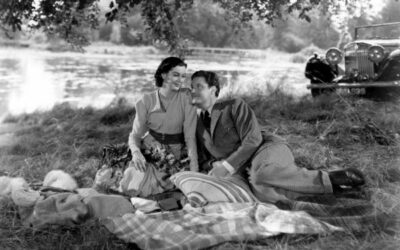
King Vidor’s <em>The Citadel</em> (1938)
Following A.J. Cronin’s The Citadel, King Vidor understands how central the picnic episode is for exploring how success and money distort the lives of Andrew and Elizabeth Manson. Once idealistic, Dr. Andrew Manson has gone over to the dark side, considering money more important than honest medical care. After years of ethical medical practice in […] read more
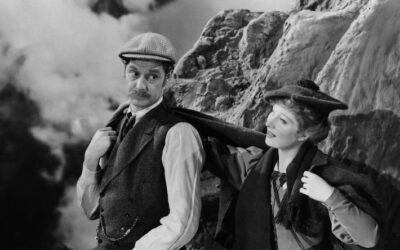
Sam Wood’s <em>Goodbye, Mr. Chips</em> (1939)
Sam Wood’s romantic picnic on a mountain in Goodbye, Mr. Chips is his idea. James Hilton’s Charles Chipping and Katherine Ellis meet while hiking in the Lake District, fall “head over heels in love,” and marry soon after. Wood sets the mountain hiking in the Austrian Tyrol and expands the chance meeting into a picnic […] read more
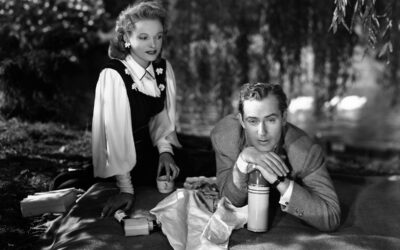
Herbert Wilcox’s <em>Spring in Park Lane</em> (1948)
A picnic in the park is a perfect situation for accommodating a would-be lover. Suspicious that her footman Richard is not what he pretends to be, Judy allows him to picnic with him on the Serpentine in Hyde Park. Conversation is rapid fire and full of innuendo and lines of poetry out of context to […] read more
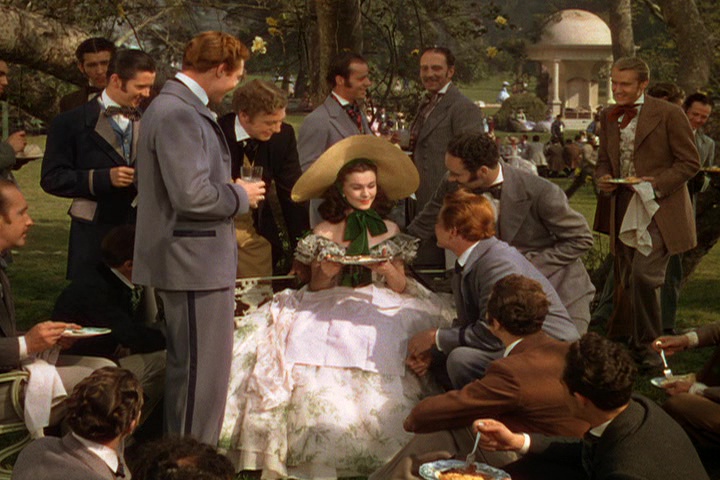
Victor Fleming’s <em>Gone With the Wind</em> (1939)
Arriving at Twelve Oakes, Gerald O’Hara is pleased to say, “Well, John Wilkes, it’s a grand day you’ll be havin’ for the barbecue.” It’s momentous because it is the beginning of Scarlett and Rhett Butler’s relationship and the engagement party for Ashley Wilkes and Melanie Hamilton. As a social gathering, the picnic barbecue is a […] read more
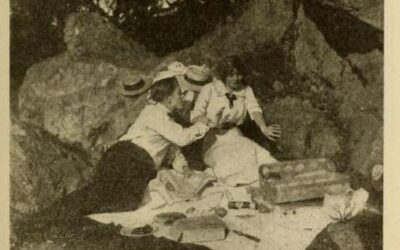
Hobart Bosworth's <em>The Valley of the Moon</em> (1914)
Of Hobart Bosworth’s four films based on Jack London novels, The Valley of the Moon* is the only lost film. Because we cannot know how Bosworth adapted London’s narrative, it’s clear from this still photo that the picnic during which Billy Roberts proposes marriage to Saxon Brown was a prominent episode. In his life, London […] read more
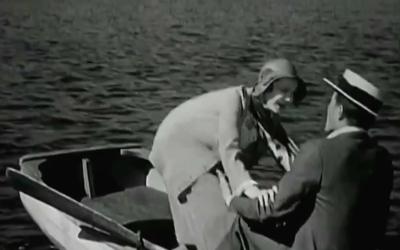
Josef von Sternberg’s <em>An American Tragedy</em> (1931)
Theodore Dreiser’s An American Tragedy intended his narrative to accentuate the pernicious effects of social and economic struggles; Josef Von Sternberg’s film narrative accentuates love and murder. Dreiser argued that von Sternberg and Paramount Pictures did not have the right to change anything they pleased. He took their money, sued, and lost. Von Sternberg retorted […] read more
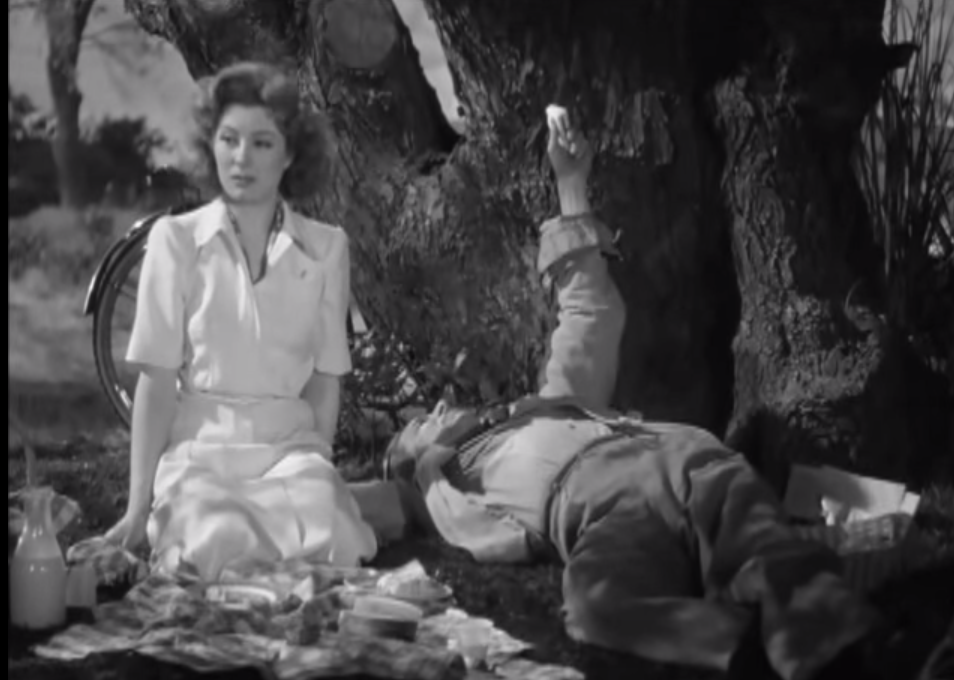
Mervyn LeRoy's <em>Random Harvest</em> (1942)
LeRoy’s Random Harvest picnic is phony. (It’s also original to the screenplay.) Smithy and Paula sit on fake grass beside an artificial stream with real goldfish. It’s props like these Nathaniel West had pulverized in his Hollywood satire The Day of the Locust. “On a lawn of fiber,’ West writes, “a group of men and […] read more
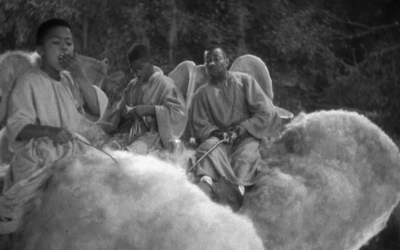
Marc Connelly's and William Keighley's <em> The Green Pastures</em> (1936)
The Green Pastures imagines a Heaven that is an eternal fish-fry picnic in a Heaven inhabited only by African Americans. It’s a faithful adaptation of Ol’ Man Adam, Roark Bradford’s racist version of the Old Testament episodes told from a supposed African American perspective. There are three versions of The Green Pastures, all by White […] read more
King Vidor’s <em>La Bohème</em> (1926)
King Vidor’s picnic in La Bohème narrates the critical moment when Mimi and Rodolpho fall in love. It’s absent from the screenplay’s sources: Puccini’s opera La Bohème and Henri Murger’s Scenes de la vie bohème (Scenes of Bohemian Life). The legend tells that this is Mimi’s first picnic, and her heart flutters with “excitement and […] read more