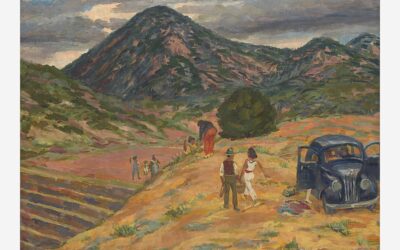
Art
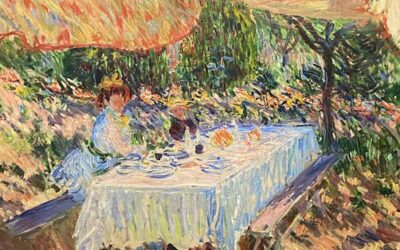
Claude Monet <em>The Tent, Giverny</em> (1883-1886). Also, <em>Lunch Under the Tent and <em>Lunch Under the Canopy</em>
Claude Monet The Tent, Giverny, about 1883-1886. read more
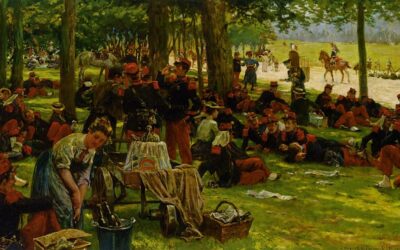
Jan Hoynck van Papendrecht's <em>Picnic after the Parade, Bois de Boulogne</em> (1906)
From the Sotheby’s catalog: “The scene depicted is a picnic of French gardistes in the Bois de Boulogne after their parade on the occasion of quatorze juillet. In the background is the sunlit area of the horse path of Longchamp, where the parade took place. Hoynck van Papendrecht witnessed this event during his trip to Paris, […] read more
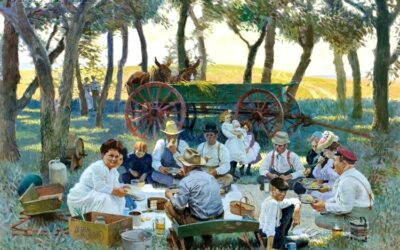
John Philip Falter's <em>Prairie Grove Picnic</em> (1977)
Falter was a commercial artist and illustrator mostly known for his Saturday Evening Post magazine covers. Featured Image: John Philip Falter Prairie Grove Picnic. Oil on Linen (1947) read more
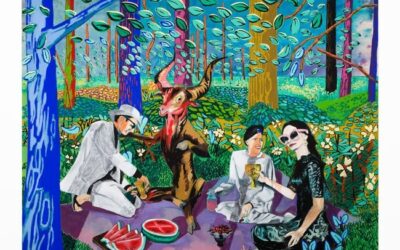
Theodore Boyer's <em> Luncheon with the Devil</em> (2012)
The Devil is portrayed as a smiling horned goat enjoying a picnic with a man and two women dressed in contemporary clothing. The food is watermelon. There is a story for this picnic that is yet to unfold. Featured Image: Theodore Boyer. Luncheon with the Devil. Oil and casein on dyed canvas (2022) read more
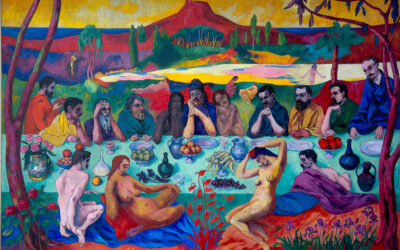
Pierre Girieud's <em>Homage to Gauguin</em> (1906)
Homage to Gauguin is an allusion da Vinci’s Last Supper. Instead of Jesus, Gauguin is seated (third from right) with his friends and admirers. A picnic feast ought to be jolly, but these picnickers are solemn and unhappy. The images and colors all related to Gauguin’s paintings and palette, though worked in a more garish […] read more
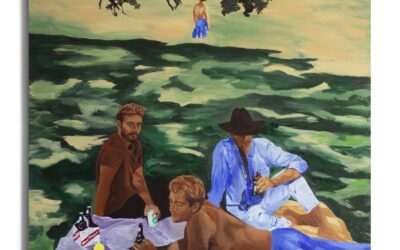
R.F. Alvarez's <em>Luncheon on the Pasture</em> (2022)
Beer and apples. Featured Image: Luncheon on the Pasture, acrylic on canvas. read more
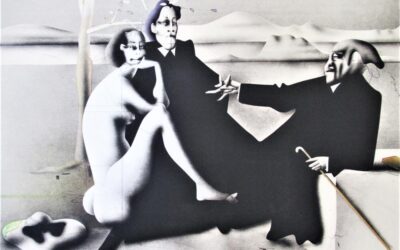
Paul Wunderlich’s <em>Das Frühstuck im Grünen</em> [<em>Luncheon on the Grass</em?] (1977)
Wunderlich’s Das Frühstuck im Grünen [Luncheon on the Grass] is a surrealistic adaptation of both Édouard Manet’s Luncheon on the Grass. Sensuality, sex, and any semblance of pleasantries are absent. Distorted, seemingly unhappy, figures sit in a barren landscape. Featured Image: Paul Wunderlich, Das Frühstuck im Grünen, #2 (1977), lithograph. (1977) read more
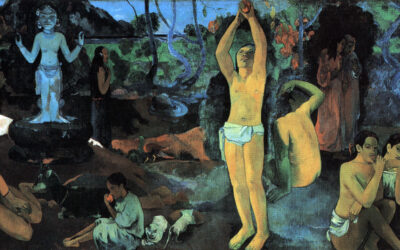
Paul Gauguin’s <em>Where Do We Come From? What Are We? Where Are We Going? </em> (1897/98)
Gauguin’s Where Do We Come From? What Are We? Where Are We Going? Vague vaguely suggests a picnic. Escaped from France, Gauguin seemed to believe his Tahitian life was picnicky. “Everything in the landscape blinded me, dazzled me,” he wrote in the Noa Noa journal. It was a feeling that never subsided. The painting’s narrative begins […] read more
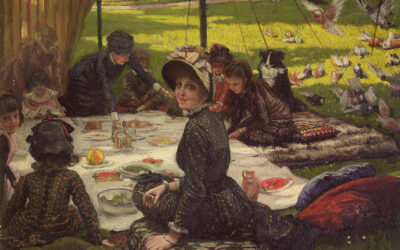
James [Jacques] Tissot’s <em>Picnic on the Grass</em> (1881/82)
Elizabeth Newton and her children enjoy a birthday party in Tissot’s garden in St. John Wood, London. The partygoers sit on cushions beside a picnic cloth laden with food and drinks prominently placed in the immediate foreground. The children are of secondary importance. Tissot was in love with Newton, and they were partners for five […] read more
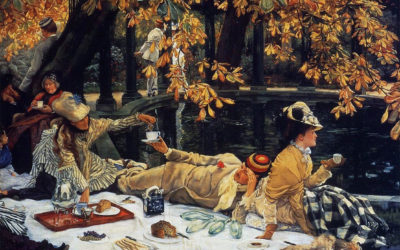
James [Jacques]Tissot <em>Holyday</em> (1876c.)
The epitome of a Victorian picnic is Tissot’s Holyday. Tissot arranged a picnic of a family and friends in the garden of his home in St. John Woods. They sit beside a sparkling white cloth, china, flatware, a cake, sliced cheese on a platter, a platter of grapes, tea, and fizzy water. The picnickers are […] read more
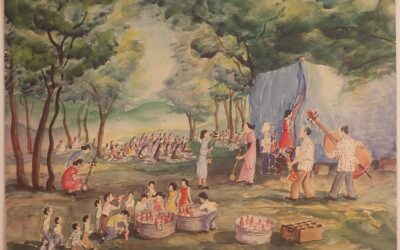
Estelle Peck Ishigo’s <em>Japanese Picnic in Elysian Park</em> (1954)
Ishigo accompanied her Japanese husband Arthur when he was interred in 1942 until World War II ended. Japanese Picnic in Elysian Park exemplifies Ishigo’s renewed spirits a decade after the hardship of unjust confinement. Elysian Park is among Los Angeles’s largest parks. Featured Image: Estelle Ishigo’s Japanese Picnic in Elysian Park (1954). watercolor on paper. UCLA […] read more
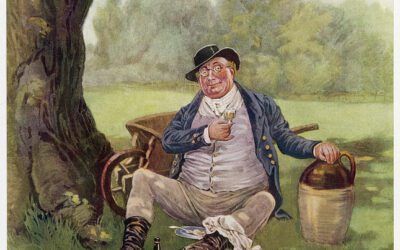
Fred Barnard’s <em>Mr. Pickwick’s Picnic</em> in <em>The Pickwick Papers</em> (1870c)
Pickwick’s picnic on a hunt in Dingley Dell is part of an abortive hunting expedition. It’s famous for Pickwick getting drunk and Sam Weller’s discussion of veal pies, pronounced “weal” in Weller’s Cockney accent. This picnic is served under the welcome shade of an old oak to make it easy for Pickwick, who suffers from […] read more
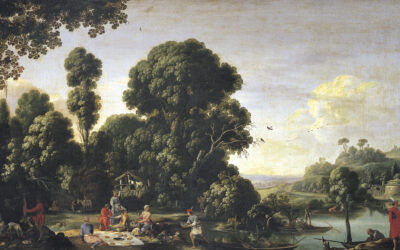
Filippo Napoletano’s <em>Merenda sull’erba</em> (1619)
Napoletano’s Merenda sull’erba is a landscape with Florentines enjoying an informal outdoor lunch by a lake. Merenda is Italian for picnic, which was not coined until 1649 in Paris. The picnickers have spread their cloth in the shade. To the left, a cook works at a fire; to the left, a servant brings fish from […] read more
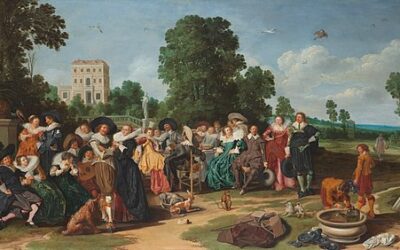
Dirck Hals’s <em>De buitenpartij</em> or <em>The Fête Champetre</em> (1627)
Hals’s De_buitenpartij (627) is of family and friends dining outside in the garden of their estate. It was meant to show off. Featured Image: Dirck Hals. Debuiten partij or The Fête Champetre (1627). There are two other versions of this group. Rijksmuseum, Amsterdam read more
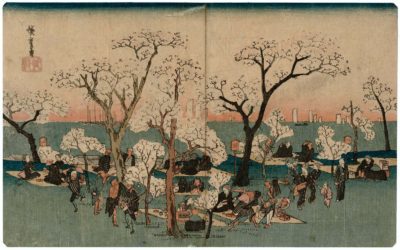
Hiroshige’s <em>Picnic at Gotenyama </em> (1833)
Hiroshige aims to depict activity relevant to the moment in a specific landscape. In this respect, his scenes in Japan correlate with J.M.W. Turner’s picturesque landscapes of the United Kingdom. While picnicking under the blooming cherry trees at Gotenyama, too much food and sake instigate a drunken brawl. Compare this with the rowdy sailors at […] read more
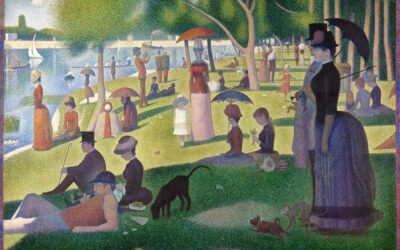
Georges Seurat’s <em>Sunday Afternoon on the Island of La Grande Jatte <?em> (1884/86)
Seurat’s La Grande Jatte is picnicky. Having a combination of leisure, ease, and easy conviviality, it’s absent food. People of all classes coexist amiably. Some sit on the grass in the shade of trades, some promenade, but there are no signs of a luncheon on the grass. Featured Image: Georges Seurat. Sunday Afternoon on […] read more
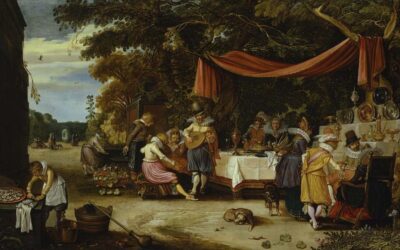
Esaias van de Velde’s <em> An Elegant Company in a Garden</em> (1614)
Van de Velde’s reputation is now based on his naturalistic landscape. But he was in demand among the affluent Amsterdam community, for whom he painted many scenes of their parties, especially garden parties, of which An Elegant Company in a Garden is an exemplar. The Boston Museum of Fine Arts’s title is misleading. There is […] read more
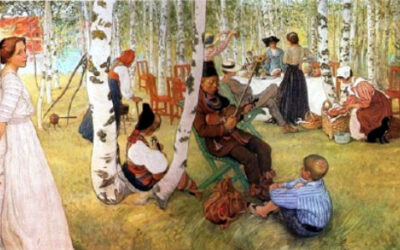
Carl Larsson’s <em>Breakfast in the Open</em> (1910)
Larsson’s outdoor breakfast is among his favorites. It’s set in a birch grove away from the family house.. Food is packed in a big hamper by a servant. The table, covered with a white cloth, has wooden chairs. In the center foreground is a man playing a fiddle, and a girl plays a lute or […] read more
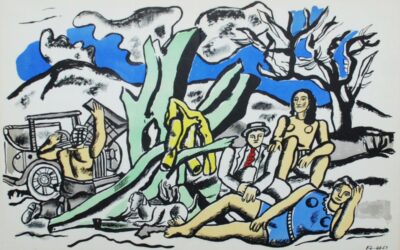
Fernand Leger's <em>Partie de Campagne</em> (1951)
Leger’s style is unmistakable and memorable. Partie de Campagne, a series variously translated as The Picnic or The Country Outing, is a series of variations, and part of a project he called the Great Parade. As lithographs, these were among Léger s most famous works. Léger’s picnickers are interested in food. In the oil paintings, […] read more
Jan Miel’s <em>La Merienda</em> and <em>Hunters at Rest</em> (1640s/50s)
Miel’s halt on the hunt and repas de chasse depicts hunters stopped by a rustic inn. In the Prado’s La Merienda, hunters have spread a cloth beside their horses and are settling in to relax. This is a perfunctory meal of sliced ham, cheese, bread, and wine. Unlike Watteau’s fashionable hunters and their ladies in […] read more
Harry Hoffman's <em>Harvest Moon Walk</em> (1912c.)
Hoffman’s Harvest Moon Walk is a masquerade picnic where revelers dress as vegetables. According to the Griswold Museum, “Hoffman’s eccentric depiction of strangely clad figures captures one of the Lyme Art Colony’s most festive rituals. On an October evening, merrymakers arrived at Florence Griswold’s house imaginatively costumed as fruits and vegetables. The marchers, a mix […] read more
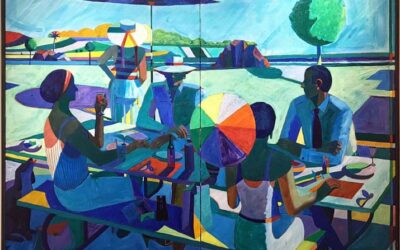
Roland Peterson’s Picnics(1960s ...on)
Petersen’s delightful obsession makes him happy. “Each painting,” he says, “has a different kind of mathematical solution; I’m not always able to solve it, but I try to work out a pattern of shapes.” Petersen’s esthetic is to amalgamate abstraction with realism and develop his theme in an architectural layout, in this case, a picnic. […] read more
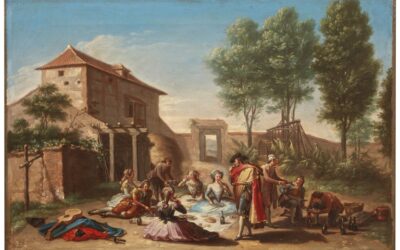
Francisco Bayeu y Subias’s <em>Merienda en el Campo</em> (1786)
Bayeu’s Picnic in the Country [aka Merienda en el Campo] is a study of a proposed tapestry destined for the royal palaces of the Spanish monarchy now exhibited in the Prado’s Salon de Consejos. The picnickers have gathered around awhile cloth set on the ground in the yard of a working farm. The aristocrats eat […] read more
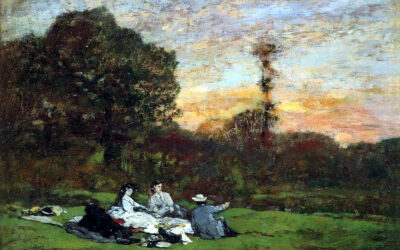
Eugène Boudin’s <em>Luncheon Grass, the Family of EugèneManet</em> (1866)
Boudin’s Luncheon Grass, the Family of Eugène (1866) is apleasant family outing in a park. Unlike Manet’s Luncheon, this is not confrontational or sexual. Because Boudin was a friend of the Manet family, especially Eugène, this picture of them picnicking on the grass may be intended as a family portrait. If so, one of the […] read more
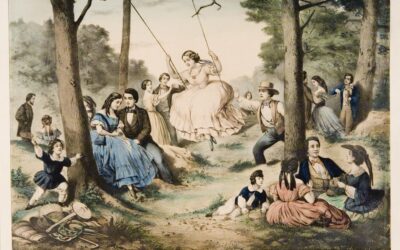
Currier & Ives’s <em>Pic-Nic Party</em> and <em>Childrens Pic-Nic</em> (1858)
Nathaniel Currier and James Merritt Ives’ lithographs The Pic-Nic Party and The Childrens Pic-Nic are picnics without food or drink. In The Pic-Nic Party, the central figure is a woman on a swing pushed by a young man, probably her beau. Just in front of her is a courting couple. In the background on the […] read more
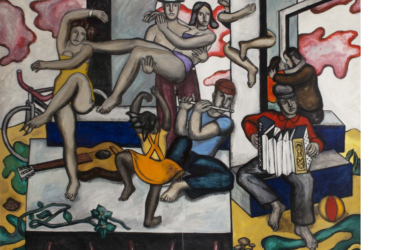
Alexander Moffat’s <em>The Picnics</em> (1963)
Moffat’s picnics, all titled Picnic and all completed in 1963, are influenced by Fernand Leger’s Partie de champagne series o paintings. Featured Image: The Picnic at the New Bridge read more
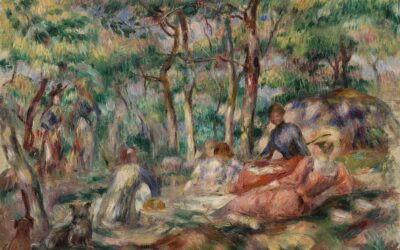
Pierre-Auguste Renoir<em>Le Repos sur l’herbe </em> (1893c.)
Renoir’s painting’s Le Repos sur l’herbe aka Resting on the Grass l’herbe is a portrait of a family at play. Renoir does not consider this a pique-nique because it is an outdoor gathering. See Pierre Auguste Renoir in Le Repos sur l’herbe and Le Déjeuner sur l’herbe (1893c.). Barnes Foundation read more
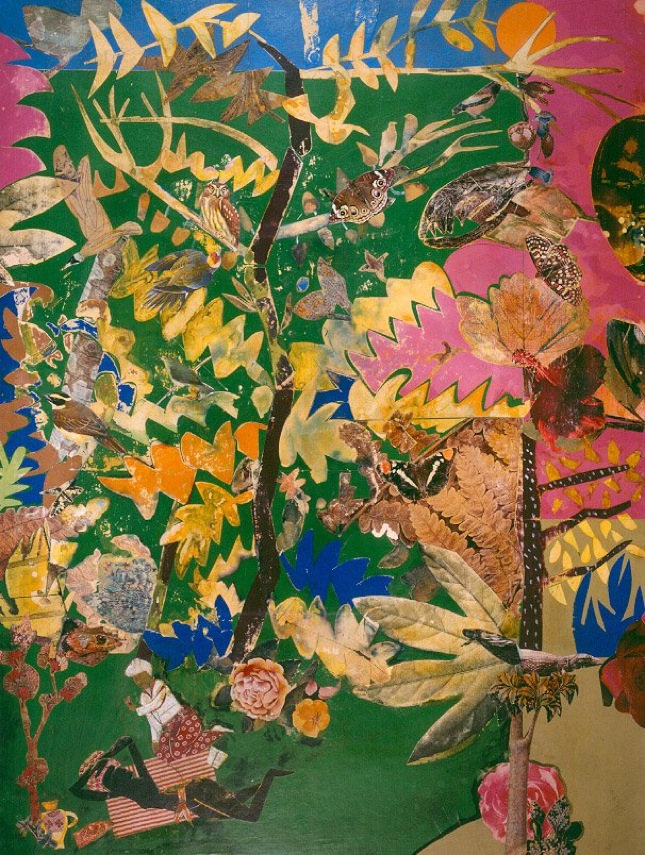
Romare Bearden’s <em>Khayam and the Black Girl</em> (1971)
Bearden transports Omar Khayyám’s Persia to the Tropics for his take on “Quatrain XI” from The Rubáiyát of Omar Khayyám. But the man is Persian and the woman is black. Though the poem suggests sensuality, Bearden presents the poet clothed but the woman naked, except for a body sash and a head turban. It’s still […] read more
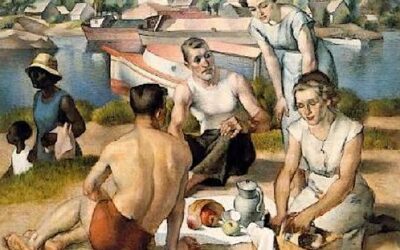
Simka Simkhovitch’s <em>The Picnic</em> (1930s)
Simkhovitch’s The Picnic is a day of leisure for a group that seems mirthless. They sit on bare earth, and each is unsmiling and subdued. There is no picnic joy as a small picnic cloth is spread around which they all gather. A man in a bathing suit reclines, his back to the viewer. Behind […] read more
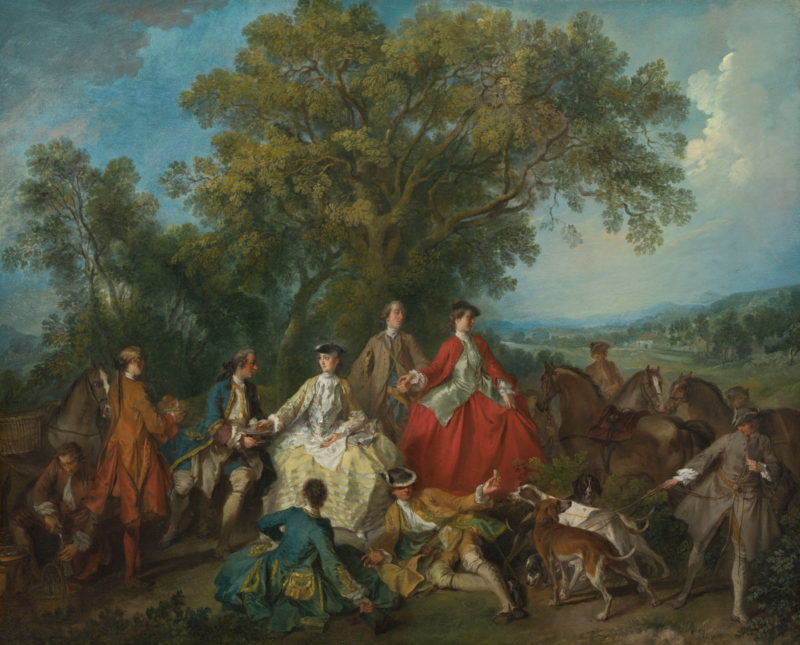
Nicolas Lancret’s <em>Picnic after the Hunt</em> (1740c.)
Because the scene is obviously a picnic, the National Gallery of Art’s title, The Picnic after the Hunt, is apt. But Lancret would not have used pique-nique because the French denoted it as an indoor dinner. More likely, he would have titled un repas de chasse, as he did for a painting now in the Louvre titled Un […] read more
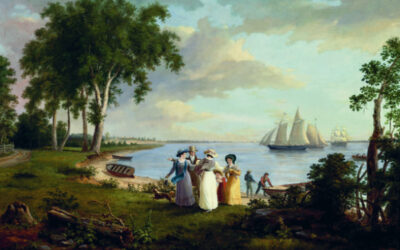
Thomas Birch’s <em>View of the Delaware near Philadelphia</em> (1831)
Birch’s View of the Delaware is a landscape embellished with a picnic party just arriving by boat to a destination on the shore near Philadelphia. See Thomas Birch. View of the Delaware near Philadelphia (1831), oil on canvas. The Corcoran Gallery of Art, Washington, D.C.). read more
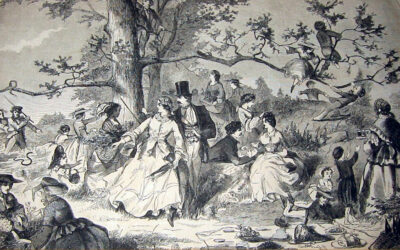
Winslow Homer’s <em>A Picnic in the Woods</em> (1858)
Homer’s A Picnic in the Woods is a pleasant joke, suggesting that the usually staid picnic might also be tumultuous. The action here is everywhere. A large picnic blanket is spread and filled with food: a bowl of fruit, a large ham with a knife for carving, a small turkey or large chicken, a bowl […] read more
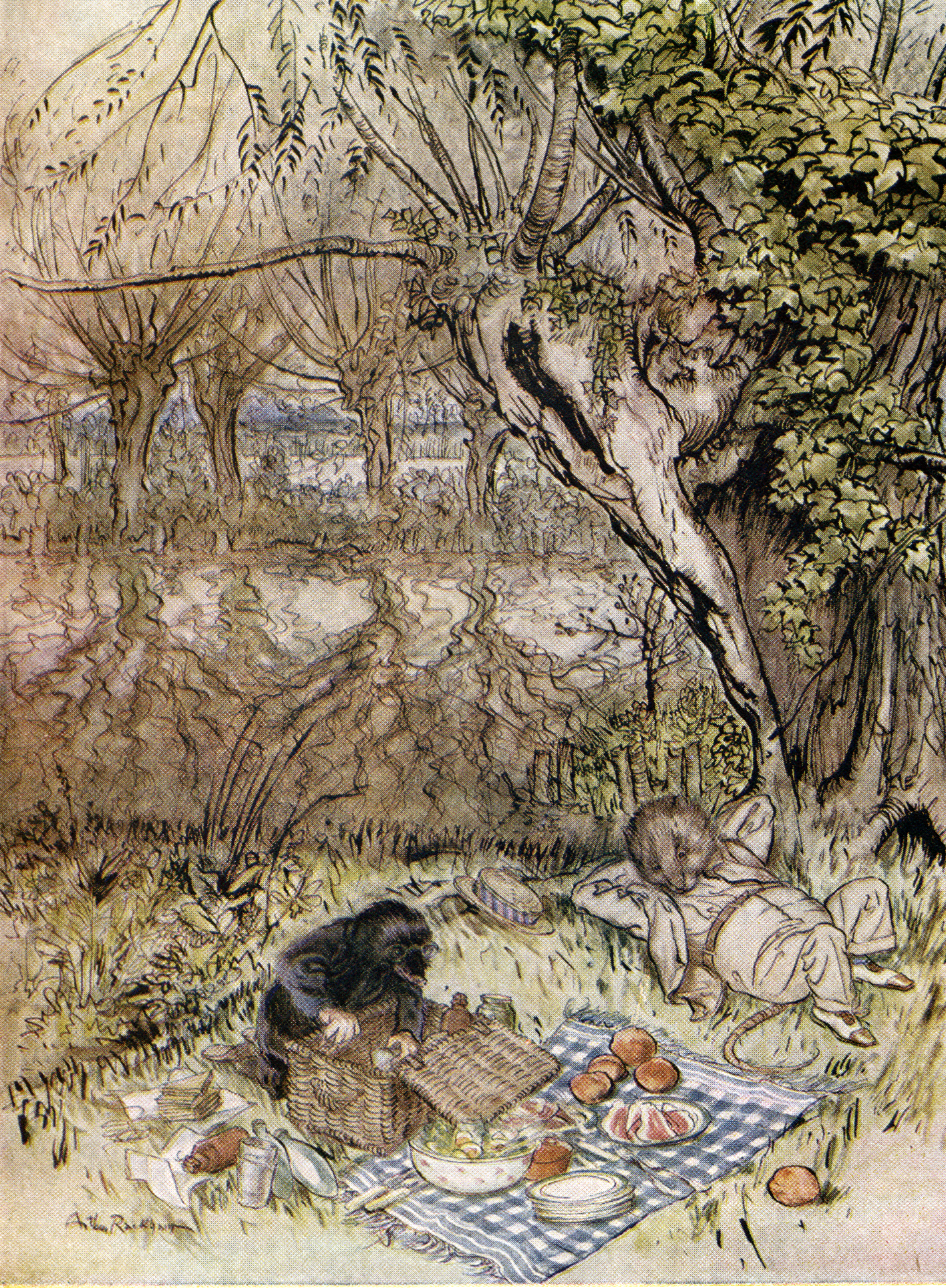
Arthur Rackham’s “The Mole begged as favour to be allowed to unpack” in <em>The Wind in the Willows </em> (1931)
“The Mole begged as a favour to be allowed to unpack it all by himself,” In Wind in the Willows by Kenneth Grahame. New York: Scribner’s Sons, 1931. read more
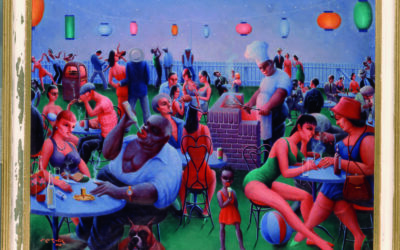
Archibald J. Motley Jr.’s <em> Barbecue</em> (1960)
Motley’s A rooftop party is a variation of a tar beach picnic. Couples are sitting at tables eating and drinking. Good spirits prevail. Motley’s typical attitude and his paintings invariable show African Americans happy in a world of easy living. “I’ve always wanted to paint my people,” he said in an interview, “just the way […] read more
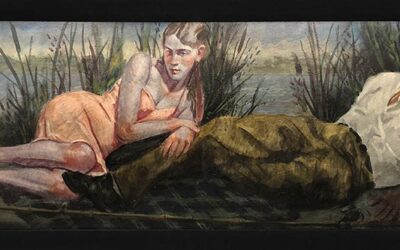
Mark Beard, aka Bruce Sargeant <em>Boy and Girl with Picnic Basket in Afternoon Sun</em> (no date)
Bruce Sargeant is a persona of Mark Beard. The picnic is a pleasantly simple: he is asleep, and she is awake, staring into space. A picnic basket sits idly in the far corner. Boy and Girl is large, 26.5 x 87 inches. read more
Augustus Egg’s <em>in Traveling Companions </em> (1862)
Egg‘s Traveling Companions is a testimony of the ease and comfort of train travel. The two elegantly dressed women, virtually mirroring images of each other, sit without even looking out of the window at the long view of the shoreline beyond. One reads the other dozes; one has a picnic basket beside her, and the […] read more
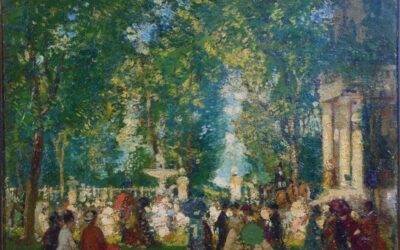
Clifford Beal’s <em>The Garden Party </em> (1920)
Beal was an important American artist in the first half of the 20th century. He’s now almost forgotten. See Gifford Beal. The Garden Party (1920), oil on canvas. The Phillips Collection, Washington, D.C. read more
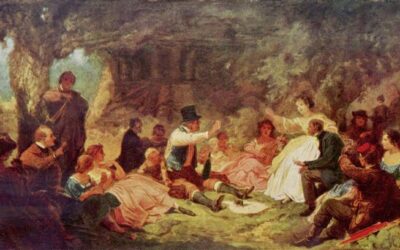
Carl Spitzweg’s <em>Déjeuner sur l’herbe</em> (1864c.)
Spitzweg’s Dejeuner sur l’herbe, Das Picknick, aka Luncheon on the Grass, is a happy middle-class person in the country. They sit, relaxing and enjoying each other’s company. The central figure, a portly man, toasts a woman in white, perhaps a bride. The company rises to the occasion. Largely forgotten now, he was an important German […] read more
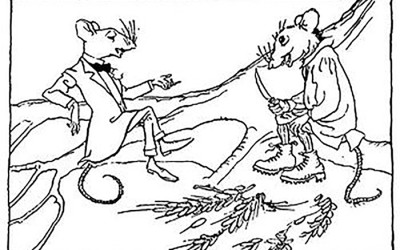
Arthur Rackham’s <em>The City Mouse and the Country Mouse</em> (1912)
Contrast Rackham’s mice with Mary Belson Elliot’s The Mice and their Pic Nic and Mickey Mouse. See Arthur Rackham. “The City Mouse and the Country Mouse,” Aesop’s Fables. Translated by Vernon Jones. London: Heinemann, 1912 read more
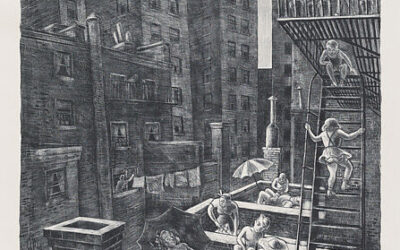
Carlos Anderson’s <em>Sunshine Canyon</em> (1943c.)
Anderson’s rooftop is an example of the urban version of tar beach. For another example, see Ringgold’s Tar Beach. See Carlos Anderson Sunshine Canyon (1943c.) read more
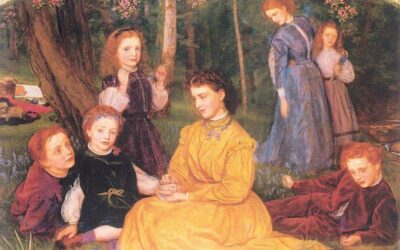
Arthur Hughes's <em> A Birthday Picnic</em> (1867)
Hughes used a picnic as a theme for a family portrait of the Pattinson family. The title he gave was A Birthday Picnic – Portraits of the children of William and Anne Pattinson of Felling, near Gateshead. A red table with food in the left background, but it is unclear whose birthday is being celebrated. […] read more
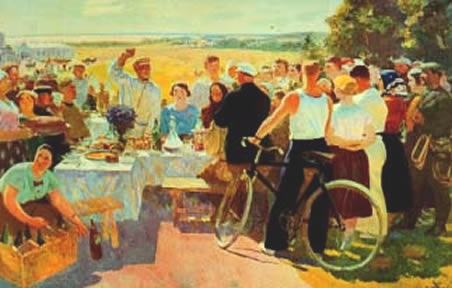
Aleksandr Gerasimov’s <em>Collective Farm Harvest Festival </em> (1937)
Gerasimov’s celebration of a very abundant harvest is propaganda. Soviet farms were not producing well, and the nation suffered chronic harvest shortages. Stalin’s propaganda program deemed otherwise, and the artists and writers were instructed to portray a land of plenty and prosperity according to the rules of Social Realism. Gerasimov’s farmers are happy and well-fed […] read more
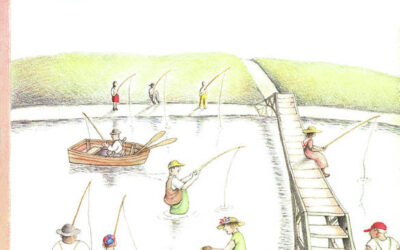
Anne Burgess’s <em>Picnic by a River </em> 1982)
Burgess’s Picnic by a River is The New Yorker’s August cover. By the side of a placid river, a mother, father, and son sit on a plate of cheese, a bowl of salad, a loaf of bread, fruits, and lemonade, Mother has a plate, and the son has a sandwich. Shoes off, they fish with […] read more
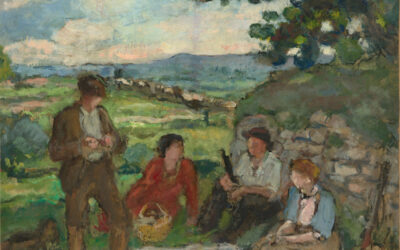
André Albert ‘s <em>Le repos des chasseurs</em>(1946)
Albert’s Le repos des chasseurs, aka Hunters’ Rest is a scaled down version of the Halt on the Hunt. The simple menu is bread ,fruit, and wine. read more
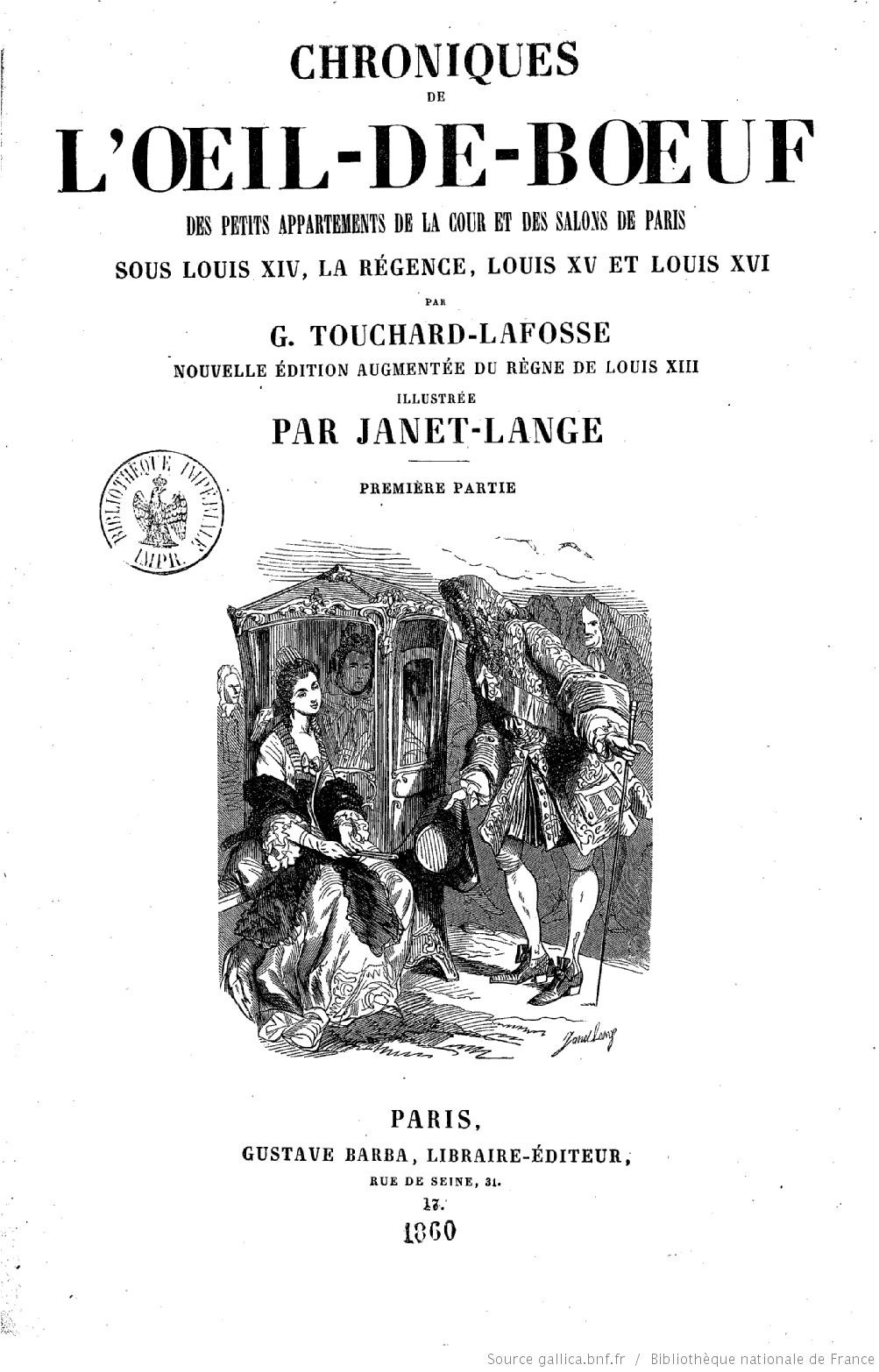
Touchard-Lafosse’s <em>Pique-Nique Manqué</em> (1776c)
Oeil-de-boeuf is Touchard-Lafosse’s pseudonym used to sign off on his gossip reports about Louis XIV’s court and Parisian society Oeil-de-boeuf is a circular window, often indoors, above a doorway. As a metaphor, it suggests gossip that is sexually tinged or embarrassing. Americans may celebrate 1776 as the year of their nation’s birth. Still, Georges Touchard-Lafosse […] read more
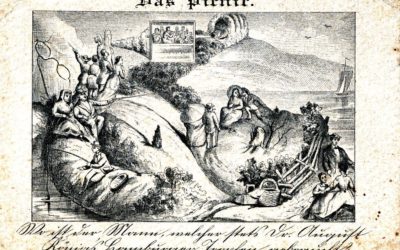
Dr. König's Elixir "Das Picnic" (1860c)
“Das Picnic” is an advertisement for Hamburger Tropfen, Dr. August König’s patent medicine, written in German by an American company in New Castle, Wisconsin. The ad’s image is a picture puzzle, and the legend is “Wo ist der Mann, welcher stets Dr. August König’s Hamburger Tropfen gebraucht?” or “Where is the man who always needs […] read more
Anthony Ackrill’s <em>Picnic</em> (2008)
It is uncertain if Ackrill’s Picnic is a spinoff of pin-up art, soft porn, or sly humor. Whatever it means to be, it’s not the kind of picnic that meets traditional expectations. This picnic is a life-sized woman holding a skull and a walking staff. This allusion suggests sexual pleasure and death, a revision of […] read more
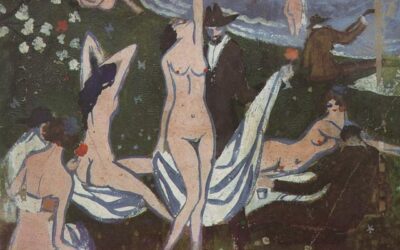
Salvatore Dali ‘s <em>The Picnic</em> (1921)
The location of this early painting, The Picnic on the Grass, is unknown. read more
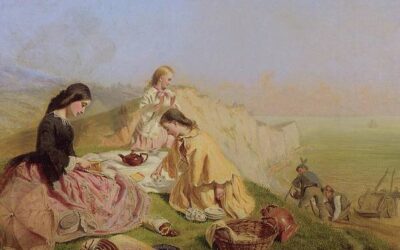
George Elgar Hick’s <em>Picnic on the Cliff s</em> (1850s?)
Three couples picnic on the edge of what looks like the cliffs in Dover. The women settle the picnic cloth while the men tend the campfire. Hicks flourished during the late 1850s through the end of the century, principally as a portrait and genre painter. read more