
Location
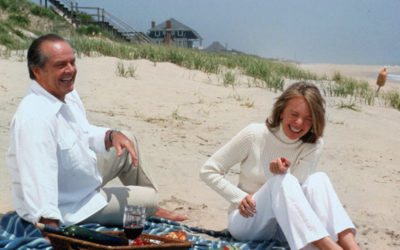
Nany Meyers' <em>Something’s Gotta Give </em>(2003)
Suds. Hamptons, New York, and Paris. Money. Two middle-aged beauties find romance and love. Perfect beach house. Perfect weather, Perfect wine. Aw shucks. “Erica and Harry sit on a blanket on a cloudy day, having a picnic lunch. Harry is telling Erica a story, and she screams with laughter.” Then it rains. The run to […] read more
Jacques Lartigue’s <em>Chou Valton at la Garoupe, Cap d’Antibes, July 1932</em>
Sunbathing on the beach with champagne. Lartigue’s shadow is seen in the lower left corner. See Jacques Henri Lartigue. Chou Valton at the plage de la Garoupe, Cap d’Antibes, July 1932. Silver Gelatin Print. read more
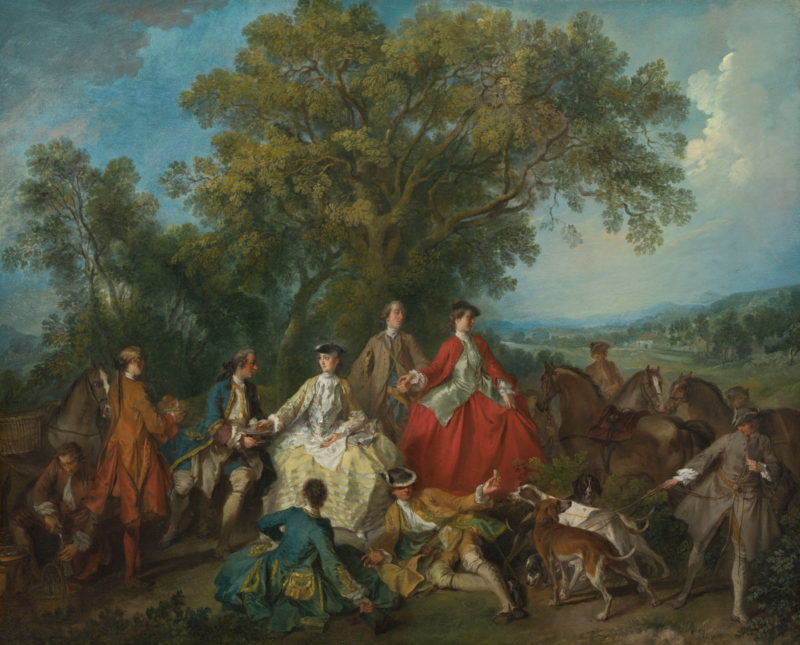
Nicolas Lancret’s <em>Picnic after the Hunt</em> (1740c.)
Because the scene is obviously a picnic, the National Gallery of Art’s title, The Picnic after the Hunt, is apt. But Lancret would not have used pique-nique because the French denoted it as an indoor dinner. More likely, he would have titled un repas de chasse, as he did for a painting now in the Louvre titled Un […] read more
Augustus Egg’s <em>in Traveling Companions </em> (1862)
Egg‘s Traveling Companions is a testimony of the ease and comfort of train travel. The two elegantly dressed women, virtually mirroring images of each other, sit without even looking out of the window at the long view of the shoreline beyond. One reads the other dozes; one has a picnic basket beside her, and the […] read more
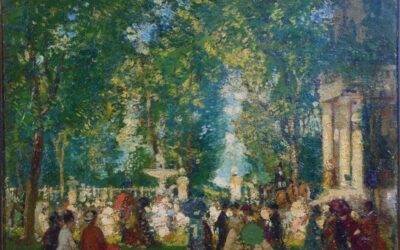
Clifford Beal’s <em>The Garden Party </em> (1920)
Beal was an important American artist in the first half of the 20th century. He’s now almost forgotten. See Gifford Beal. The Garden Party (1920), oil on canvas. The Phillips Collection, Washington, D.C. read more
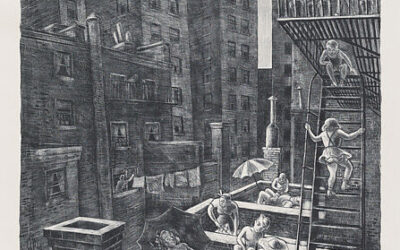
Carlos Anderson’s <em>Sunshine Canyon</em> (1943c.)
Anderson’s rooftop is an example of the urban version of tar beach. For another example, see Ringgold’s Tar Beach. See Carlos Anderson Sunshine Canyon (1943c.) read more
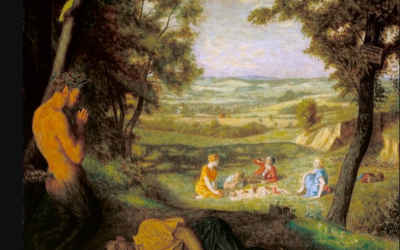
George Warner Allen. <em>Picnic at Wittenham</em> (1947-1948)
Picnic at Wittenham is George Warner Allen’s pleasant allusion to the myth of Pan with an edge that suggests Allen’s homosexuality. In the center, a group is having a picnic in an open, sunlit grassy lawn. The bright colors of the picnickers lead the eye to them first, and only after does the viewer’s eye […] read more
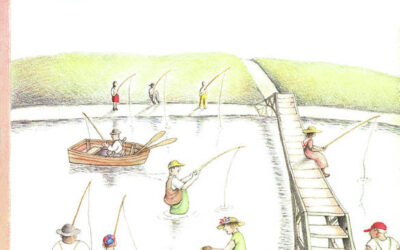
Anne Burgess’s <em>Picnic by a River </em> 1982)
Burgess’s Picnic by a River is The New Yorker’s August cover. By the side of a placid river, a mother, father, and son sit on a plate of cheese, a bowl of salad, a loaf of bread, fruits, and lemonade, Mother has a plate, and the son has a sandwich. Shoes off, they fish with […] read more
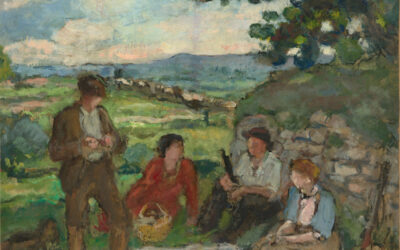
André Albert ‘s <em>Le repos des chasseurs</em>(1946)
Albert’s Le repos des chasseurs, aka Hunters’ Rest is a scaled down version of the Halt on the Hunt. The simple menu is bread ,fruit, and wine. read more
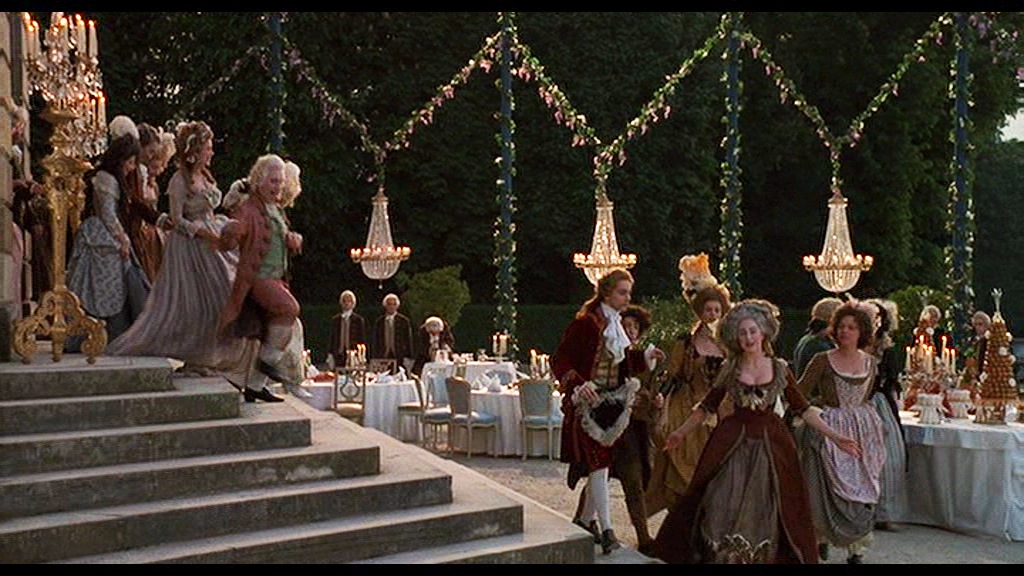
James Ivory’s <em>Jefferson in Paris,/em> (1995)
Ivory and Jhabvala imagine a “typical” gala Parisian garden party circa 1784. It was hosted by the Marquis de Lafayette for Thomas, then acting as American ambassador. Though de Lafayette was philosophically democratic, he was required to cultivate relationships with the Parisian fashionistas and aristocratic hedonism of pre-revolutionary France. The gala is fluff meant only […] read more
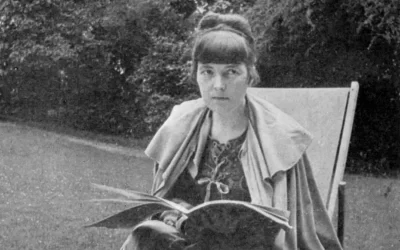
Katherine Mansfield's "The Garden Party" (1922)
Mansfield’s “The Garden Party” describes the Sheridan family’s Wellington, New Zealand, summer picnic garden party. The day is early summer, the weather ideal, the air warm and windless, and the blue sky has a veil of gold: “They could not have had a perfect day for a garden party if they had ordered it—Windless, warm, […] read more
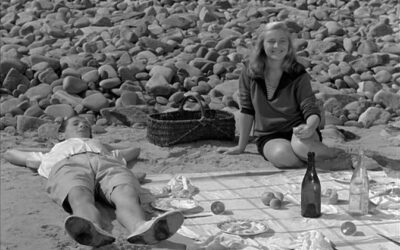
Claude Autant-Lara’s <em>The Ripening Seed </em> (1954)
Autant-Lara’s Le Blé en herbe is good at separating the dual aspects of love in Colette’s novel about adolescents and friends for years and learning about love while vacationing in Normandy. There are two parts to the narrative. In the first part, teenagers Philippe and Vinca fall in love and endure the pleasure and rough […] read more
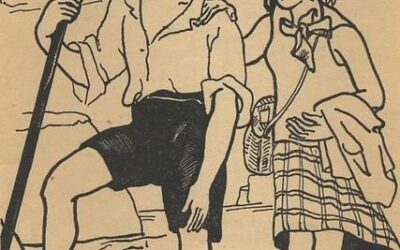
Colette’s <em>The Ripening Seed</em> (1923)
It’s a momentous picnic for a young couple to understand they are courting in Colette’s The Ripening Seed. With the summer half gone, Phil Adebert (sixteen and a half) and Vinca Ferret (fifteen and a half) pack their picnic baskets and walk down the rocky cliffs like “explorers, to eat out of doors in one […] read more
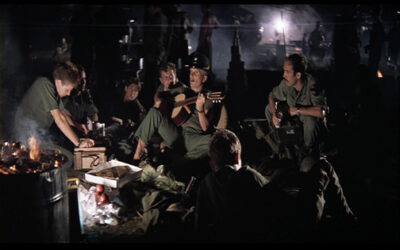
Francis Ford Coppola’s <em>Apocalypse Now</em> (1979)
Coppola’s Apocalypse Now is inspired by Conrad’s The Heart of Darkness. Coppola adapted the action and characters to his conception of the “insane” war in Vietnam, and the beach party picnic is his addition to the narrative. Coppola ensures nothing is quite right in his narrative, especially Lt. Col. Bill Kilgore’s war in Vietnam. As […] read more
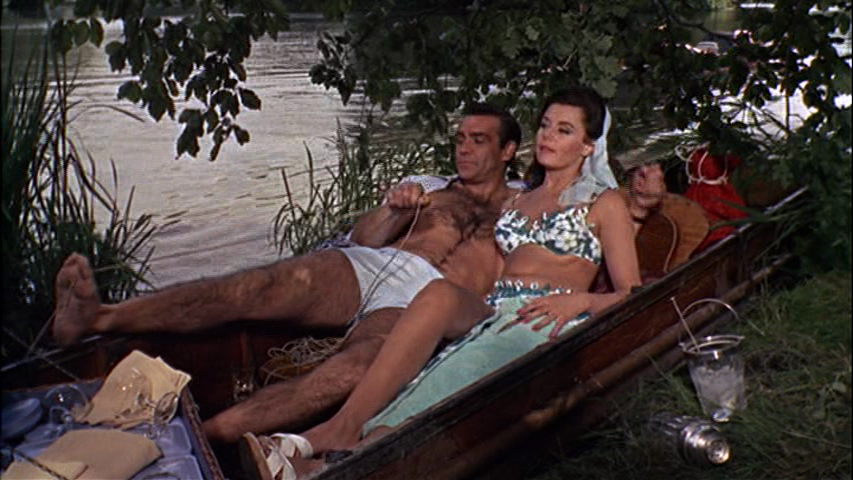
Terrence Young’s <em>From Russia, With Love </em> (1963)
Terrence Young’s picnic in From Russia With Love does not happen in Ian Fleming’s novel. It’s inconsequential, shaken but not stirred. Young’s picnic begins when Bond and his current lover, Sylvia Trench, are punting in a boat on /River Cherwell in Oxford. It’s summer. They are tied up in the shade, dressed in bathing suits, […] read more
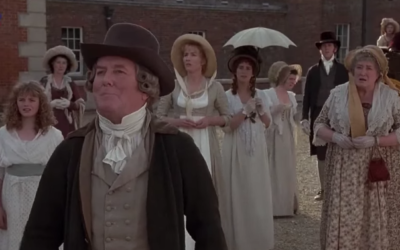
Ang Lee's <em>Sense and Sensibility</em> (1995)
Austen knows how to ruin a picnic, as she does in Sense and Sensibility. Ang Lee and his screenwriter Emma Thompson get the disappointment right. But then invent an original picnic to make up for Austen’s to mitigate the Dashwood family’s letdown. Critics and Austen fans did not care about this revision, and Thompson’s freely […] read more
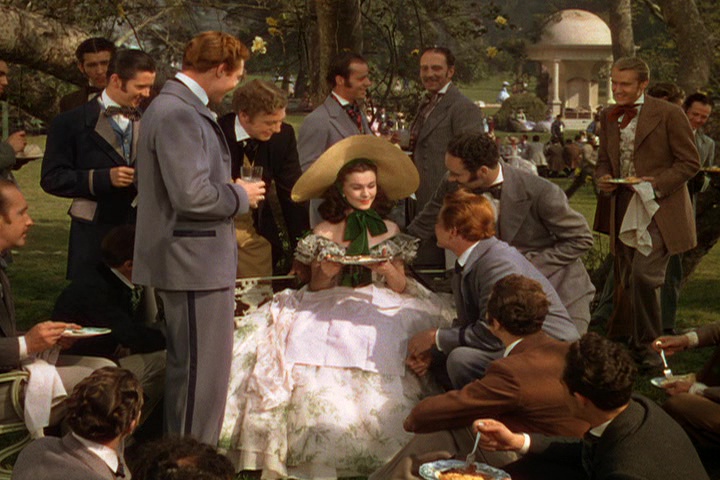
Victor Fleming’s <em>Gone With the Wind</em> (1939)
Arriving at Twelve Oakes, Gerald O’Hara is pleased to say, “Well, John Wilkes, it’s a grand day you’ll be havin’ for the barbecue.” It’s momentous because it is the beginning of Scarlett and Rhett Butler’s relationship and the engagement party for Ashley Wilkes and Melanie Hamilton. As a social gathering, the picnic barbecue is a […] read more
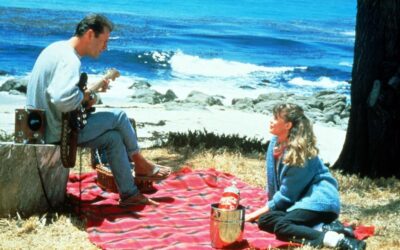
Blake Edwards’s <em>Blind Date</em> (1987)
Edwards’s comedy is sometimes madcap, but when matters settle, there is a happy ending with a picnic on the beach. What else is new? See Blake Edwards’s Blind Date (1987). The screenplay is by Dale Launer. Featured Image: Bruce Willis as Walter Davis; Kim Bassinger as Nadia Davis celebrated their honeymoon on the beach. read more
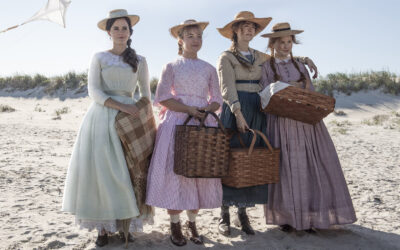
Great Gerwig’s <em>Little Woman</em> (2019)
There are two picnics in Gerwig’s Little Women: a wedding picnic and a beach picnic. The first is Meg March and Mr. Brook’s reception. As in Alcott’s novel, it’s “a plentiful lunch of cake and fruit, dressed in flowers.” But Gerwig’s foods include wine, lemonade, and coffee. The happiness is marred only by Aunt March’s […] read more
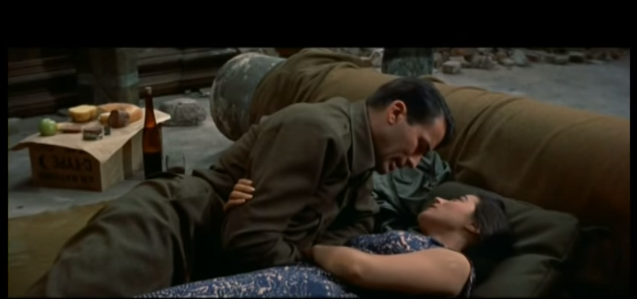
Nunnally Johnson's <em>The Man in the Gray Flannel Suit</em> (1956)
Wilson’s The Man in the Gray Flannel Suit and Johnson’s film strongly solidified the character of Tom Wrath as a symbol of mid-twentieth Century America, the rising generation of white, well-educated men striving for wealth and power in mid-century 19th century America. Ernest Hemingway disdained Wilson’s novel as a drivel but was silent about the […] read more
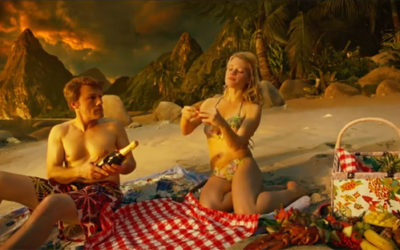
Terry Gilliam's <em>Zero Theorem</em> (2013)
Gilliam’s Zero Theorem is a sexy, pleasantly ordinary picnic. Except it is virtual, taking place in Qohen’s computer program and placed there by his horrid boss to make him work, work, work. The picnic is a romp on the tropical beach with a virtual sex worker Bainsley. Before the picnic, supremely unhappy Qohen Leth, a […] read more
John Varley’s <em>Picnic on the Nearside</em> (1980)
Included in Varley’s “Picnic on the Nearside is a romantic picnic on the Moon. Fox Carnival Joule and Halo are pals. But their relationship is altered when Halo changes into a woman with full breasts, curves, “the works,” etc. To avoid the sexual confrontation, Fox suggests they visit Old Archimedes on the Nearside, a restricted […] read more
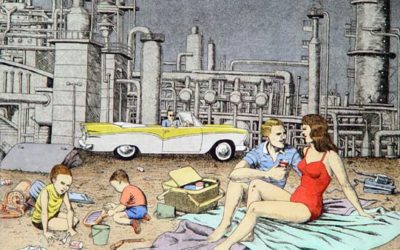
William B. Montgomery’s <em>Industrial Picnic</em> (1986)
You have to look at this again to fully grasp the satire. Nice. Compare this with Banksy’s picnic. See William B. Montgomery. Industrial Picnic. 1986. Etching, hand-colored read more
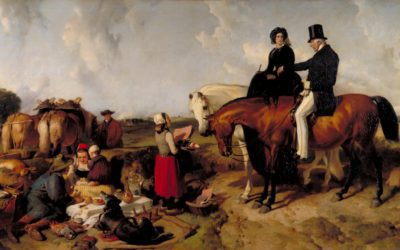
Edwin Landseer’s<em>A Dialogue at Waterloo</em> (1850)
Landseer’s A Dialogue at Waterloo is a portrait of Arthur Wellesley, Duke of Wellington, and his daughter-in-law, Lady Douro, visiting the battlefield. As the Duke describes the scene as thirty-five years before, they are accosted by a young peasant girl selling souvenirs of the battle. Behind her, enjoying a picnic is her family. The great […] read more
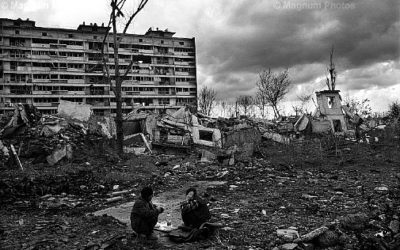
Thomas Dworzak’s <Ruins of Chechnya</em> (2002)
Dworzak’s picnic in Grozny, Chechnya, is disconcerting. Chechen men having a picnic in a bombed-out neighborhood near Minutka Square. See Thomas Dworzak. Picic in the Ruins of Chechnya (2002). Magnum Photos. read more
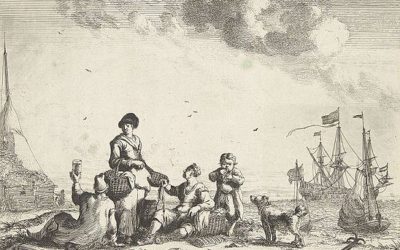
Ludolf Bakhuizen's <em>Picnick aan zee </em> (1701)
Bakhuizen embellished this seascape (his usual subject) with a group of picnickers. Picnick ann zee’s contemporary title is appropriate but inaccurate because picnic was not applied to an alfresco meal in 1701. Pique-nique had only been included in Gilles Mange’s dictionary in 1694, and it denoted an indoor gathering at which guests contributed food or […] read more
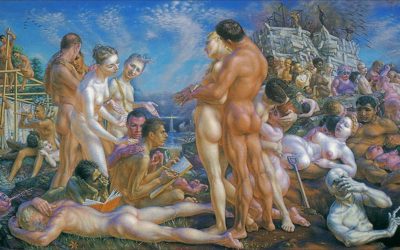
Paul Cadmus’s <em> What I Believe </em> (1947-1948)
Cadmus’s What I Believe (1947-1948) is a beach picnic without food, inspired by E.M. Forester’s essay of the same-named. Forster is the dark man reading a book with the red cover in the lower left foreground. The figures are based on some of Cadmus’ friends and former lovers. See Paul Cadmus. What I Believe (1947-1948), […] read more
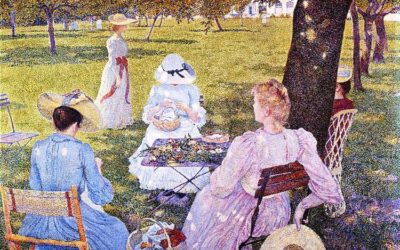
Theo Van Rysselberghe’s <em>The Family In The Orchard</em> (1890)
See Theo Van Rysselberghe. The Family In The Orchard (1890). Collection State Museum Kroller-Muller,Otterlo, Netherlands read more
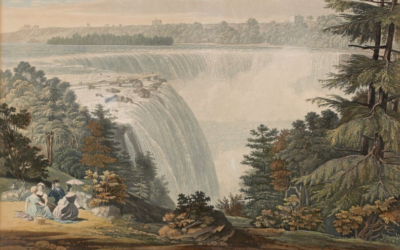
William James Bennett’s <em>Niagara Falls</em> (1830)
William Bennett picnickers placidly observing the sublimity of Niagara Falls make the landscape friendly and accessible. The fall’s thundering power and force are intimidating, but the inclusion of picnickers reduces the scope of the scene and makes it comprehensible. Bennett’s visual setting is atypically picturesque, and in this instance, often imitated. Featured Image: William James […] read more
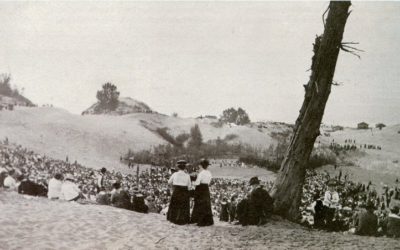
Edna Ferber’s <em>Fanny Herself</em> (1917)
Fanny Brandeis is a new woman, whose career comes first, and when Clarence Heyl, an unacknowledged suitor, asks her to picnic, she says that she’s so busy working that she has forgotten how. But the next morning, Fanny is sitting in a train heading out from Chicago to the Indiana Dunes on Lake Michigan, a […] read more

Edward Albee's <em>Seascape</em> (1975)
Albee’s Seascape is set on a beach, the evolutionary boundary from which sea creatures emerged to walk on land. The action begins innocently. Charlie and Nancy Man are just finishing a picnic when they encounter two primordial green lizards, Leslie and Sarah, who have crawled up the beach. The confrontation is antagonistic and often cruel. […] read more

Nan Goldin’s <em>CZ and Max on the Beach, Truro, MA </em> (1976)
Goldin’s is a spoof at Mickey Mouse’s expense. “CZ and Max on the Beach, Truro, MA” is a staged picnic of CZ and Max on a picnic cloth next to Mickey Mouse’s picture on the cover of The New York Times Magazine. Goldin seems to be suggesting that such outings are “mickey mouse”—an expression that […] read more

Felice Benuzzi <em>No Picnic on Mount Kenya</em> (1952)
Benuzzi’s original title for his memoir was Fuga sul Kenya – 17 giorni di liberta [Escape on Kenya – 17 days of liberty]. But being deeply impressed by Vivienne de Watteville’s Speak to the Earth, her memoir of camping on Mount Kenya, * he renamed the narrative No Picnic on Mount Kenya. What particularly impressed […] read more
Mabel Dwight’s <em>Coney Island Beach</em> (1928)
Dwight’s beach scene is no picnic. It’s a crowded Coney Island scene with a humous twist. Compare Dwight’s beach scene with John Sloan’s South Beach Bathers (1908) and Reginald Marsh’s Beach Picnic (11939). Featured Image: Mable Dwight’s Coney Island Beach 1932 hand-colored litho Smithsonian http://americanart.si.edu/collections/search/artwork/?id=7663 read more
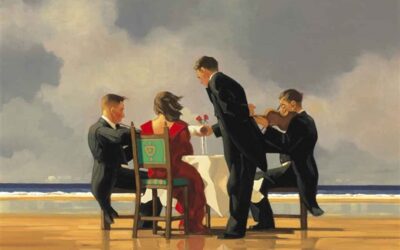
Jack Vettriano’s <em>Elegy for the Dead Admiral</em> (1994)
Vettriano’s Elegy for the Dead Admiral is a beach picnic on the sand at the surf’s edge. A woman in red sits with her back to the viewer facing the sea. She is serenaded by two violinists and served by a waiter. The situation alludes to the death of the admiral and this woman’s remembrance. […] read more

Jean François de Troy’s <em>Hunt Breakfast</em> (1737)
De Troy’s hunt meals were designed for aristocratic patrons. Two paintings Hunt Breakfast and The Death of a Stag were commissioned as companions pieces by Louis XV and designed for his private dining room in Fontainebleau. Hunt Breakfast depicts the high spirits of the hunters and family and entourage before the hunt. The Death of a […] read more
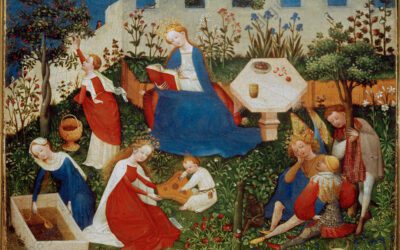
Upper Rhenish Master’s <em>The Little Garden of Paradise</em> (1410/20)
The Garden of Paradise recasts in a contemporary Hortus Conclusus as an allegory of life before the Fall. Tucked into a protected garden, free from original sin, homage the Virgin Mary and the baby Jesus are at ease. The secluded garden offers serenity in a busy world. The Virgin Mary, in the blue gown, sits […] read more
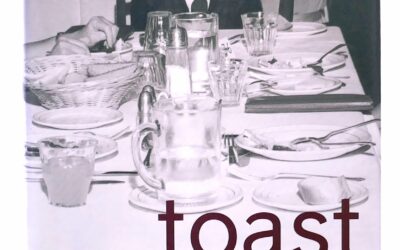
Nigel Slater's <em>Toast: The Story of a Boy's Hunget</em> (2004)
Slater’s picnic in the family backyard is a metaphor for his homosexuality and his conflicted relationship with his father, who wants him to be masculine. Tinned Ham” is humorous up to a point, but the picnic menu can make you gag. Slater describes a particularly awful confrontation during a picnic on the lawn and an […] read more
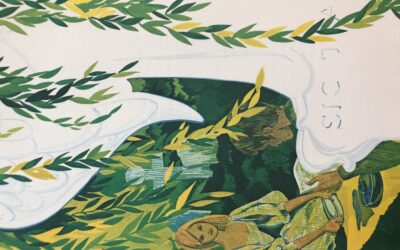
Nikka Hazelton’s <em>The Picnic Book</em> (1969)
Hazelton prefers picnics that are not spontaneous.. She contends a picnic begins when you “invite the people and then figure out the food.” “My idea of a good picnic, she writes, “is one that I can fix up at home and need only carry and unpack at the chosen spot. I loathe cooking out-of-doors, which […] read more
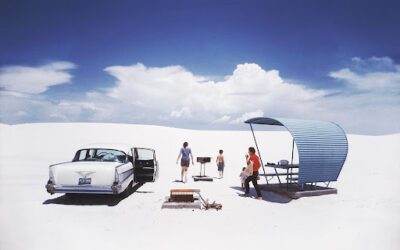
Gary Winogrand's <em>White Sands Monument</em> (1964)
Gary Winogrand’s photograph, White Sands Monument, is a stunning view of a picnic table in the White Sands National Monument in New Mexico. The white dunes are composed of powdery gypsum. The figures have left their Chevrolet and set out a picnic lunch under the picnic awning to shelter them from the intense sun and […] read more
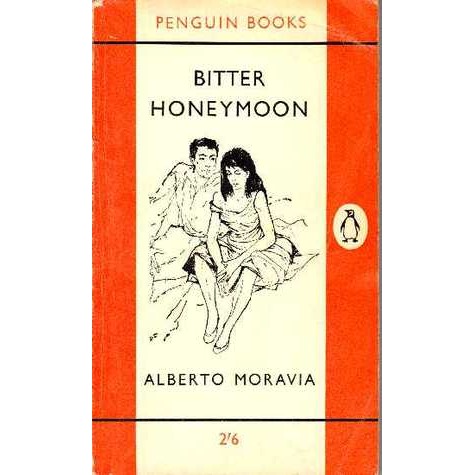
Alberto Moravia’s “Back to the Sea” (1945)
Moravia’s story’s “Back to the Sea” [Ritorno al mare] is about a picnic is without a shred of joy. It’s partly about gender relations and a metaphor for post-war Italy in the guise of a nightmare merénda, In the summer of 1945, Lorenzo, an unregenerate Fascist, takes his estranged wife, unnamed, to a picnic at […] read more
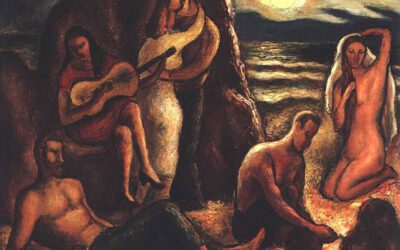
Judith Deim's <em>The Beach Picnic </em>(1936)
Deim’s The Beach Picnic is a portrait of the Cannery Row crowd in Monterey, California. Among the picnickers are John Steinbeck, the kneeling figure lighting the fire, Ed Rickets (bearded) and reclining with a beer in hand, Deim playing the guitar, who looks down at Rickets. Featured Image: Judith Deim [Barbara Stevenson] The Beach Picnic […] read more

Thomas Rowlandson’s <em>Richmond Bridge, Surrey </em>(after 1803)
Rowlandson’s Richmond Bridge, Surrey documents a picnic party at low tide on the Thames’s sandy shore opposite Hampton Court. It was common for Londoners to hire a water taxi to transport picnicker out of the city and into the country for an afternoon of eating and conversation. The party over, a carriage was hired to […] read more
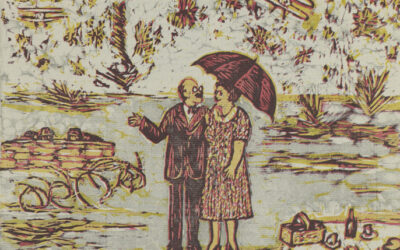
Fernando Arrabal's <em>Picnic on the Battlefield</em> (1959c.)
Fernando Arrabal’s Picnic on the Battlefield I, a one-act play, is a metaphor for the stupidity of war. Arrabal undermines picnic expectations as the well-meaning but obtuse Tépans march onto an active battlefield to entertain their son Zapo. When the action begins, Zapo is surprised to see them and cautions them to leave because they […] read more
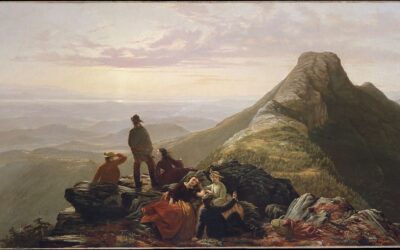
Jerome Thompson’s <em>Belated Party on Mansfield Mountain</em> (1858)
Six hikers have reached a plateau near Mansfield Mountain’s top and are ready to picnic just before sunset. Thompson titled the painting a Belated Party to provide tension, and we wonder if the picnickers will safely walk down the 4400-foot mountain in the evening darkness. It’s a likely assumption to think they would not go […] read more

John Fowles's <em> Daniel Martin</em> (1977)
Fowles’s notion of wrecking pleasure is an aborted picnic on the River Cherwell. Daniel Martin and Jane Mallory, two Oxford undergraduates, set out for a pleasant outing. It’s intended as an innocent date because Daniel is dating Mallory’s sister Nell and Jane is engaged to Martin’s best friend, Anthony. They are punting and chatting, not […] read more
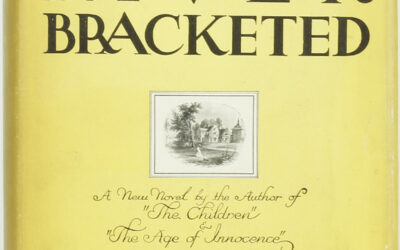
Edith Wharton's <em>Hudson River Bracketed</em> Beach Picnic (1929)
Wharton’s Hudson River Bracketed has two picnics, and I’ll treat each as a separate posting. Each picnic features the protagonist Vance Weston with different women, Halo (Héloïse) Spear on Thundertop Mountain at sunrise over the Hudson River, and Laura Lou Tracy’s honeymoon beach picnic. Both picnics have unappetizing food, a surprise because Wharton was food-centric […] read more
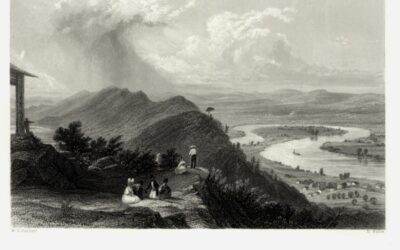
William Bartlett<em>View from Mount Holyoke</em> (1838c.)
Bartlett’s View from Mount Holyoke was accompanied by a text by Nathaniel P. Willis. The view is a topographical landscape, and Willis asserted that this was “Probably the richest view in America, in point of cultivation and fertile beauty.” Unknown to Bartlett and Willis, Thomas had painted the Oxbow from Mount Holyoke in 1836. Exercising […] read more
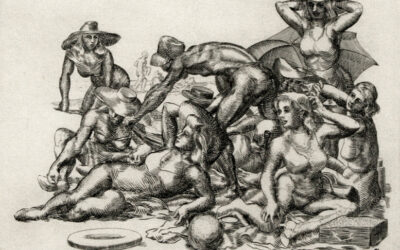
Reginald Marsh's <em>Beach Picnic</em> (1939)
This is a favorite among Marsh’s Coney Island images. In this instance, a collection of Venuses. Compare it with John Sloan’s South Beach Bathers and Mabel Dwight’s Coney Island Beach. Featured Image: Beach Picnic (1939). Engraving. read more
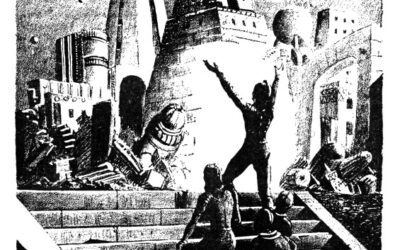
Ray Bradbury's "The Million Year Picnic" (1946)
Bradbury’s “The Million Year Picnic” is a sad metaphor about what a picnic is not—a family’s escape from Earth to build a new Eden on Mars. We don’t know how it ends because this is the final story in the collection of The Martian Chronicles. Sometime around 1999, the Thomas family (Mom, Dad, and three […] read more