
1800-1899
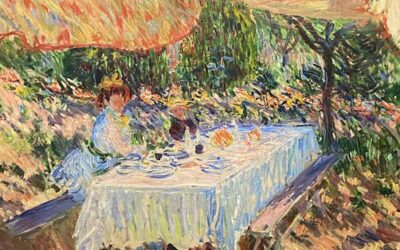
Claude Monet <em>The Tent, Giverny</em> (1883-1886). Also, <em>Lunch Under the Tent and <em>Lunch Under the Canopy</em>
Claude Monet The Tent, Giverny, about 1883-1886. read more
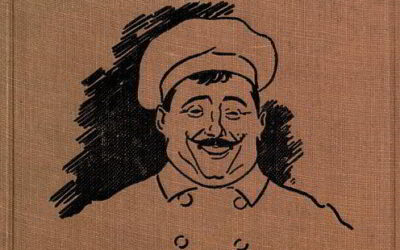
“Thumbers” or Bookmaker’s Sandwiches
“Thumbers” are thick beef, pork, or mutton sandwiches that were popular crowd food at the Newmarket racetrack. The name alludes to the small-sized sandwiches held between the thumb and forefinger. Except for gastronome Edward Spencer. in his Cakes & Ale: A Memory of Many Meals and a recipe for “Thumbers,” dignified with the name Bookmaker’s […] read more
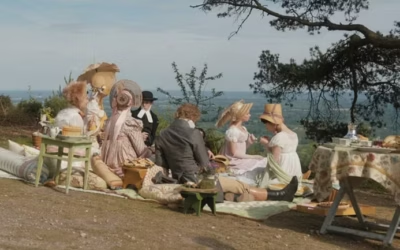
Jane Austen’s <em>Emma</em) (1816)
Austen’s Emma has two picnic episodes, one of which never happens * and the other a proper picnic at Box Hill. During strawberry season, Emma Woodhouse and her crowd gather in Knightley’s Donwell Abbey garden. Mrs. Elston’s enthusiastic plan for a “pic-nic parade” is cutesy. Addressing Knightley, she says, “It is to be a morning […] read more
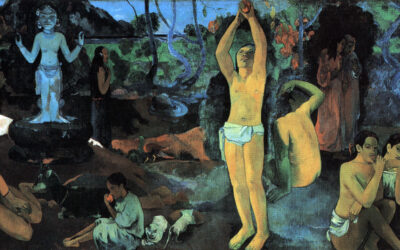
Paul Gauguin’s <em>Where Do We Come From? What Are We? Where Are We Going? </em> (1897/98)
Gauguin’s Where Do We Come From? What Are We? Where Are We Going? Vague vaguely suggests a picnic. Escaped from France, Gauguin seemed to believe his Tahitian life was picnicky. “Everything in the landscape blinded me, dazzled me,” he wrote in the Noa Noa journal. It was a feeling that never subsided. The painting’s narrative begins […] read more
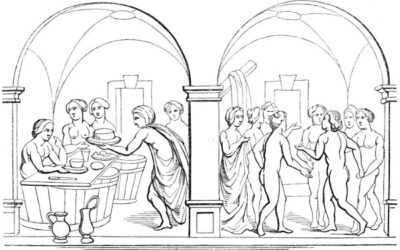
Thomas Wright’s <em>The History of Domestic Manners and Sentiments in England</em> (1862)
Thomas Wright found songs, now obscure, about women having meals in taverns and bathhouses that are suspiciously like picnics. He writes about this in The History of Domestic Manners and Sentiments in England, suggesting that sharing food and entertainment is common among the lower classes. In one song, women meeting in a tavern each contribute […] read more
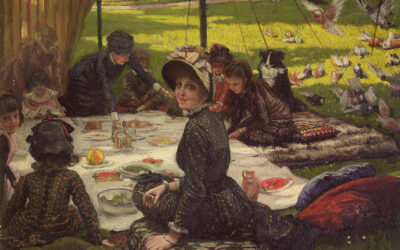
James [Jacques] Tissot’s <em>Picnic on the Grass</em> (1881/82)
Elizabeth Newton and her children enjoy a birthday party in Tissot’s garden in St. John Wood, London. The partygoers sit on cushions beside a picnic cloth laden with food and drinks prominently placed in the immediate foreground. The children are of secondary importance. Tissot was in love with Newton, and they were partners for five […] read more
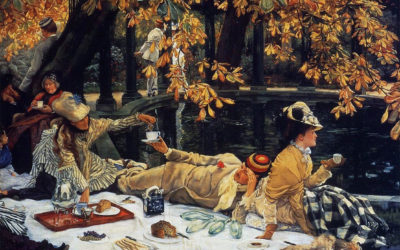
James [Jacques]Tissot <em>Holyday</em> (1876c.)
The epitome of a Victorian picnic is Tissot’s Holyday. Tissot arranged a picnic of a family and friends in the garden of his home in St. John Woods. They sit beside a sparkling white cloth, china, flatware, a cake, sliced cheese on a platter, a platter of grapes, tea, and fizzy water. The picnickers are […] read more
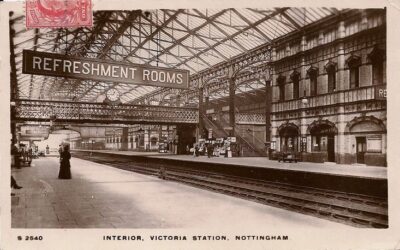
Charles Dickens. "The Boy at Mugby Junction" and the "Universal French Refreshment Sangwich" (1866)
Dickens vented his distaste for English travel food, especially sandwiches served in cold, comfortless train stations. The Boy at Mugby Station working in h Refreshment Room gleefully tells anyone who will listen (or not) how awful the refreshments (if they can be called refreshments are: “You don’t know what I mean? What a pity! But […] read more
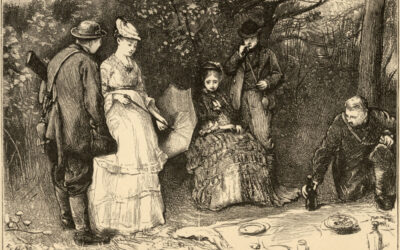
Anthony Trollope’s <em>Phineas Redux</em> (1874)
Trollope’s Phineas Redux is the fourth book in the Phineas Finn Series. It was among his most popular novels. Numerous hunt scenes and references suggest Finn’s plight evading his enemies. A halt during a fox hunt provides the opportunity for a simple picnic lunch in the field. Featured Image: Frank Holl’s illustration caption is “You […] read more
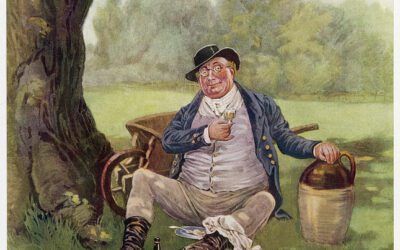
Fred Barnard’s <em>Mr. Pickwick’s Picnic</em> in <em>The Pickwick Papers</em> (1870c)
Pickwick’s picnic on a hunt in Dingley Dell is part of an abortive hunting expedition. It’s famous for Pickwick getting drunk and Sam Weller’s discussion of veal pies, pronounced “weal” in Weller’s Cockney accent. This picnic is served under the welcome shade of an old oak to make it easy for Pickwick, who suffers from […] read more
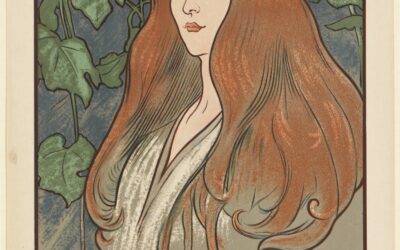
Harold Frederic’s <em>The Damnation of Theron Ware </em> (1896)
Frederic’s The Damnation of Theron Ware, or Illumination, is a satire of American Methodism. The narrative explores the mid-life crisis of Theron Ware, a married Methodist Episcopal pastor who falls for Celia Madden, an Irish Catholic, in a small town in New York State. During a staid, conservative Methodist camp meeting, Ware sneaks off to […] read more
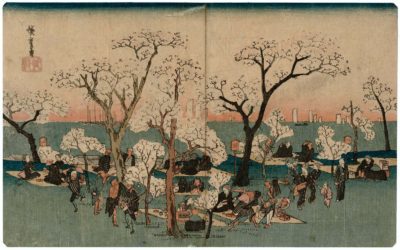
Hiroshige’s <em>Picnic at Gotenyama </em> (1833)
Hiroshige aims to depict activity relevant to the moment in a specific landscape. In this respect, his scenes in Japan correlate with J.M.W. Turner’s picturesque landscapes of the United Kingdom. While picnicking under the blooming cherry trees at Gotenyama, too much food and sake instigate a drunken brawl. Compare this with the rowdy sailors at […] read more
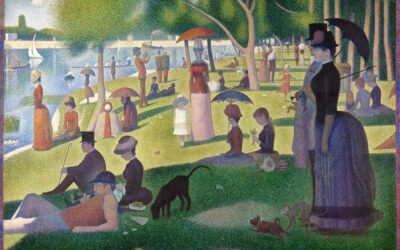
Georges Seurat’s <em>Sunday Afternoon on the Island of La Grande Jatte <?em> (1884/86)
Seurat’s La Grande Jatte is picnicky. Having a combination of leisure, ease, and easy conviviality, it’s absent food. People of all classes coexist amiably. Some sit on the grass in the shade of trades, some promenade, but there are no signs of a luncheon on the grass. Featured Image: Georges Seurat. Sunday Afternoon on […] read more
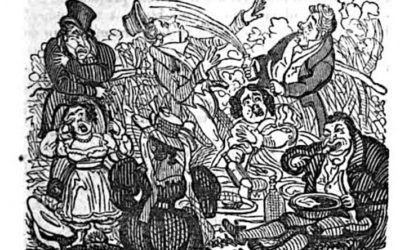
<em>The Pic-Nic</em> Song (1829)
Corny picnic satire was in vogue among English music before Gilbert and Sullivan’s 1871 Thespis, or The Gods Grown Old. Typical “The Pic-Nic” is sung to the air of “Here’s the Maiden of Bashful Fifteen” from Sheridan’s The School for Scandal. Its inclusion in Arliss’ The Melodist, a collection of popular songs, suggests opportunities for […] read more
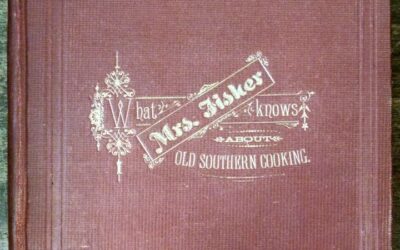
Abby Fisher's Fried Chicken (1881)
The second oldest African American cookbook is Fisher’s What Mrs. Fisher Knows About Old Southern Cooking, Soups, Pickles, Etc. She does not mention picnics in her text, but fried chicken is a picnic staple. Fried Chicken: Cut the chicken up, separating every joint, and wash it clean. Salt and pepper it, and roll into flour well. […] read more

Kenneth Grahame’s <em>Dream Days</em> (1898)
Grahame’s Dream Days are more evidence of his affinity for boats and picnics. Before Ratty’s picnic in Wind in the Willows, Grahame relates a pleasant dream about boating on a river in an Arcadian world. “I just go. But generally, it begins by–well, you’re going up a broad, clear river in a sort of a […] read more
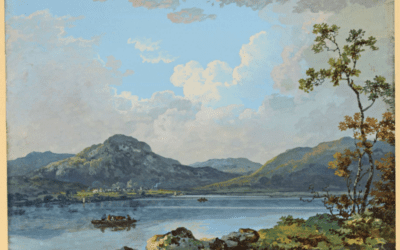
William Wordsworth’s <em>The Excursion</em> (1814)
Wordsworth’s lines reveal the sudden beauty a picnicker might encounter, which triggers pleasure and spiritual ease at an evening picnic: Ah! That such beauty, varying in the light Of living nature, cannot be portrayed By words, nor by the pencil’s silent skill; But is the property of him alone Who […] read more
Leo Tolstoy’s <em>The Hunt</em> (1852)
Tolstoy’s “The Hunt” from Childhood, Boyhood, Youth is a memoir episode of picnicking with his father during a hunt in which he remembers the sights, sounds, and smells of the forest: the chatter of the peasants, rumbling of horses, cries of quails, a hum of insects, and the smell of the soil, grain, and steam […] read more
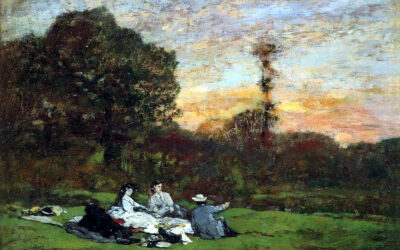
Eugène Boudin’s <em>Luncheon Grass, the Family of EugèneManet</em> (1866)
Boudin’s Luncheon Grass, the Family of Eugène (1866) is apleasant family outing in a park. Unlike Manet’s Luncheon, this is not confrontational or sexual. Because Boudin was a friend of the Manet family, especially Eugène, this picture of them picnicking on the grass may be intended as a family portrait. If so, one of the […] read more
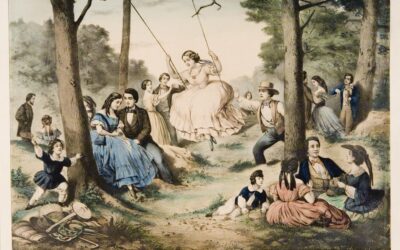
Currier & Ives’s <em>Pic-Nic Party</em> and <em>Childrens Pic-Nic</em> (1858)
Nathaniel Currier and James Merritt Ives’ lithographs The Pic-Nic Party and The Childrens Pic-Nic are picnics without food or drink. In The Pic-Nic Party, the central figure is a woman on a swing pushed by a young man, probably her beau. Just in front of her is a courting couple. In the background on the […] read more
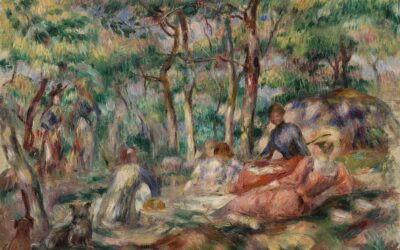
Pierre-Auguste Renoir<em>Le Repos sur l’herbe </em> (1893c.)
Renoir’s painting’s Le Repos sur l’herbe aka Resting on the Grass l’herbe is a portrait of a family at play. Renoir does not consider this a pique-nique because it is an outdoor gathering. See Pierre Auguste Renoir in Le Repos sur l’herbe and Le Déjeuner sur l’herbe (1893c.). Barnes Foundation read more
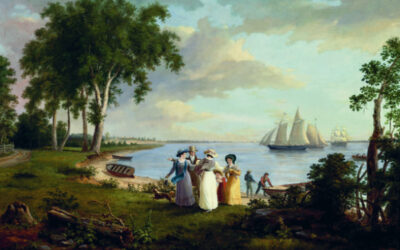
Thomas Birch’s <em>View of the Delaware near Philadelphia</em> (1831)
Birch’s View of the Delaware is a landscape embellished with a picnic party just arriving by boat to a destination on the shore near Philadelphia. See Thomas Birch. View of the Delaware near Philadelphia (1831), oil on canvas. The Corcoran Gallery of Art, Washington, D.C.). read more
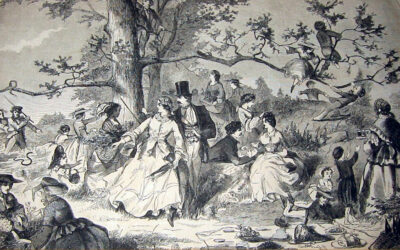
Winslow Homer’s <em>A Picnic in the Woods</em> (1858)
Homer’s A Picnic in the Woods is a pleasant joke, suggesting that the usually staid picnic might also be tumultuous. The action here is everywhere. A large picnic blanket is spread and filled with food: a bowl of fruit, a large ham with a knife for carving, a small turkey or large chicken, a bowl […] read more
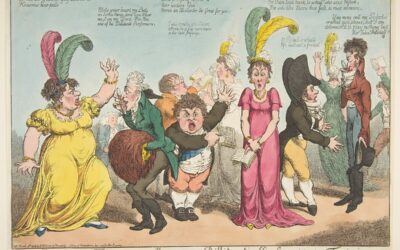
Charles Williams’s <em>A Peep into Tottenham Street, or Dilettanti Performers in Training </em> (1802)
Williams’s Peep into Tottenham Street, or Dilettanti Performers in Training is a knockoff of Gillray’s caricature Dilettanti Theatrical;-or-a Peep at the Green Room. Vide Pic-Nic Orgies (Tottenham Street was the location of the rooms the Pic Nics rented for their theatricals, dinners, and gambling. The obese woman in yellow is Albina Hobart, Lady Buckinghamshire. She exclaims […] read more
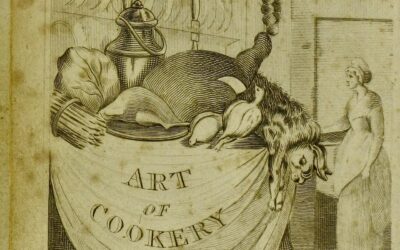
Eliza Rundell’s Fricassee and Cold Beef in <em>A New System of Domestic Cookery </em> (1806)
Fricassee is picnic food when dining indoors. It’s mentioned in Samuel Foote’s The Nabob (1772) and Mary Belson Elliott’s The Mice and Their Pic Nic (1809). Had Elliott needed a recipe, she might have found it in Mrs. Rundell’s A New System of Domestic Cookery, Formed Upon Principles of Economy, and Adapted to the Use of Private Families (1806). Fricassee of […] read more
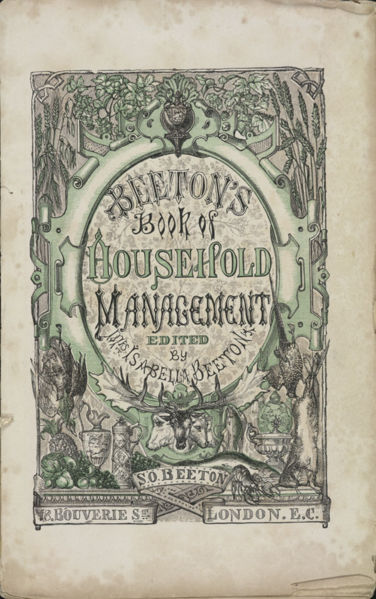
Isabella Beeton's “Veal Pie” in <em>The Household Management</em> (1861)
Unlike Sam Weller’s “weal pies,” Mrs. Beeton’s includes a recipe for a proper veal pie.* Veal Pie Ingredients.—2 lbs. of veal cutlets, 1 or 2 slices of lean bacon or ham, pepper and salt to taste, 2 tablespoonfuls of minced savoury herbs, 2 blades of pounded mace, crust, 1 teacupful of gravy. Mode.—Cut the cutlets […] read more
Augustus Egg’s <em>in Traveling Companions </em> (1862)
Egg‘s Traveling Companions is a testimony of the ease and comfort of train travel. The two elegantly dressed women, virtually mirroring images of each other, sit without even looking out of the window at the long view of the shoreline beyond. One reads the other dozes; one has a picnic basket beside her, and the […] read more
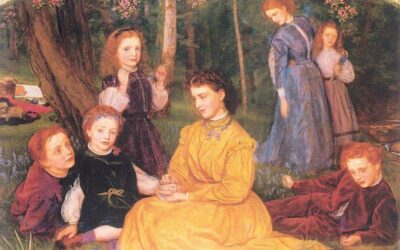
Arthur Hughes's <em> A Birthday Picnic</em> (1867)
Hughes used a picnic as a theme for a family portrait of the Pattinson family. The title he gave was A Birthday Picnic – Portraits of the children of William and Anne Pattinson of Felling, near Gateshead. A red table with food in the left background, but it is unclear whose birthday is being celebrated. […] read more
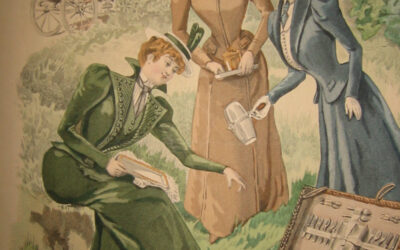
Abel Goubaud’s <em>Pique-Nique</em> in <em> La revue de la mode</em> (1889)
Goubaud’s pique-nique in La revue de la mode is an advertisement for picnic ware for upscale readers. As usual for picnics, this is a rural setting in an open forest. A country town can be seen deep in the background, as well as a chauffeur-driven electric Mercedes equipped with a picnic hamper and pannier de […] read more
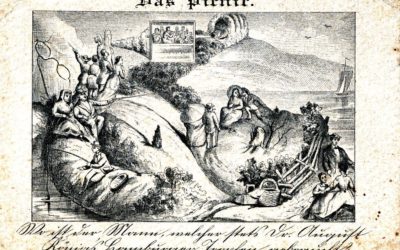
Dr. König's Elixir "Das Picnic" (1860c)
“Das Picnic” is an advertisement for Hamburger Tropfen, Dr. August König’s patent medicine, written in German by an American company in New Castle, Wisconsin. The ad’s image is a picture puzzle, and the legend is “Wo ist der Mann, welcher stets Dr. August König’s Hamburger Tropfen gebraucht?” or “Where is the man who always needs […] read more
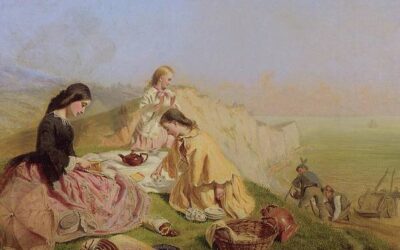
George Elgar Hick’s <em>Picnic on the Cliff s</em> (1850s?)
Three couples picnic on the edge of what looks like the cliffs in Dover. The women settle the picnic cloth while the men tend the campfire. Hicks flourished during the late 1850s through the end of the century, principally as a portrait and genre painter. read more
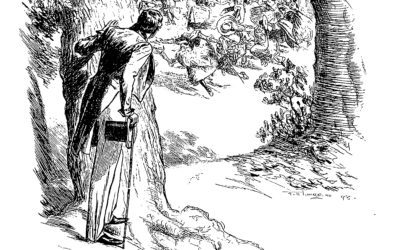
Nathaniel Hawthorne's <em>The Blithedale Romance</em> (1852)
Hawthorne’s memories of Brook Farm were a childish and boisterous masquerade picnic party for a six-year-old boy. Hawthorne refused to participate and “lay under the trees and looked on.” A decade later, Hawthorne refashioned this party an unpleasant “satanic” masquerade picnic for The Blithedale Romance.” Hawthorne refashioned a birthday picnic when he was a member […] read more
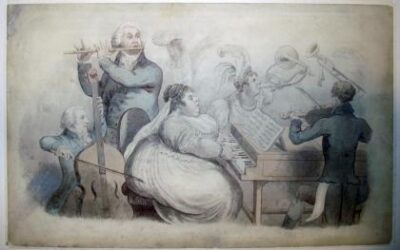
Edward Francis Burney’s <em>The Pic-Nic Orchestra</em> (1802)
The Pic-Nic Society was a London club devoted to theatrical entertainment, lavish dinners, and gambling. The Pic-Nics notoriety invited scandal and satire. Burney’s The Pic-Nic Orchestra is a knock-off of James Gillray’s The Pic-Nic Orchestra. Caricatures like Burney’s and Gillray’s helped make the word picnic then by those familiar with the Parisian dining custom widely […] read more
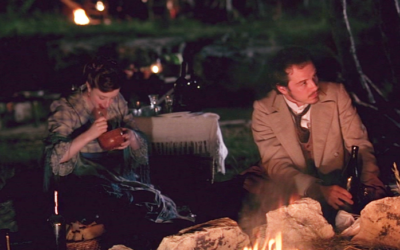
Anton Chekhov’s <em>The Duel</em> (1891)
Two people regard the same picnic as if from different worlds. The Deacon, a young clergyman, thinks, “My God, how nice it is! People, rocks, the fire, the twilight, a monstrous tree—nothing more, and yet how fine it is. “Laevsky, a man on the verge of a nervous breakdown, unhappy in love, deep in debt, […] read more
Mark Twain 's <em>The Adventures of Tom Sawyer</em> (1876)
Becky Sharp’s “pic-nic” begins with “a giddy and rollicking company” on an island in the Mississippi. After traveling by old ferryboat three miles below the town of Hannibal, the picnickers “swarmed ashore and soon the forest distances and craggy heights echoed far and near with shoutings and laughter.” The picnic turns adventuresome when Tom and […] read more
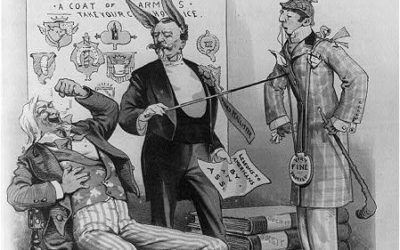
Ward McAllister's <em>Society As I Have Found It</em> (1890)
McCallister was a member of the Establishment and a paid social advisor, especially to Caroline Webster Schermerhorn Astor, the acknowledged queen of New York society. The text’s epigram is: “One who reads this book through will have as rough a mental journey as his physical nature would undergo in riding over a corduroy road in […] read more
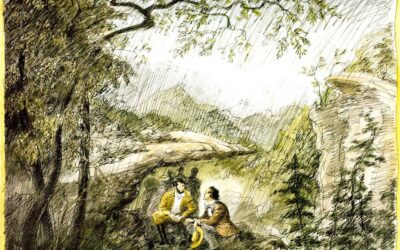
Nathaniel Hawthorne & Herman Melville Picnic on Monument Mountain (August 1850)
When Melville and Hathorne picnicked on Mount Mansfield in August 1852, Piper Heidsieck corks were popped. That’s what Cornelius Mathews wrote The Literary World during their climb to the summit. Until this meeting, the two authors were unacquainted though they lived seven miles apart; Hawthorne in Lenox and Melville in Pittsfield. In Pittsfield. Mathews wrote […] read more
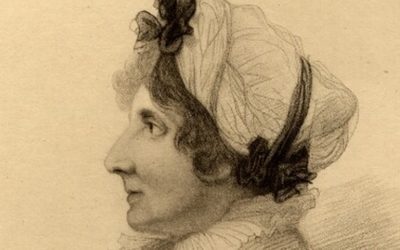
Letitia Barbauld’s <em>A Legacy for Young Ladies</em> (1826)
Barbauld’s etiquette book A Legacy for Young Ladies Consisting of Miscellaneous Pieces in Prose and Verse was an important social resource. Like Miss Manners or Emily Post, Barbauld is sure that what she has to say is correct. Barbauld’s explanation of “pic nic” then a new indoor dining style is positive. She writes that it’s a “very sociable […] read more
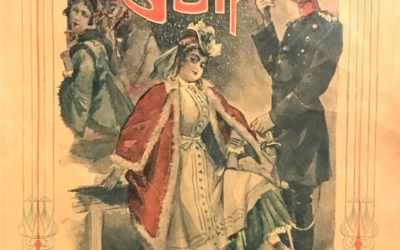
Guy de Maupassant’s <Boule de suif</em> (1880)
De Maupassant knows that the picnic of this story is not the picnic you expect. Instead of grass, the setting is s a four-horse coach carrying ten passengers fleeing the Prussian army advancing on Rouen for safety at Le Havre. Instead of being congenial, all but one of the passengers are mean-spirited and hypocritical. The […] read more
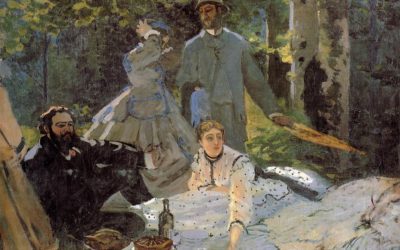
Claude Monet’s <em>Le déjeuner sur l’herbe</em>, or <em>Luncheon on the Grass</em> (1865)
Monet responded to Manet’s Le déjeuner sur l’herbe his painting in 1865 but left it uncompleted. Unlike Manet, who painted in the studio, Monet painted outdoors. This presented logistical problems because his picnic was to be monumental, approximately 15 x 20 feet. It was also intended to rival academic historical painting by depicting the well-to-do […] read more
Leonard Dakin’s family family picnics (1880s-1890)
Dakin’s photographs are a record of the family in the 1880s and early 1890s in Cherry Valley, Otsego County, New York According to Pauline Dakin Taft,the family “had a passion for picnics. There were picnics all the time at any time of day. Perhaps the lake was a favorite spot for these picnics, for there […] read more
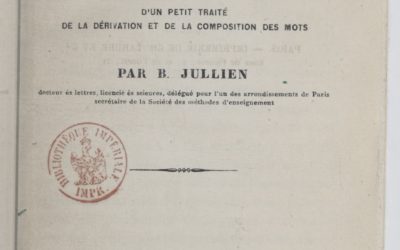
Jullien Bernard’s nonsense etymology of piquenique (1862)
Bernard writes that piquenique is a corruption of the English pick an each. Something is wrong because this explanation is nonsense. Never noticed, the etymology was never corrected. See Jullien, Bernard. Les principales étymologies de la langue française : précédées d’un petit traité de la dérivation et de la composition des mots. Paris: Hachette, 1862. […] read more
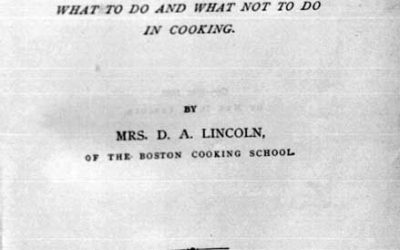
Mary Lincoln ‘s <em>Mrs. Lincoln's Boston Cook Book: What to Do and What Not to Do in Cooking</em> (1884)
Lincoln’s Mrs. Lincoln’s Boston Cook Book: What to Do and What Not to Do in Cooking was influential, especially because Fannie Merritt Farmer was among her students at the Boston Cooking School. Specifically, Lincoln offers these “Picnic Dishes”: Woodlawn Chicken, Sweetbread Sandwiches, Potted Liver, Highland Eggs, and Chantilly Cakes (chocolate with coconut icing). But she […] read more
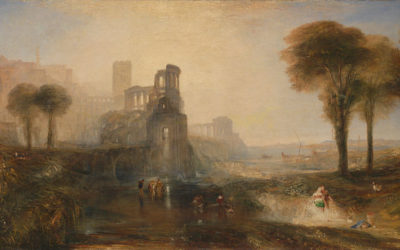
J.M.W. Turner's <em>Caligula's Palace and Bridge</em> (1831)
Among Suetonius’ apocryphal stories in The Lives of the Caesars (121c. CE) is Emperor Caligula’s three-mile bridge across the Bay of Naples from Baiae to Puteoli. It’s the kind of folly you associate with Caligula in one of his less savage moods, and the idea of it appealed to many who enjoyed Seutonius’s narrative. Horace […] read more
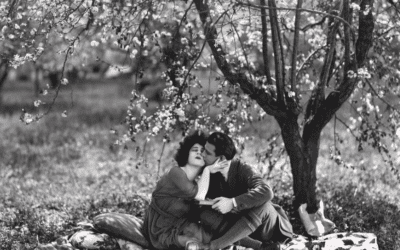
Alexandre Dumas fils’s <em>La Dame aux Camélias</em> (1848)
Dumas, fils’s La Dame aux Camélias does not have a picnic episode. But Roy C. Smallwood’s Camille makes a lover’s picnic a set piece. read more
Wyvern’s Picnic Ham and Picnic Tongue in <em>Culinary Jottings </em> (1879)
Picnic Ham is a staple cut of pork that’s cheap and needs extensive cooking or smoking. It is sometimes retailed as a picnic shoulder or pork shoulder since it is the entire front leg and shoulder. Retailers cut the meat in two, about six pounds, and may call it a Boston butt. The picnic ham […] read more
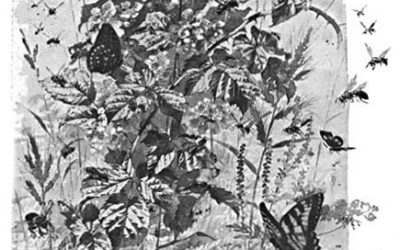
William Hamilton Gibson's "Honey Dew Picnic" (1897)
Gibson, nature writer and artist of the 1890s, describes the nature of things in “Honey Dew Picnic” from My Studio Neighbors (1897) is, a humorous essay about the feeding frenzy of insects in a forest. He says that while he never actually witnessed the honey-dew picnic, he has found ample evidence that it was so. […] read more
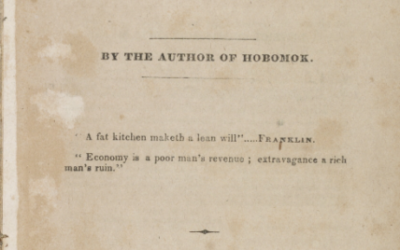
Lydia Maria Child's <em>The Frugal Housewife, Dedicated to Those Who Are Not Ashamed of Economy</em> (1829)
Child’s The Frugal Housewife is among the most popular American cookery and domestic manuals but has no specific recommendations for picnics. The 1830 edition does have a recipe for buffalo’s tongue; “Buffalo’s tongue should soak a day and a night and boil as much as six hours.” But the rising popularity of picnicking made no […] read more
Winslow Homer’s <em>Picnicking in the Woods</em> (1858)
Picnicking in the Woods. Harper’s Weekly, Vol. II, September 4, 1858. Woodblock read more
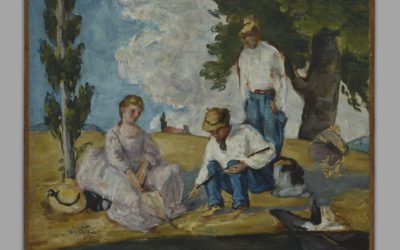
Paul Cezanne’s <em>Le Déjeuner sur l’herbe</em> or <em>Picnic on a Riverbank</em> (1873-1874)
Cezanne’s Picnic on a Riverbank (1873-1874) is a partie de campagne that may be a vague allusion to Manet’s Luncheon on the Grass (1863) A trio of two men and a woman congregate on the riverbank. The woman sits alone, hat off, her parasol between her legs. A man next to her holds a fishing […] read more