
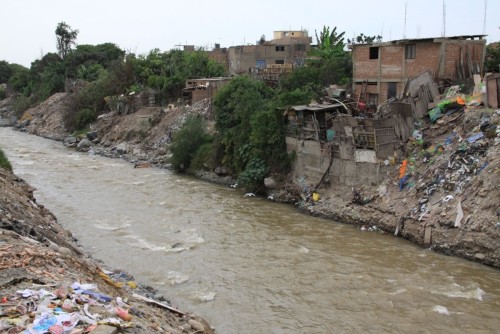
Vargas Llosa imagines Lima as a city of extremes. It’s beautiful if you “concentrate on the landscape and the birds, but it’s “ugly if you notice the piles of garbage festering as it “piles up on the outer edge of the Malecón and spills down its face.”
Most of The Notebooks of Don Rigoberto is concerned with graphic sexuality (some call it pornography), but Rigoberto’s family picnic is without sexual innuendo. Planned as a happy day in the country with his wife, Lucretia, and his son, Fonchito, the picnic becomes a comedy of errors.
Problems are immediate: the heat in Lima is sweltering, the air is polluted and dense, and traffic crawls. They lose the route to the Rímac River in Chaclacayo, and when they find it, they wander into a local garbage dump and an outdoor latrine. Though none of these unfortunate facts conforms to the pastoral expedition anticipated by Don Rigoberto,” he is “armed with unassailable patience and a crusader’s optimism.”
The culminating mishap occurs when Rigoberto wades into the Rímac’s swift current, slips, and loses the picnic basket. Gone are the spicy ceviche, the rice and duck, the crepes with blancmange, and the wine. Gone is the checkered cloth and napkins especially selected by Dona Lucrecia. Everything. Miraculously, there are no recriminations, and when they get home, they have another picnic in the kitchen, eating avocado-with egg-and-tomato sandwiches and sipping a cold beer.
Imagining otherwise, Rigoberto thinks (maybe?) the family picnic “wasn’t so disastrous after all.” Though Rigoberto, Lucrecia, and Fonchito might laugh off the picnic’s disasters and passionately make love, Vargas Llosa is daring (warning) his readers that they might not be happy for long.
See Mario Vargas Llosa. The Notebooks of Don Rigoberto. Translated by Edith Grossman, New York: Farrar, Straus & Giroux, 1998
Featured Image: This photograph of the Rímac River confirms Vargas Llosa’s suggestion that modern life in Lima is filled with detritus. Photo/Andina Defusion