
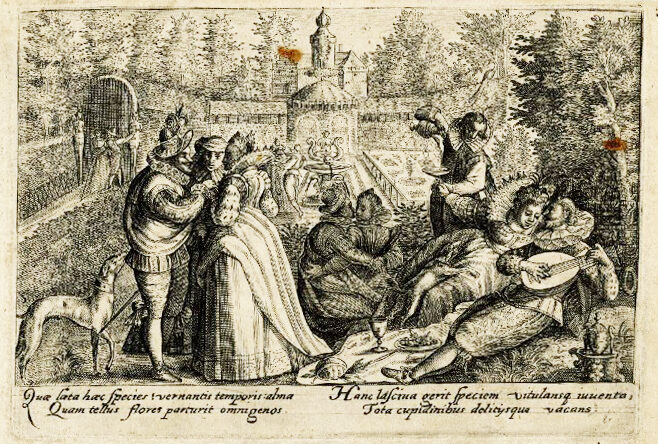
Early in the 16th century, Dutch emblem books were primers or handbooks for youthful aristocrats. Among the more socially and sexually suggestive of these books are Crispijn de Passe, the Elder’s The Garden of Love, aka Hortus Voluptatum, and New Mirror for Youth, aka Nieuwen ieucht spieghel, both of which include the same illustration, Young People Amusing Themselves in a Spring Garden.
As an emblem for correct behaviors at a picnic party, De Passe presents a playful and lusty picnic without suggesting anything untoward. The men and women have paired off and converse, dance, sing, play musical instruments, and engage in romance. Refreshment is required and must be shared, so a white picnic cloth with a carafe of wine and a bowl of fruits is provided. The scene is worldly and sensual, and reflecting the rising worldliness in the Netherlands resulted in many garden party paintings that celebrated wealth and a relaxation of social and sexual inhibitions.
The accompanying legend suggests men and women are expected to engage in discreet sexuality:
How fertile are these sights! In springtime: nourishing
As Earth brings forth flowers of all kinds
These incite frolic and youthful celebration
Freeing you for all desires and delights.
Featured Image: Crispijn de Passe the Elder. Young People Amusing Themselves in a Spring Garden. New Mirror for Youth, aka Nieuwen ieucht spieghel (1599 and 1617), copperplate engraving. The British Museum includes this illustration only in De Passe’s 1599 Hortus Voluptatum, aka The Garden of Love without mentioning that it is an emblem of love. The 1617 text is listed in https://www.dbnl.org/titels/titel.php?id=_nie004nieu01. Text translation from Latin by Ken Albala. Also D. Franken. L’œuvre grave des van de Passe (1881)