
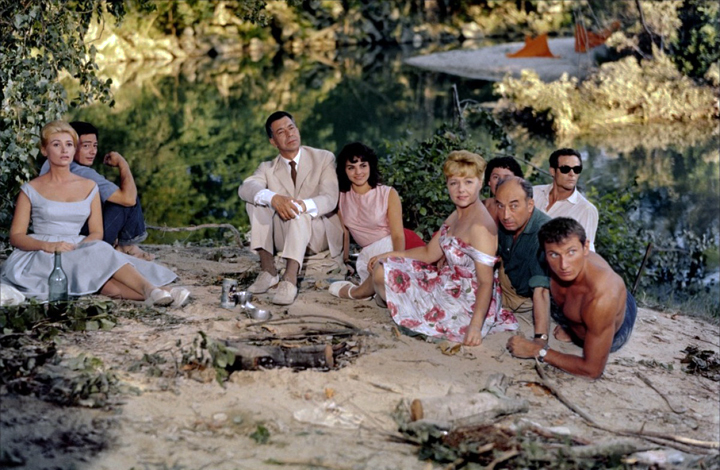
Renoir’s Le déjeuner sur l’herbe has misled some to think it’s an allusion to Manet’s Le déjeuner sur l’herbe, but it’s not so. Renoir’s satire aims for Brave New World, Huxley’s, a dystopian world in which science and industrial efficiency improve the human condition. In Huxley’s new world, babies are hatched in automated factories. But in Renoir’s world, passionate sex makes babies.
Two contrasting picnics exemplify the satire. The first picnic is a wedding announcement hosted by two scientific rationalists, staunch anti-sex advocates, Alexis, the director of a baby production factory, and Marie-Charlotte, the no-nonsense leader of a troop of anti-sex young women, best described as Amazons. The picnic party will formalize their soon-to-be sexless marriage in a grass field near a ruined temple dedicated to Diana, presumably to identify with the goddess’s virginity. The picnic turns topsy-turvy when Gaspard, a gnarly Pan-like goatherder, plays his panpipes, conjuring a mistral that excites sexless men and women with erotic sexual passion.
Separated in the chaos, Alexis wanders until he finds Nénette, a young buxom peasant woman, naked and swimming in a river. He’s about to turn away, but when Gaspard plays his panpipes again, Alexis is aroused and accepts Nénette’s offer to make love. After which, they join Nénette’s friends picnicking on a sandy riverbank. Bemused by the informality, Alexis nonchalantly munches a sandwich.
Soon after, he and Nénette join the group for a motorbike ride. The look on Alexis’s face proves that the sexual encounter has changed his personality. Once dour, now he smiles. Marie-Charlotte and the baby factory are out of his mind, and he accepts the picnic’s informality as a natural fact of life. This episode is momentary and separated from Nénette. Alexis resumes his prudish demeanor.
Alexis is restored to his “rational” self when he leaves and intends to marry Marie-Charlotte. It does not happen as planned because nature outmaneuvers Alexis’s rationalism. Faced with Nénette’s pregnancy, Alexis’s advocacy of artificial insemination evaporates. Ecstatic at the prospect of becoming a father, he chucks the sexless Marie-Charlotte and marries the sensual Nénette.
The cast: Paul Meurisse as Prof. Étienne Alexis; Ingrid Nordine as Marie-Charlotte; Catherine Rouvel as Nénette; Charles Blavette as Gaspard
Renoir’s Une partie de campagne is a faithful adaptation of Du Maupassant’s story (1946),
See Jean Renoir. Le déjeuner sur l’herbe, aka Picnic on the Grass (1959). Screenplay by Jean Renoir; Aldus Huxley. Brave New World (1932)