
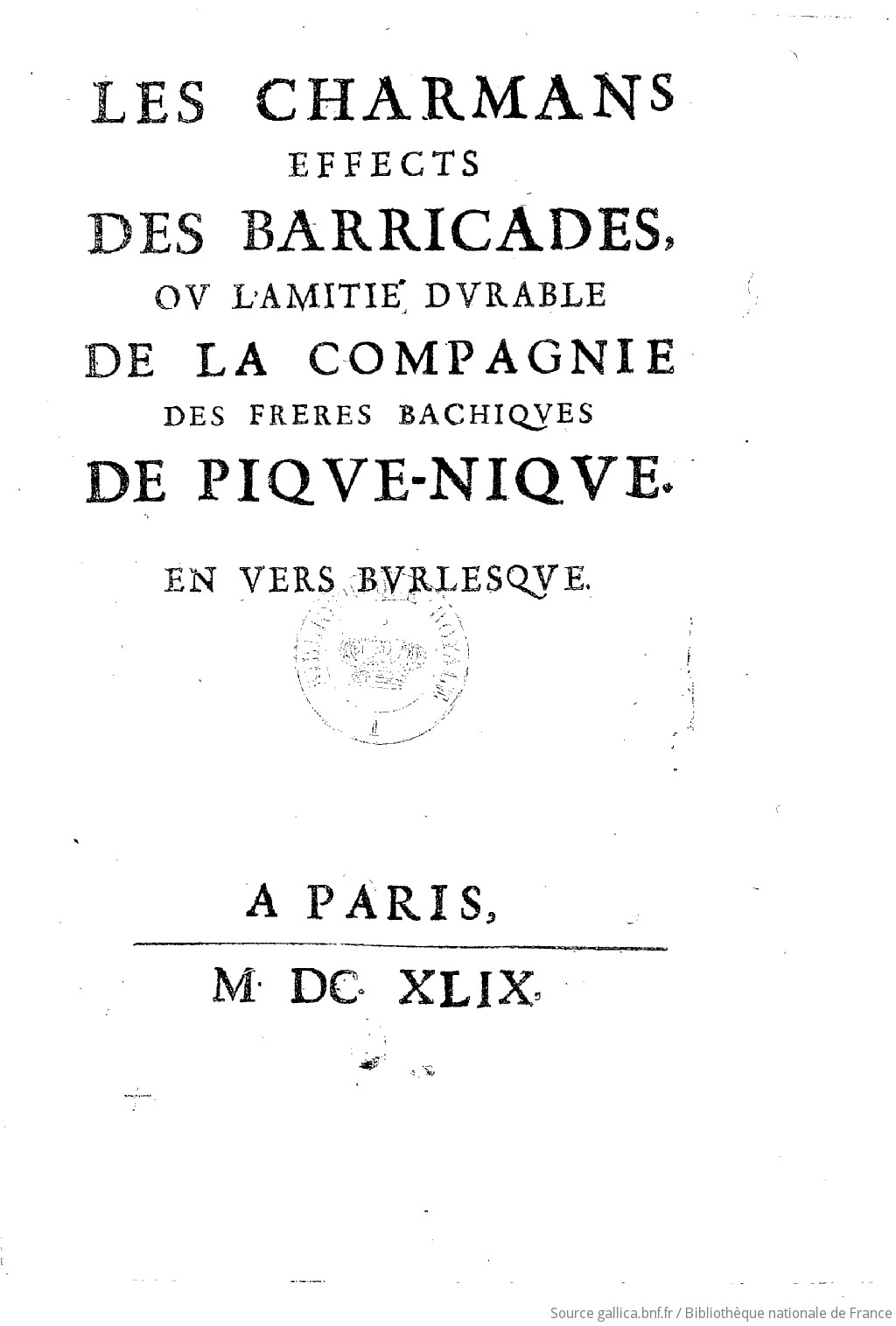
Pique-Nique was originally a man’s name. It was coined in 1649 by an anonymous author satirizing a French soldier and his cohorts who gave up their martial duties for the pleasure of drinking and gourmandizing.
Since 1694, we have supposed that piquenique is a word without a source, a mystery defined in the lexicographer, Gilles Ménage’s Dictionnaire du Etymologique de la Langue Françoise as a genteel dining style, at which each participant paid a separate reckoning: “Nous disons faire un repas á piquenique, pour dire faire un repas òu chacun paye son écot.”
What Ménage, a skilled etymologist, did not know, or chose to ignore, was that forty-five years earlier, Pique-Nique, and his Bacchic cohorts were lampooned in an anonymous verse satire Les Charmans Effects Des Barricades, Ou L’amitié Durable De La Comapgnie De Frères De Bacchique De Pique-Nique, En Vers Burlesque during the second year of the War of Fronde, a conflict between the French parliament and Cardinal Mazarin, regent for Louis XIV.
Is Pique-Nique a hero? Or is he a joke, a boor given to excess? The satirist seems to favor the latter, for among hundreds of anti-Cardinal Mazarin satires, collectively called mazarinades, it’s Pique-Nique and cohorts and not Mazarin who takes the brunt of the satire, and the linkage with Bacchus drunkenness suggests insult. Above all, the satirist says Pique-Nique was un grand beuveur, a heavy drinker.
What side in the Fronde conflict Pique-Nique served is ambiguous, but he and his comrades gave up their swords and formed an eating and drinking club. Like medieval knights, they dined at a round table as perturbateurs de la joye, deviants of pleasure. Armed with plates and utensils, the satirist writes they now attacked grillades, sauces, ragouts, and cabirotades [stews] while swilling gallons of wine. At the table, each would regale the company with tales of valor. However, to their credit, it was required that each must pay his share of the bill, “chacun en paysant sa dépense.”
The combination of pique and nique is unique. Perhaps it was meant to give a whiff of something gross, ostentatious, odious, or obscene? Perhaps nique had some coded meaning that we are unaware of. In contemporary French slang, nique means fuck, and faire la nique means to make lunch.
Fortunately, Pique-Nique was worthy of ridicule in 1649. Though he’s now an unknown person, whose name has survived his transient moment of notoriety.
See: http://gallica.bnf.fr/ark:/12148/bpt6k5675957t.r=++les+charmans+effects.langEN; http://books.google.com/books?id=-ntKAAAAcAAJ&printsec=frontcover&dq=les+charmans+effects&hl=en&sa=X&ei=bXftUoPvK-iwsQS-i4DYBQ&ved=0CCsQ6AEwAA#v=onepage&q=les%20charmans%20effects&f=false; Christian Jouhaud. Mazarinades: La Fronde des mots. (1985); Kathryn Gucer. “The Folger’s Mazarinades: Libraries within Libraries” (January 28, 2013); Gilles Ménage. Dictionnaire Étymologique de la Langue Françoise. 2 vols. (1694; Henri Bordier and Édouard Charton. History of France. (1860)😉 A. L. Moote. The Revolt of the Judges: The Parlement of Paris and the Fronde, 1643-1652 (2015); Roger Planchon. Louis, enfant roi. Screenplay by Roger Planchon (1993)