
Picnics are coded with a silent implicit expectation that there will be food, lots of it, and that it will be shared. It’s a chief aspect of commensality, accentuating positive feelings which picnickers expect. Picnic feasting is without guilt. It is an expression of vitality, joy, and lavish pleasure.
The earliest repas de pique-nique held in a Parisian tavern is remembered for its gluttony. In 1649, a satirist suggested that a man nicknamed Pique-Nique and Bacchic friends who dined gave up being soldiers because they preferred feasting instead. Their diet consisted of ragouts, grillades, and cabirotades [stews] and swilled gallons of wine and beer. The cost of the feasting was not shared, and each paid his own way, chacun sa part.
Jean-Jacques Rousseau was not thinking of a pique-nique in 1762 when he wrote, “The turf will be our chairs and table, the banks of the stream our sideboard, and our dessert is hanging on the trees.” He knew that pique-nique was an indoor meal for which friends shared the cost. Sharing the bill at a tavern or restaurant was to dine en pique-nique; sharing a meal at home was un repas de pique-nique. For an outdoor gathering, such as in his novel Emile, Rousseau exaggerated and called it un festin, or feast. He continues, “The dishes will be served in any order, appetite needs no ceremony; each one of us, openly putting himself first, would gladly see everyone else do the same; from this warm-hearted and temperate familiarity there would arise, without coarseness, pretense, or constraint, a laughing conflict a hundredfold more delightful than politeness, and more likely to cement our friendship.”
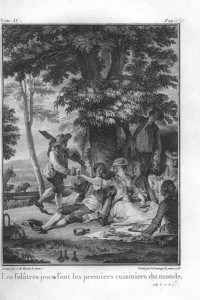
Jacques Rousseau. Emile or On Education , in Complete Works of J.J. Rousseau. (Brussels and London : J.L. de Boubers, 1762/83.
Jean-Michel Moreau’s illustration for Emile, Les folâtres jeux sont les premiers cuisiners du monde, or Playful games, sportive games, frisky games are the best chefs in the world, captures the picnicky qualities of alfresco dining. Couples are sitting on the grass in the shade of a great oak. They have been eating and drinking enough to be boozy and amorous. Rousseau suggested they had had “a glass or two of good wine,” but Moreau ups the ante, and in addition to the empty bottle on the cloth, three more bottles are cooling in the stream. Moreau also scants Rousseau’s advice and goes (very) heavy on the wine. Because Rousseau was a vegetarian (and was particularly fond of white foods!), the menu might have been milk, cheese, vegetables, fruits, bread, milk, sweet cream, and pastries.
London Pic Nics were members of a London club devoted to feasting, theatrical entertainments, and gambling, introduced the word picnic into common English speech. The Pic Nics, also known as dilettanti, were amateur actors whose passion was performing in private theatricals. The society’s motto was “Excess” and an epigram adapted from Catullus’s satire “Carmina, Carmen, XIII”:
If you, Fabullus, have a mind
To sup with me, in decent kind,
A few days hence, God willing
You’ll bring Pic Nic for your fare,
We then shall feast on something rare
Which only costs a shilling!
(The “shilling” was a joke. Membership dues were expensive, and each dinner required each member to contribute six bottles of wine.)
The Pic Nics organized during an interregnum of their war with France, called the Treaty of Amiens. Anglicized the French pique-nique and borrowed the dining custom of sharing the expenses of the dinner. Members were obligated to pay a hefty membership fee. Additionally, each was required to bring a serving of food and six bottles of wine, and contribute a food determined by lot. (They used a hat.) Henry Angelo, an original Pic Nic, explains that “the plan [for the Pic Nics] was derived from a friendly custom prevalent among our gay neighbours, the French, who formed little societies wherein the feasts were supplied by a general subscription of viands, pastry, fruit, wines, and liqueurs—each contributing according to the dictates of their own liberality.”
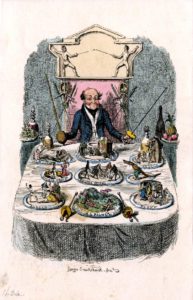
George Cruikshank, Frontise for Henry Angelos Reminiscence (1834)
Because the Pic Nic’s motto was “Excess,” Angelo’s word choice of “liberality” is an understatement. A better word is “required” for Pic Nics, which were required to pay hefty subscription dues and to bring six bottles of wine and a portion of food, the kind of which was determined by a lottery drawing from a hat. Even so, there were deficits that needed to be covered by some of the affluent principal backers. The lottery was unfair in the sense that it did not distinguish simple from elaborate, costly foods. Henry chortles, recalling that “Nothing could exceed the amusement which this lottery gastronomic produced; for that hoodwinked duchess, Fortune, played her tricks with her wonted ill-nature. Those who had the least to spare were the first to draw the most expensive lots; and those, on the contrary, to whom the money was of little import, drew the cheapest. Some luckless fair, whose beauty was her sole dowry, drew a Perigord pie, [pie made of game and flavored with truffles] value three guineas at least, whilst her rich neighbor drew a pound cake, value half a crown. Then some needy sprig of fashion, a younger brother, drew his lot of misery in a ticket for a dozen of champagne; and a wealthy nabob, another half a dozen China oranges.”
About seventy years later, during the Franco-Prussian War, Boule de suif, Guy de Maupassant’s courtesan, trying to escape the Prussian army, Boule de Suif, courtesan, packed a commodious picnic that suggests her chubby physique. Granted, it’s a three-day coach ride, and being practical, she packed a basket chockablock with an enormous dish containing two whole chickens cut into joints and embedded in jelly pies, fruits, dainties of all sorts,” and four bottles, probably wine.
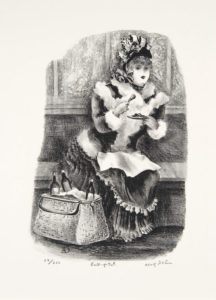
Adolf Dehn. “Ball of Fire” (1945)
For the Victorian gentry and fashionables, Mrs. Beeton suggested a menu for forty persons in her The Nook of Household Management. Among the 111 Bills of Fare, Mrs. Beeton, there is only one for a picnic –and it’s for the faint-hearted. When carried out as instructed, Beeton’s picnic requires extensive preparation, cooking, serving staff, requisite transportation, and disregard of cost. Mrs. Isabella Beeton’s “Picnic for Forty Persons” is Victorian gluttony. It has achieved cult status and reciting the menu essential for picnic lore: a cold roast beef, a cold boiled beef, 2 ribs of lamb, 2 shoulders of lamb, 4 roast fowls, 2 roast ducks, 1 ham, 1 tongue, 2 veal-and-ham pies, 2 pigeon pies, 6 medium-sized lobsters, 1 piece of collared calf’s head, 18 lettuces, 6 baskets of salad, 6 cucumbers, stewed fruit well sweetened, 3 or 4 dozen plain pastry biscuits, 2 dozen fruit turnovers, 4 dozen cheesecakes, 2 cold cabinet puddings, 2 blancmanges, a few jam puffs, 1 large cold plum-pudding, a few baskets of fresh fruit, 3 dozen plain biscuits, a piece of cheese, 6 lbs. of butter, 4 quartern [sic] loaves of household broad, 3 dozen rolls, 6 loaves of tin bread for tea, 2 plain plum cakes, 2 pound cakes, 2 sponge cakes, a tin of mixed biscuits, 1/2 lb, of tea, a stick of horseradish, a bottle of mint-sauce, salad dressing, vinegar, made mustard, pepper, salt, good oil, and pounded sugar, 3 dozen quart bottles of ale, packed in hampers; ginger-beer, soda-water, and lemonade, of each 2 dozen bottles; 6 bottles of sherry, 6 bottles of claret, champagne à discrétion, and any other light wine that may be preferred, and 2 bottles of brandy. Water, Mrs. Beeton offers, “can usually be obtained, so it is useless to take it.” This certainly lightens the load, immeasurably.
McTeague, the protagonist of Frank Norris’s novel McTeague: A Story of San Francisco, attends his first picnic with the Sieppe family at Schuetzen Park. He’s surprised at what is parked for the family: clam chowder, huge loaves of rye bread full of grains of chickweed, wiener-wurst and frankfurter sausages, unsalted butter, pretzels, cold, underdone sliced chicken with mustard, dried apples, a dozen bottles of beer, and a Gotha truffle (a baked brown pudding). Afterwards, the men and children wander off while the women clean up. But what he remembers most is dessert, a Gotha truffle, a baked brown bread pudding.
Kenneth Grahame’s opening chapter of The Wind in the Willows affirms the gluttony associated with picnicking. Although he’s a solitary Rat, a dandy prepares a picnic capable of feeding his entire circle of friends if they might show up. So before Rat climbed into his boat, he, Kenneth Grahame’s Rat, setting out for a picnic in the woods, crammed his wicker until he could scarcely lug it to his boat. When Mole asks him what’s in it, Rat replies breathlessly, struggles with a trunk of cold chicken. . . coldtonguecoldhamcoldbeefpickledgherkinssaladfrenchrollscresssandwichespottedmeatgingerbeerlemonadesodawater——.
About seventy-five years later, it’s reputed that W.C. Fields ventured on a three-day picnic, W.C. Fields filled car, probably ac Cadillac with watercress, chopped olives and nuts, tongue, peanut butter, strawberry preserves, deviled eggs, spiced ham sandwiches, celery stuffed with Roquefort cheese, black caviar, pâté de foie gras, anchovies; smoked oysters, baby shrimps, and crabmeat, tinned lobster, potted chicken and turkey, Swiss, Liederkranz, and camembert cheeses, olives, three or four jars of glazed fruit, angel food and devil’s food cakes, gin, wine, and a case of Lanson champagne.
The picnickers, Ford Madox Ford survived what he called a ”Homeric Feast” to celebrate the Feast of the Annunciation. “Banquet at Calanques” was held on a perfect day on a high cliff above a rocky inlet. The food and paraphernalia carted by boat and lifted by pulley to the top of the cliff included fifty pounds of bouillabaisse cooked in an immense cauldron over a driftwood fire. The rest of the foods were cooked elsewhere, including twelve cocks stewed in wine and savory herbs, a salad as big as a cartwheel, a sweet-cream cheese with a sauce made of marc and sweet herbs, and many pounds of apples, peaches, figs, and grapes. And, if Ford is to be believed, they consumed sixty-one bottles of wine in four hours.
Among the meals Edna Lewis describes in her cookery memoir A Taste of Country Cooking is her mother’s role in preparing, orchestrating, and serving food for Revival Sunday and Dinner on the Grounds, in Freetown, Virginia. “Because she liked to arrive at the church with the food piping hot,” Lewis explains, “My mother would spread out a white linen tablecloth before setting out the baked ham, the half-dozen or more chickens she had fried, a large baking pan of her light, delicate corn pudding, a casserole of sweet potatoes, fresh green beans flavored with crisp bits of pork, and biscuits that had been baked at the last minute and were still warm. The main dishes were surrounded by smaller dishes of pickled watermelon rind, beets, cucumbers, and spiced peaches. The dozen or so apple and sweet potato pies she had made were stacked in tiers of three, and the caramel and jelly layer cakes were placed next to them. Plates, forks, and white damask napkins and gallon jars of lemonade and iced tea were the last things to be unpacked.” When all the food from the mother and all of the picnickers is unloaded, it fills a sixty-foot length of tables. Saying Grace is the signal to eat. Lewis does not at all feel self-conscious about the feast she had described. This is the picnic code she adheres to.
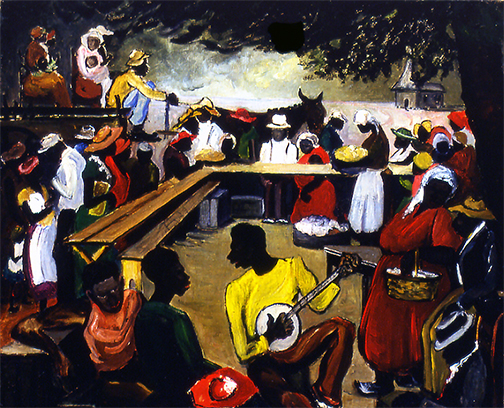
Nell Choate Jones. Church Supper (1945c.)
Unlike Mrs. Beeton’s suggestions, the Five Chefs’s Picnic, organized by Pierre Freney and Craig Claiborne in the summer of 1966, was cooked and served on the beach of Gardiners Island in Long Island Sound. Their menu for twelve picnickers is cooked by four-star New York Times-rated chefs. Working together, they cooked Mussels Ravigote, Pâté Bluefish au vin blanc, beef salad, seviche, poached striped bass with Sauce Rouille, grilled squab [fifteen], cold stuffed lobster, a mélange of fruits, assorted cheeses [Brie, Camembert, goat cheese], French bread, Chablis, and Beaujolais Supérieur.
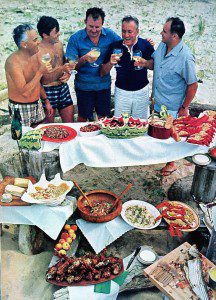
Mark Kauffman. “Magnificent Pique-Nique: Five Celebrated Chefs on a Cookout.” (1965)
Vladimir Nabokov’s Ada, or Ardor, describes the picnic party for Ada’s sixteenth birthday. Family and guests arrive in a charabanc, caléches, a red motorcar, and bicycles to a picnic site in an old pine forest. Servants serve food on Sèvres dinnerware from baskets filled with crustless sandwiches, roasted turkey, Russian black bread, Gray Bead Beluga caviar (the most expensive), candied violets, raspberry tarts, white and ruby port, watered claret for the children, and cold sweet tea.
Mrs. Bratbe’s August Picnic is Jacqueline Wheldon’s is about a three-day picnic for 800 guests. Hytha Bratbe’s annual event is more like a country fair picnic. It’s a purposely conspicuous affair held on her West Sussex Downs, surpassing Mrs. Isabella Beeton’s picnic for forty persons—and crushing it. Amounts are not given, but this is a schematic of what Mrs. Bratbe ordered to be served: cured beef, pork and lamb roasts, mutton pies, cider, apples and plums of many local kinds, bread, butter, eggs, honey, soft cheeses, bacon, milk, cream, Sussex cake, beechnuts, striped tomatoes, lettuce hearts, cucumber, potatoes, spinach, parsley, and broccoli, cheese, fancy pastries, coffee, teas, rare fruits (unspecified), marzipan and almonds, herbs, pounds of caviar, mounds of frogs’s legs, and bowls of jellied snails.
Claudia Roden’s memory of picnicking on Mediterranean beach dunes in Alexandria is described in Everything Tastes Better Outdoors. Roden remembers the picnic was held in the spring to celebrate Shem en Nessem [Sham el Nassim], the national holiday of Egypt marking the New Year. It’s prepared in the family’s home kitchen and carted and erved with staff: Moroccan Style, Sanbusak/ Pies filled with meat and Pine Nuts, Meat Ajja / An Omelette, Kukye Gusht [Iranian Omelette], Kibbeh Naye [raw lamb and cracked wheat paste] Bazargan [burgul salad], Tabbouleh [Cracked Wheat Salad], Stuffed Vegetables, Stuffed Onion, Leeks Zucchini, Lemon Chicken, Lahma bil Karaz [Meatballs with Cherries], Salq bi loubia [Spinach with Black-Eyed Beans], Lentil Tomato salad, Loubia bi Zeit [Green Beans in Olive oil].
The July Fourth picnic Joyce Carol Oates describes in Black Water (1992) is fairly typical of American holiday outings. What they eat is described in a manner that is just slightly enough off-key to make the feast unappetizing: “No: it was time for the feast; borne by the wind a delicious smell of grilling meat over which Ray Annick in a comical cook’s hat and apron presided, swaying-drunk but funnily capable: slabs of marinated tuna, chicken pieces swabbed with Tex-Mex sauce, raw red patties of ground sirloin the size of pancakes. Corn on the cob, buckets of potato salad and coleslaw and bean salad, and curried rice, quarts of Häagen-Dazs passed around with spoons.”
Calvin Trillin’s “no-frills picnic” for a flight from New York to Miami is an intentional joke. Keeping to the picnic code of fest, Trillin isn’t shy about carrying on a huger bundle of food. He ironically claims he’s doing this to beat the cost of in-flight food, but he’s a master at humorous exaggeration. Like Grahame’s Rat, Trillin packs his necessities: a small jar of fresh caviar, some smoked salmon, crudités with pesto, tomato-curry soup, butterfish with shrimp stuffing, gelée, spiced clams, limed dill shrimp, tomatoes stuffed with guacamole, marinated mussels, and an assortment of pâtés, stuffed cold breast of veal, a bottle of Pouligny-Montrachet, a selection of chocolate cakes, some praline cheesecake, and Italian cheesecake with fresh strawberries and Grand Marnier. The meal was incomplete, Trillin explains, because a fried chicken was left out. “You must be a gourmet eater,” declares the woman sitting in the next seat over.
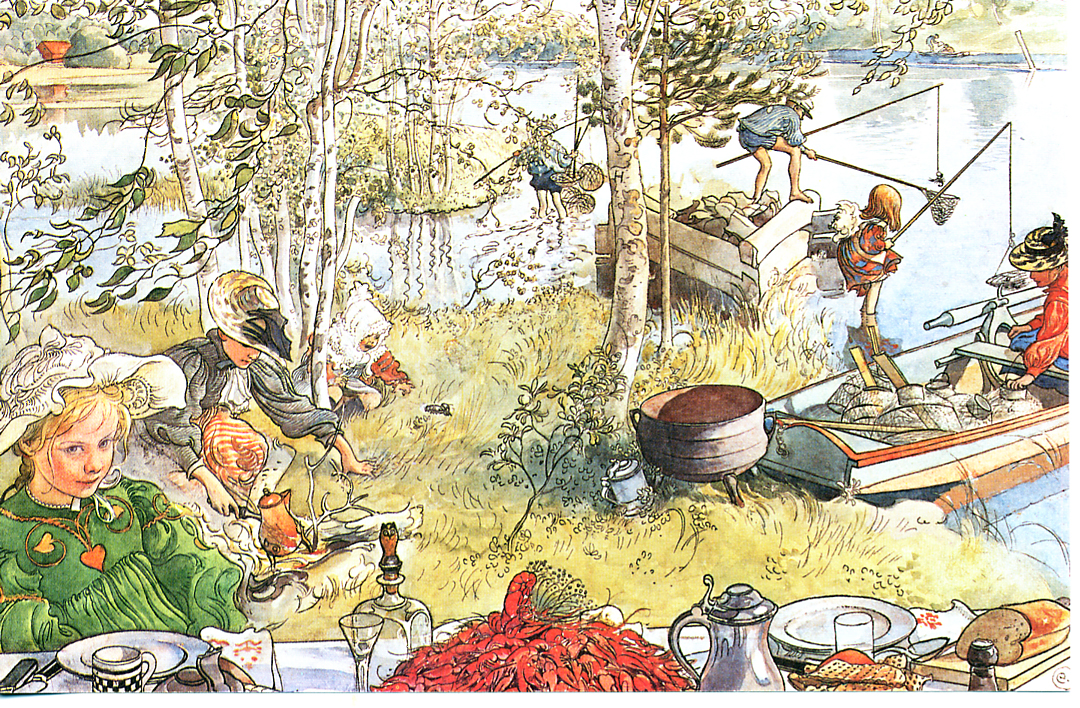
Featured Image: Carl Larsson. Kraftfangst, aka Crayfish Season Opens (1897) from A Home Series (1899), watercolor on paper. National Museum, Stockholm