
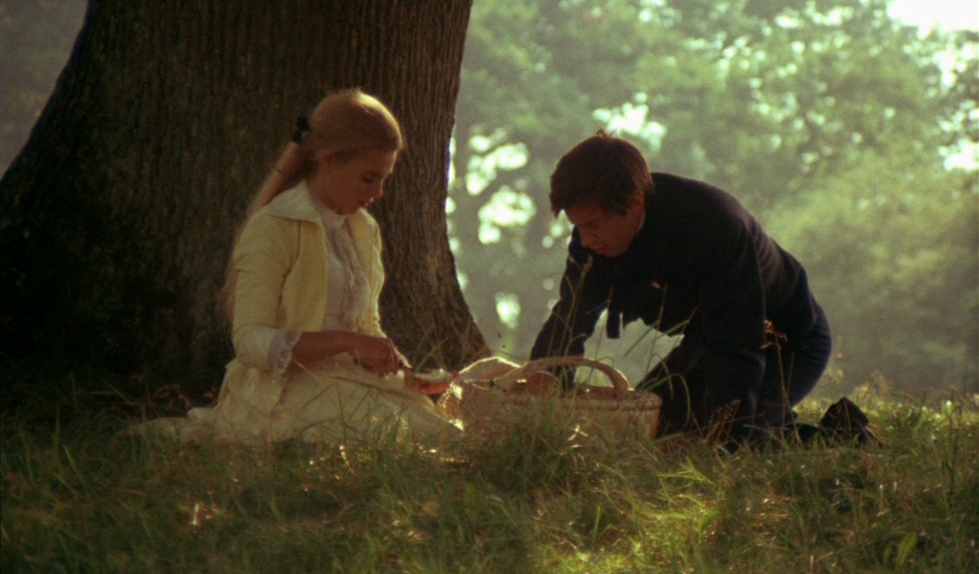
Pique-nique is a French word, the etymology of which is murky. Picnic is its English cognate. Because of the enthusiastic usage of picnic in England and the United States, anglophones have presumed otherwise, turning its origin topsy-turvy. Among the confused are the editors of the 1897 The Columbian Cyclopedia, who categorically state “the F. pique-nique is derived from Eng. picnic, and not vice versa.” Even messier, all attempts to explain the compound sources of “pic” and “nic” have failed. E. Coham Brewer’s The Dictionary Of Phrase And Fable suggests picnic derives from the Italian piccola nicchia (a small task). However, Italians use the term scampagnatura, literally a holiday or a trip to the country, or lolazione sull’erba, luncheon on the grass.
Any words rhyming with pic and nic seem fair game for etymological mischief. Pure nonsense is Maison Goyard’s 2016 advertisement explaining that picnic is “a contraction of the expression piquer (meaning to nibble) nique (things of little value)” –was coined in the 13th century. During the Middle Ages, the picnic is a frugal pursuit undertaken by the French aristocracy while hunting or travelling.”
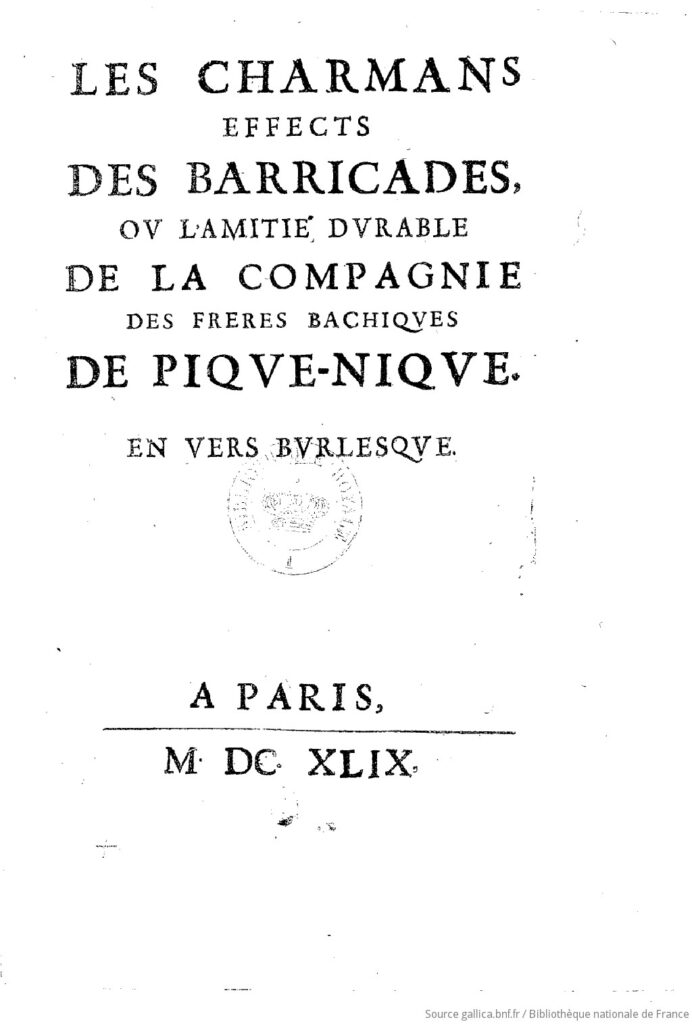
Until recently, pique-nique and picnic were supposed to be obscure words without a history. This murkiness was partially cleared with the discovery of an unsigned satire published in 1649 describing the exploits of a French soldier named Pique-Nique in Les Charmans effects des barricades, où l’amitié durable de la comapgnie de frères de Bacchique de Pique-Nique or The Durable Friendship of the Brothers of Bacchic Picnic. Otherwise unidentified, Pique-Nique and his Bacchic comrades, soldiers otherwise engaged in the War of the Fronde, were satirized for abandoning their military duties to feast and drink excessively. Above all, the satirist says Pique-Nique was un grand beuveur, a heavy drinker.
During the decades following the Fronde, Parisians forgot Pique-Nique and comrades by 1694, when published as piqueniue in Gilles Ménage’s authoritative Dictionnaire Du Etymologique De La Langue Françoise, it was without a history. According to Menage, “At a picnic meal, everyone pays his reckoning, a vital part of the meal according to the Flemings. The word is not in our old language, and it is unknown in most Provinces.” Nous disons faire un repas à piquenique pour dire faire un repas où chacun paye son écot ce que les Flamans disènt parte vital chacun fa part. Ce mot n’eft pas ancien dans notre Langue & il eft inconnu dans la pluspart de nos Provinces. The reference to the Flamans (Flemings) is unsubstantiated and subsequently ignored. As far as anyone knows, the ancient Greek tradition of sharing food and drink called eranos is unrelated to the French dining entertainment. Ménage, an expert etymologist, is mum about it. There is no mention of the Spanish custom of the merienda or the Italian merenda.
The repas de pique-nique, now spelled hyphenated, continued unabated in Paris, but was slow to catch on elsewhere. The English were unaware of the custom. Lord Chesterfield mentions it in an unpublished letter of 1748 with his son Philip Dormer, who reports that a significant activity at a picnic, or salon gathering, in Leipzig is gambling. Phillip’s letters are missing, Lord Chesterfield’s Letters were not published until 1774, and the word picnic went unnoticed in the U.K the start of the 19th century when the Pic Nics, a posh London club devoted to dining, theatrical entertainments, and gambling, was established in 1801. The club disbanded amid scandal in 1803, but pic nic, among other spelling variations, entered into common parlance. 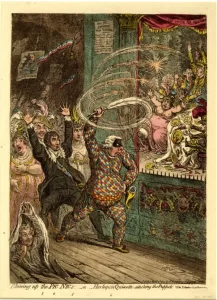
More than two hundred years later, the French denoted pique-nique ( the hyphenated spelling fixed) as an indoor social gathering for a meal at home, elsewhere, or in restaurants. Privately at home, Jean Jacques Rousseau dined “tête à tête en piquenique,” at Madame Vacossin’s [restaurant], he split the bill in the “pic-nic style.” But in his novel Emile, an outdoor social gathering is “un gran festin.” Jean-Antoine Watteau’s La Collation (1721c), Édouard Manet’s Déjeuner sur l’herbe (1863), and Fernand Léger’s La Partie de champagne (1952) are picnics known by euphemisms.
In England, evolved and picnicking shifted from “in” to “out.” While Rousseau shared meals at home, Oliver Goldsmith implied an outdoor picnic in his 1766 novel The Vicar of Wakefield, but did not use the word. “Our family dined in the field, “ the Vicar explains, “we sat, or rather, reclined round a temperate repast, our cloth spread upon the hay.” Presumably, readers knew what Goldsmith meant. Thirty years later, the setting’s shift continued when John Harris, a London publisher, added a “pic nic dinner” to an illustrated story in verse for children, The Happy Courtship; Merry Marriage, and Pic-Nic Dinner of Cock Robin. Allowing for the established French custom of sharing, each animal brings something: Jenney Wren her beauty, food, Robin cherry wine. Because wedding guests are animals and plan to be married outdoors under a great oak, Harris decided to call their wedding party a “Pic-Nic Dinner.” For a short time, picnics were still an indoor custom. In 1809, Mary Elliott’s pedantic The Mice and Their Pic Nic severely criticizes the London City Mice for their “pic nic” dinner. Retelling Aesop’s fable and Horace’s Mus Urbanus et Mus Rusticus. Elliott’s moral was that it is better to eat acorns on a barn floor than chicken fricassee and whipped-cream plum cake in the cupboard of a London townhouse. The picnic fails when most of the mice are attacked and eaten by a kitchen tabby cat. Read as a metaphor recalling the scandalous behavior of the London Pic Nics, Elliott is suggesting that picnics are grievously sinful. Happily, The Mice and Their Pic Nic failed to persuade children and adults from picnicking anywhere.
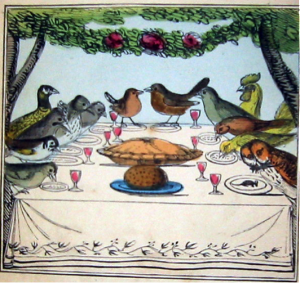
The Happy Courtship (1814 edition).
For Americans, a picnic is always an outdoor event. “Excursion,” an 1867 anonymous essay for Harper’s Weekly, makes the case that a picnic is an American birthright: “It is a cardinal belief with every man, woman, and child that a picnic includes pretty nearly the most perfect form of human enjoyment, the writer exclaims. “What the full requirements of a picnic may be admits of some range of opinion, but the great charm of this social device is undoubtedly the freedom it affords.” The author’s fixed definition for outdoor picnicking presumes no authority other than experience and custom. Picnics, American picnics, must be outdoors, and that’s that. In the mid-twentieth century, the relentlessly judgmental M.F.K. Fisher’s “true” picnic (and maybe yours?) must be outdoors and away from home. “It can consist of a piece of bread and an apple, eaten anywhere in the outdoors that will make it taste good,” she argues, “but it is not strictly speaking, a picnic if it is on a terrace, or in a patio, or under the linden tree in the backyard.”
Featured Image: Bo Widerberg, Elvira madigan. The screenplay is by Bo Widerberg (1967)
Select History
1592: Thomas Nashe’s Strange News of the Intercepting Certain Letters introduces “potte-luck.”
1649: A soldier named Pique-Nique was lampooned in Les Charmans effets des barricades, où l’amitié durable de la comapgnie de frères de Bacchique de Pique-Nique.
1694: Giles Ménage defined piquenique, without attribution, as a meal at which guests share the cost in Dictionnaire Du Etymologique De La Langue Françoise. Pique-Nique, the musketeer, was forgotten, completely.
1745c: Jean-Jacques Rousseau’s The Confessions confides he dined tête-à-tête en piquenique at home.
1755: Samuel Johnson’s Dictionary of the English Language (1755) omits Picnic.
1772: Samuel Foote links the nick-nack with picnic in The Nabob.
1748: Lord Chesterfield’s son Philip Dormer described an afternoon gathering in Leipzig in 1748. Dormer’s letter is lost; Chesterfield’s Letters were not published until 1774.
1778c: J.J. Rousseau dined en manière de pique-nique in a restaurant remembered in Reveries of a Solitary Walker.
1802: The London Pic Nic Society, a group devoted to gambling, theatrical performances, and gourmand dining.
1806: The Courtship, Marriage, and Pic Nic Dinner of Cock Robin. To Which is Added, Alas! The Doleful Death of the Bridegroom is the first outdoor dinner named a picnic in the modern sense.
1807: Washington Irving and James Kirk Paulding satirized women’s fashion using “picnic stockings.”
1818: Dorothy Wordsworth asked a friend. “By the bye, what is the origin of the word Picnic? Our Windermere gentlemen have a Picnic every day.” The friends’ answer is unknown.
1825: Jean-Anselm Brillat-Savarin’s The Physiology of Taste, or Meditations on Transcendental Gastronomy, describes a halt on the hunt, haltes de chasse, but does not call it a pique-nique.
1828: Noah Webster’s American Dictionary of the English Language (1828) omits Picnic.
1862: Bernard Julien’s Les principales étymologies de la langue française is sure that piquenique is a corruption of the English pick an each.
1864: Édouard Manet’s Le déjeuner sur l’herbe conforms to French usage that a picnic is an indoor gathering.
1867: “Excursion,” an essay in Harper’s Weekly, makes the case, “It is a cardinal belief with every man, woman, and child that a picnic includes pretty nearly the most perfect form of human enjoyment.
1897: E. Cobham Brewer’s The Dictionary of Phrase and Fable writes that pic-nic derives from the Italian piccola nicchia (a small task), that is, each person being set a small task towards the general entertainment.
1897: Editors of The Columbian Cyclopedia claim that the pique-nique is derived from English. picnic, and not vice versa.”
1911: The Encyclopedia Britannica tentatively suggests picnic may be a rhyming word or a small old French coin called a pique.
1913: Webster’s Revised and Unabridged Dictionary suggests an unsubstantiated link between “picnick” and “knick-knack.”
1944: Osbert Sitwell condemns Picnic as an ugly word in “Picnics and Pavilions.”
1952 Fernand Léger’s series La Partie de Campagne conforms to French usage that a picnic is indoors.
1958: Eric Partridge’s Origins, A Short Etymological Dictionary of Modern English scants nique and repeats that pique derived from the French, meaning to pick, to pierce, to pick up, to pluck, to gather, to choose.
1959 Jean Renoir’s film Le déjeuner sur l’herbe, based on a story by Guy de Maupassant, includes two picnics.