
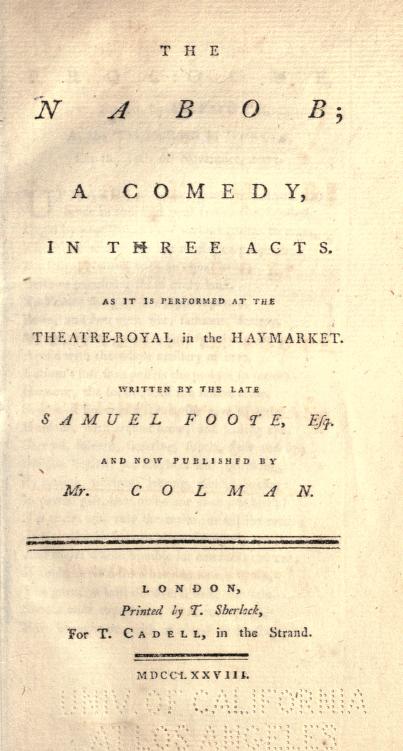
Samuel Foote’s play The Nabob, first produced in 1772, now obscure, is the first mention of the compound word “nick-nack.” Foote used it in the sense of dining en piquenique, which suggests familiarity with the Parisian dining custom. The alliterative corruption is meant to be humorous, and Foote was known for his quick wit. and it’s likely he coined the word, but this cannot be substantiated.
According to Foote, a nick-nack is a meal to which guests are expected to bring a share of food and wine. Unfortunately for Foote, nick-nack is buried in The Nabob, and by not using picnic, he lost his chance for a linguistic coup.
Janus: Time enough. —You had no particular commands, master Conserve?
Conserve: Only to let you know that Betsy Robins has a rout and supper on Sunday next.
Janus: Constant still, Mr. Conserve, I see. I am afraid I can’t come to cards, but shall be sure to attend the repast. A nick-nack, I suppose?
Conserve: Yes, yes; we all contribute, as usual: The substantials from Alderman Sirloin’s; Lord Frippery’s cook finds fricassees and ragouts; Sir Robert Bumper’s butler is to send in the wine, and I shall supply the dessert.
Janus: There are a brace of birds and a hare that I cribbed this morning out of a basket of game.
Conserve: They will be welcome. [Act 1, sc. 2]
Ironically, the anonymous poem, “Samuel Foote,” appearing in a journal titled The Pic Nic (1803), remembered Foote as ” A satirist without gall, a random wit,/That shot his bolt, not caring where it hit.” By then, Foote had been dead for twenty-six years, and the picnic was first entering the popular English vocabulary.
See Foote, Samuel. The Nabob: A Comedy in Three Acts. London, 1772