
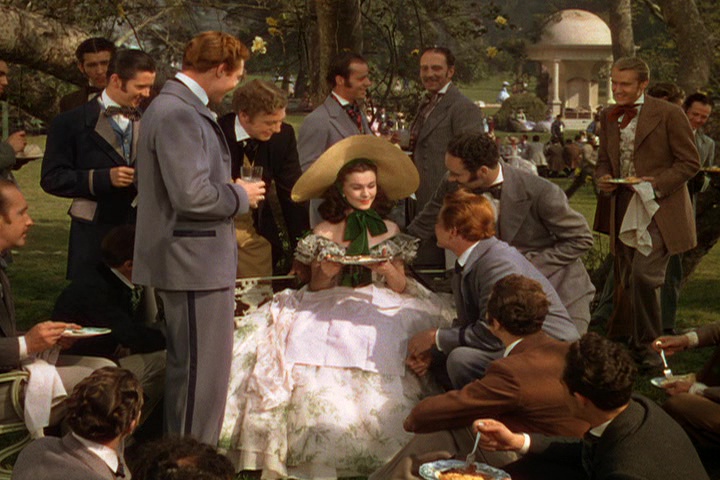
Arriving at Twelve Oakes, Gerald O’Hara is pleased to say, “Well, John Wilkes, it’s a grand day you’ll be havin’ for the barbecue.” It’s momentous because it is the beginning of Scarlett and Rhett Butler’s relationship and the engagement party for Ashley Wilkes and Melanie Hamilton. As a social gathering, the picnic barbecue is a metaphor for Southern arrogance and folly. The Civil War is beginning, and the Confederacy will lose.
Though it importantly departs from the novel by omitting the African American slaves’s picnic barbecue, the Wilkes’ garden party at Twelve Oakes follows Margaret Mitchell’s Gone With the Wind.
In a rare moment, Mitchell, whose handling of slavery is slippery and pro-South, writes that though unseen, the African American slaves (she calls them servants) were united with the Wilkes and company by the pervasive aroma of barbecue. But David O. Selznick, the film’s producer and guiding force, refrains from even noticing this detail.
The screenplay describes the party as a barbecue, “a scene of gaiety and wild charm. The barbecue – a furbelow (showy?) feast – is spread over the lawn. Children run under the trees. Black Mammies tag after them. Gallants and their ladies are eating, drinking, laughing – and Negroes, grinning and shiny-eyed, wander over the grass, holding aloft great trays of food and drink aloft. There is a long table stretching down the center of the lawn at which many guests sit.”
But this is not what we actually see. Instead of a table, Scarlett sits in state on a chair, plate in hand, surrounded by a dozen admirers. Insulated from the “gaiety and wild charm,” we see Ashley Wilkes and Melanie Hamilton standing sedately, smiling at each other. Beyond them, the endless vista of guests strolling in a manicured garden.
See: Margaret Mitchell. Gone With the Wind. New York: Macmillan Company, 1936; Victor Fleming. Gone With the Wind (1939). Screenplay by Sidney Howard based on Margaret Mitchell’s novel (1936).
David O. Selznick was a tough producer. He fired George Cukor and Sam Wood before settling on Victor Fleming. Besides Sidney Howard, writers included Oliver H.P. Garrett, Ben Hecht, Jo Swerling, and John Van Druten.