
Merienda is an al fresco snack or a light lunch that predates piquenique, which was not clearly associated with indoor dining until 1694. Early on in its history, merienda is associated with humor and satire. It’s described in 1554 by the anonymous author of The Life of Lazarillo de Tormes and of His Fortunes and Adversities when Lazarillo and his blind master snack on a bunch of grapes. “Now I want to be generous with you,” says his master, “we’ll share this bunch of grapes, and you can eat as many as I do. We’ll divide it like this: you take one, then I’ll take one. But you have to promise me that you won’t take more than one at a time. I’ll do the same until we finish, and that way there won’t be any cheating.” The humor of the episode is obvious, and, of course, both cheat.
Miguel Cervantes included a merienda in the first book of Don Quixote. Fifty years after Lazarillo snacked on grapes, Cervantes described an episode as a break during which Don Quixote argues the merits of imagination with a pompous and ignorant priest. Quixote, already a bit cracked, joyfully demolished the priest’s arguments while the group waited for a lunch of rabbit pasties and wine to be served on a cloth spread on the grass. For the authoritative 1780 edition of Don Quixote, Antonio Carnicero’s illustration of the merienda is definitely picnicky.
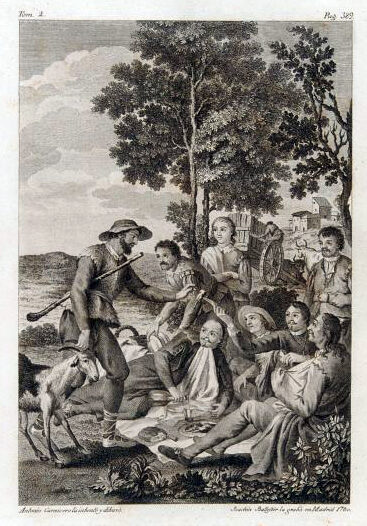
Antonio Carnicero. Don Quixote and friends share their picnic meal with a shepherd (1780), engraving
By 1626, the merienda was an established practice, not as a snack but a regular alfresco dining experience. Francisco de Quevedo’s The Swindler describes such an entertainment as a luncheon in Madrid’s Casa del Campo. Playing the part of the gracious host, Pablos, the Swindler, who expects that his merienda will create the illusion that he is a man of substance. It’s an elaborate spread with servants hired for the occasion to serve hot and cold meats, fruit, and desserts. Just when Pablos is on the verge of success, he is discovered as a fraud.
By the 1770s, la merienda was a suitable subject for still life painting. Luis Egidio Meléndez’s La Merienda [aka Afternoon Meal] 1772 is a still life of picnic fruits suggesting a snack, or intended as a celebration of summer and a bountiful harvest. Overflowing spill grapes, bread, melon, peaches, and pears, beside which is a bottle of wine, a copper jug, and a ceramic bowl. Oddly, the picnickers are missing, though one of them has already taken a slice of melon.
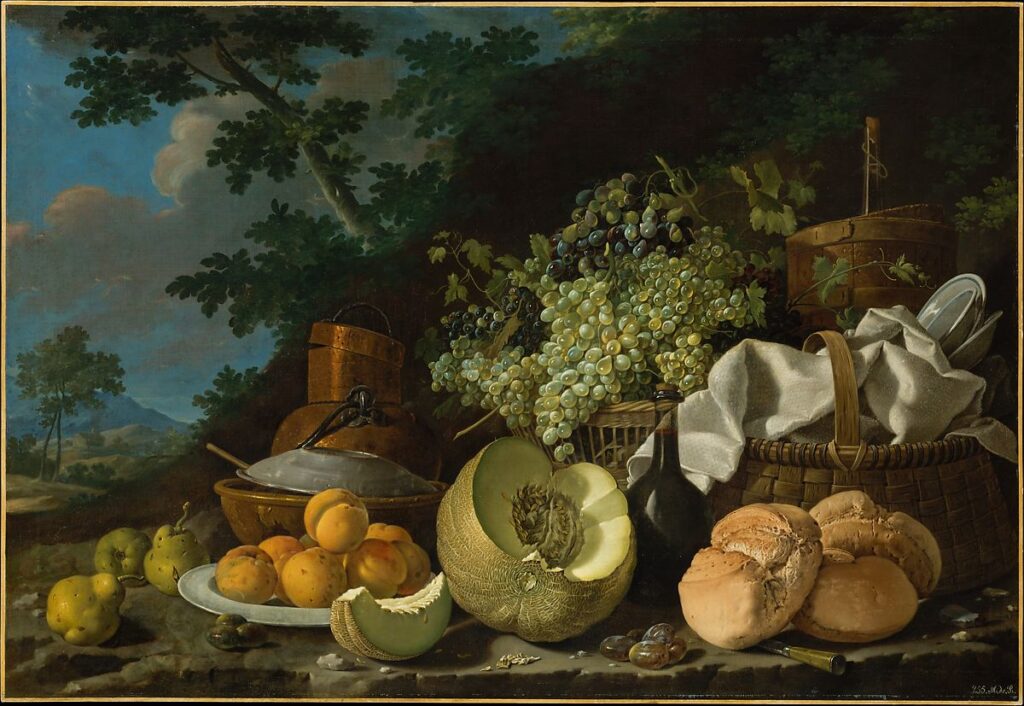
Luis Egidio Meléndez’s La Merienda [aka The Picnic] 1772. Oil on canvas. The Metropolitan Museum of Art
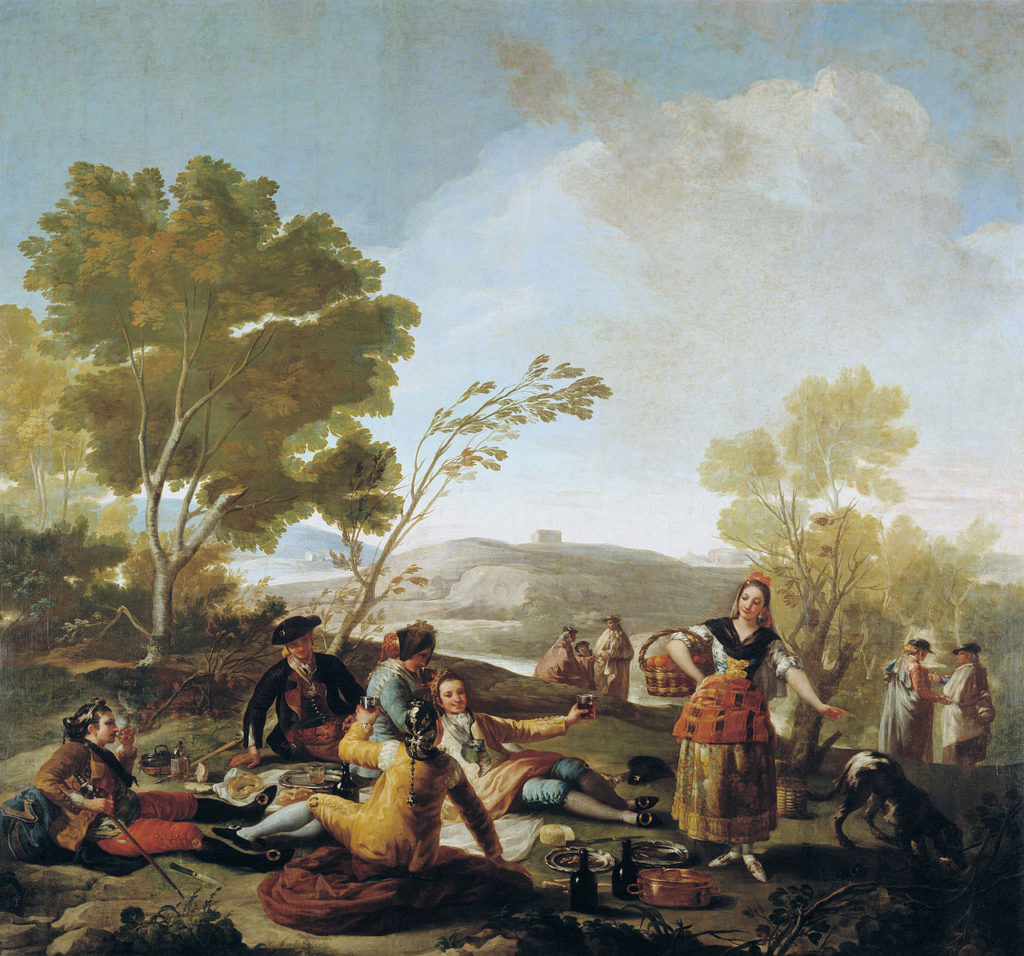
Francesco de Goya. La merienda a orillas del Manzanares, aka The Picnic at the Edge of the Manzanares (1776). Oil on Canvas. Museo del Prado,
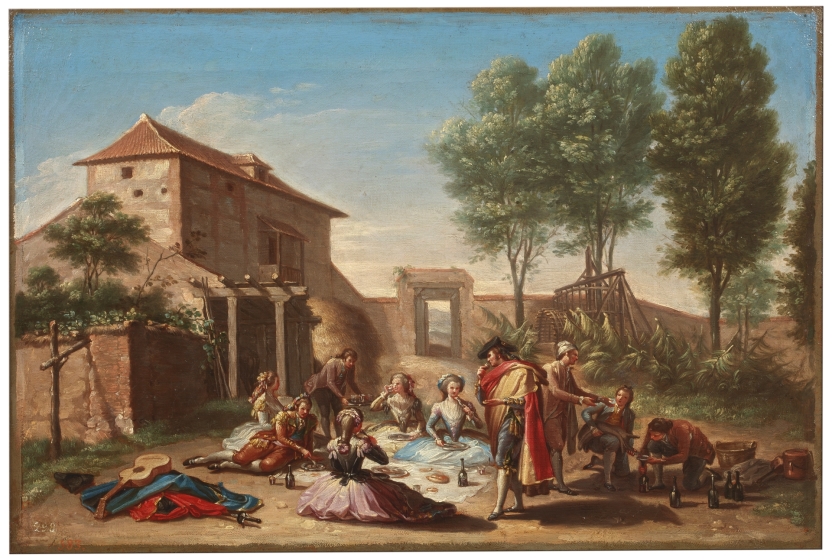
Featured Image: Francisco Bayeu. Merienda en el Campo, aka Picnic in the Country (1786), oil on canvas. Museo del Prado. Bayeu’s merienda is a study of a proposed tapestry destined for the royal palaces of the Spanish monarchy, now exhibited in the Prado’s Salon de Consejos. The picnickers have gathered around a while cloth set on the ground in the yard of a working farm. The aristocrats eat from plates and are attended to by servants, drinking heavily as there is a bottle of wine for each person. The women are eating with forks. A man in a red and yellow cape poses while the others eat. Perhaps he is providing entertainment with a guitar and sword, and other garments for ladies in a heap nearby. Red and yellow are the colors of the Spanish flag adopted during the reign of Charles III, for whom Bayeu was a court painter.