
Elliott’s The Mice and Their Pic appeared in 1809, six years after Harris’s The Happy Courtship, Nic. It is now remembered, if at all, as the second published reference to a picnic in English. However, following the French custom of indoor dining, the mice’s “pic nic” is held in the cupboard of a London townhouse. Elliott’s readers were expected to recognize that this fable is an adaptation of Aesop’s fable “City Mouse and the Country Mouse.” The link to Horace’s satire “Mus Urbanus et Mus Rusticus” is important because Elliott suggests a comparison of contemporary London to the decadence of Rome.
Elliott was probably advised by her experienced publisher, William Darton, to use a “picnic” as a preachy fable showing how gluttony is sinful and has grievous consequences. Darton’s model was the London Pic Nic Society, a scandalous gossip item during 1802/3. [See discussions of the Pic Nic Society, The Happy Courtship, and James Gillray posted elsewhere on PicnicWit.com]
Presuming that most of her readers, children and adults, would be unfamiliar with a “pic nic” dinner, Elliott covers this gap with a definition:
What was meant by a Pic Nic, they could but wonder,
Yet ventur’d no question for fear of a blunder;
When they did understand, how they open’d their eyes.
For the guests to bring food was indeed a surprise,
“Well, surely,” thought some, oar [our] old country ways
Are more gen’rous by far, for with us the host pays
While here, those invited subscribe to the treat,
And visit their neighbour to eat their own meat!
Elliott does not follow her own definition. The Country Mice arrive empty-handed, expecting to be hosted by the London Mice, who have promised an epicurean Christmas dinner. Used to corn kernels, the Country Mice are feted with
cold soups, sweetmeats, and fricassee chicken, cold bacon, pickles, whipped cream, plum-cake, cheesecake, custards, and Cheshire cheese. There is some resistance to the new foods, but when they join in the feast, they seal their fate. For though you might enjoy such a meal, Elliott means it to be gluttonous, and so sinful that it must end badly—and abruptly:
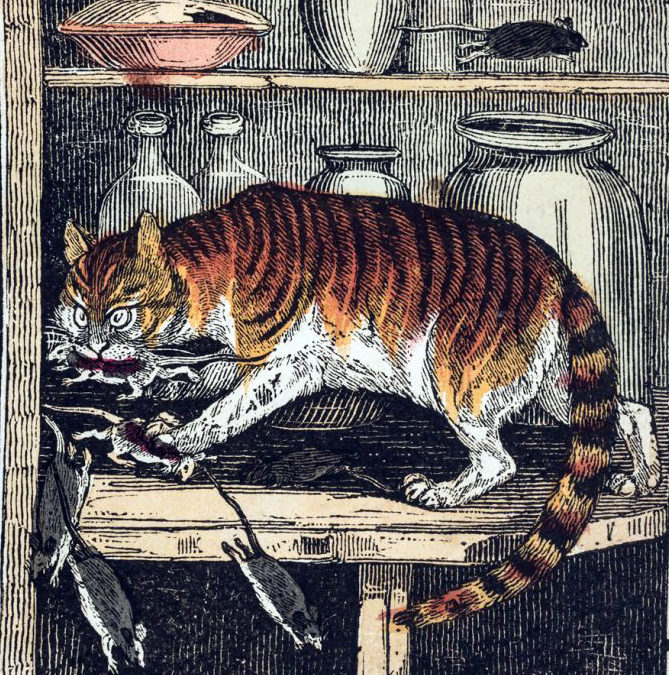
When sudden the cupboard door wide open flew,
And in rush’d a fierce-looking, large tabby cat,
Who advance’d, with huge strides . . .
In the chaos, all that is heard are the shrieks, groans, and crunching of bones.
The few Country Mice who manage to return (all of them scared) are admonished for being seduced by the promise of luxury at a “pic nic” dinner in a London townhouse. Old
Wheatears [the sage of the mice in the barnyard ]delivers a stern sermon:
I’m assur’d as for man, so for mice, there’s a station.
That seldom is chang’d but for mortification.
And if we but look round the world, we shall see,
No species, from evils entirely free,
For happiness not to the rich is confin’d,
But chiefly depends on the worth of the mind.”
Elliott’s tale failed to persuade readers that a “pic nic dinner” was grievously sinful.
At the start, twenty mice depart from their Devonshire barn for London. Ten arrive safely in London, but only four survive the attack in the pantry.
Featured Image: The kitchen tabby makes a picnic. (1813 edition)
See Mary Belson Elliott. The Mice, and Their Pic Nic. A Good Moral Tale, &C. By a Looking-Glass Maker (1809). Unacknowledged in the first edition, Elliott went on to a long, successful career using her married name.