
Unlike real-life children who are often persnickety about what is offered, fictional children at picnics take what is offered. That’s because most juvenile stories associate fun with baskets full of sweets, carbs, and fats. Presumably, well-behaved children require comfort food.
Food at the first children’s picnic stories, The Happy Courtship, Merry Marriage, and Pic-nic Dinner of Cock Robin and Jenny Wren, and The Mice and their Pic Nic is a peculiar mishmash.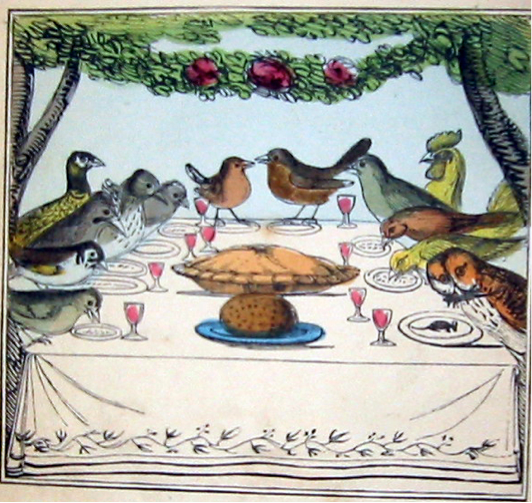
John Harris’s food for the 1806 fable The Happy Courtship is based on what he presumed animals would bring to a “pic nic dinner.” Raven brings walnuts; Dog brings a meaty bone; Owl brings wheat; Pigeon brings tares (greens; Squirrel predictably brings nuts; and Magpie brings cheese. Only Little Mary, a girl (who never appears again), brings cheese, apples, bacon, and plums. In contrast to Mary Belson Elliot’s anthropocentric moral fable, The Mice and Their Picnic, the London Mice are satirized as being effete snobs. Their epicurean city dinner is outlandish and a surprise to their humble country cousins, who usually eat kernels and acorns on a barn floor. Faced with cold soup, sweetmeats, fricassee chicken, cold bacon, pickles, whipped cream, plum-cake, cheesecake, custards, and Cheshire cheese, there is an awkward moment as the Country Mice dig in.
Almost seventy years after The Happy Courtship, there is a shift as comfort foods begin to dominate the picnic wicker. Stella Austin’s popular but long-forgotten 1873 Stumps is basically a comfort food picnic fueled with apple tarts, plum cake, shortbread, mulberry tart, sponge cake, bread and butter, hard-boiled eggs, plums, pears, greengage plums, macaroons, and Stumps’s favorite is “trawberry jam.” Three years later, Mark Twain’s food choice in The Adventures of Tom Sawyer is a piece of wedding cake that Tom Sawyer carries in his pocket when he and Becky Thatcher leave their rollicking picnic and get lost in McDougal’s Cave. In 1908, Kenneth Grahame’s The Wind in the Willows, Rat’s wicker is so crammed full of stuff that Water Rat can scarcely carry it to his boat. We laugh at Rat’s “coldtonguecoldhamcoldbeefpickledgherkinssaladfrenchrollscressandwidgespottedmeatgingerbeerlemonsodawater” –but it’s enough to feed Ratty’s friends, and probably of the voracious weasels, too. Rat’s second skimpier picnic in “Wayfarers All” (and usually forgotten) is more adult and includes a loaf of French bread, sausage, and wine. A.A. Milne’s Winnie the Pooh likes honey and little cakes with pink icing, and Frances Burnet Hodgson’s picnic menu for her 1911 The Secret Garden is a crusty cottage loaf, currant buns, roast eggs, and potatoes garnished with butter and salt. Notably, before they pass out on a sandbar in the English Channel, the Potts’s family in Ian Fleming’s Chitty Chitty Bang Bang devours a basket of “hard-boiled eggs, cold sausages, bread-and-butter sandwiches, jam puffs and bottles of the best fizzy lemonade and orange soda.“
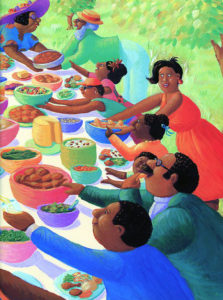
Diane Greenseid. “Then Mr. Pete came running—” In Jacqueline Woodson. We Had a Picnic This Sunday Past (1997)
Though the comfort food pattern ebbs and flows, it changes much. Jacqueline Woodson’s We Had a Picnic This Sunday Past is a joyous family gathering with lots to eat: biscuits, fried chicken, sweet corn, cinnamon bread, cranberry muffins, sweet potato pie, peach cobbler, yams, potato salad, a baked ham, cornbread, homemade ice cream, and cousin Martha’s store-bought cake. Margaret Gordon’s Wilberforce Goes on a Picnic describes a family of obese bears who pass out from overeating. The bears’s blue gingham picnic blanket is chockablock with hamburgers on rolls, sandwiches, a jar of catsup, a bowl heaped with mashed potatoes, bananas, yellow fruit (of some kind), a pie (contents unknown), a cake (perhaps cheesecake covered with nuts), and a plate of tarts with some pink filling (maybe strawberries). Upon awakening, the bears ride home to a scrumptious dinner.
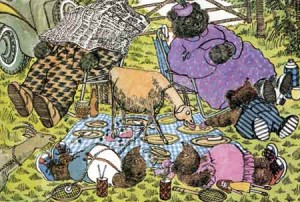
And-they-ate-until-they-were-full,” Margaret Gordon. Wilberforce Goes on a Picnic (1982).
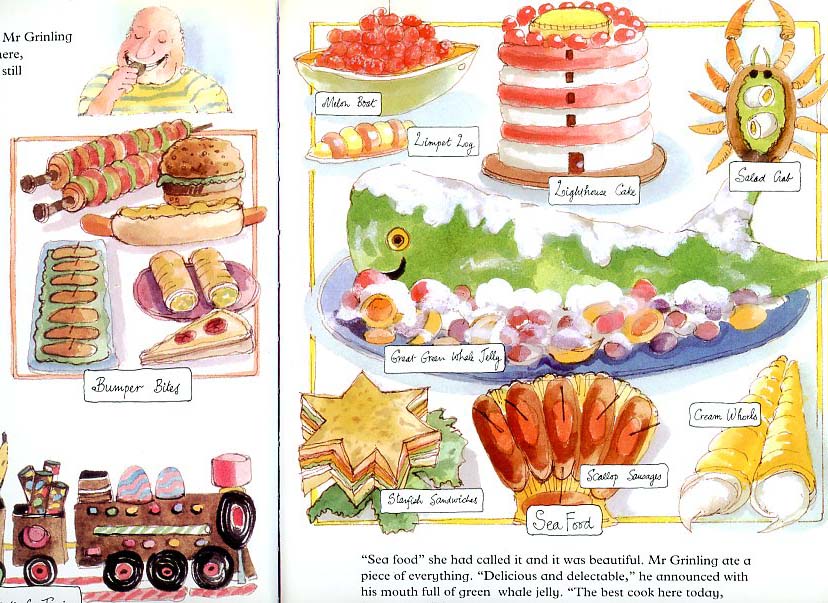
Armitage and David Armitage’s The Lighthouse Keeper’s Picnic suggests that Mr. Grinling, the lighthouse keeper, must lose weight But indelible Image taken away from this Grinling’s is the book’s centerfold, two pages of hamburgers, hot dogs, beef or lamb kebabs, pizza, scallop sausages, crab salad, sandwiches, melon, layer cake, cream whorls, green jelly, melon, grapes, bananas, pears, apples, peaches, cupcakes, Danish pastry, cherry tart, chocolate éclair, ice cream with whipped cream “Delicious and delectable,” the ecstatic Mr. Grinling murmurs when he can take a breath.
Children’s cookbooks rely on standard comfort foods. Some authors do offer sound advice about eating for good health and taste, But in the language of comfort food, if it ain’t sweet, it ain’t upbeat, cheery, and satisfying Typically, a menu will suggest pink lemonade with strawberries, cheese rolls, apple and bacon sandwiches, and cherry tomatoes with clover-honey dressing, ambrosia fruit salad, caramel-nut popcorn, candy, and cookies Winnie-the-Pooh’s Teatime Cookbook, Inspired by A. A. Milne is a powerful unrivaled collection of comfort foods without constraints: Breads and Toasts, Scones, Muffins, and Crumpets, Jams and Butters, Sandwiches, Cookies and Biscuits, and Cakes and Pastries.
A hunt is required to find alternative menu suggestions. The foods in Brunhoff’s Babar’s Picnic are vegetarian. Babar, Celeste, their children, cousin Arthur, and their friend the Old Lady dine on smallish portions of bananas, pears, apples, grapes, and sandwiches (contents unknown). Olive Oyl has perversely prepared two picnic baskets packed with salami, fresh rye bread, pickles, root beer, and lemonade. The meal is graciously declined by Popeye, an unlikely gourmet, who demurs, “No, thanks, Olive, I’d rather have spinach.”
Featured Image: Ronda Armitage and David Armitage. The Lighthouse Keeper’s Picnic (1993)
See: Margaret Gordon. Wilberforce Goes on a Picnic (1982); Jacqueline Woodson’s We Had a Picnic Sunday Past. Illustrations by Diane Greenseid (1997)
: