
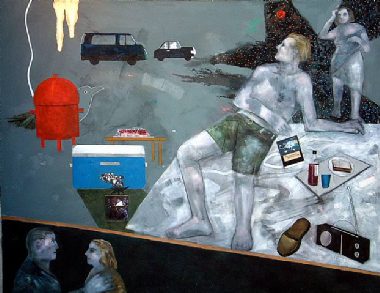
James G. Davis’s Prometheus Bound, Prometheus Unbound, is a picnic enigma based on the Greek myth of Prometheus. The best-known versions of which are Hesiod’s Theogony (700 BCE) and Aeschylus’s Prometheus Bound, Prometheus Unbound, and Prometheus Fire-Bringer (415 c. BCE).
None of the Prometheus variations is picnicky. Prometheus angered Zeus by tricking him into choosing fat wrapped around skin and bones rather than a human body at a sacrifice. Prometheus also had a secret that his mother, Gaia, told him that might lead to Zeus’ downfall, which he would not reveal. For these reasons, Prometheus’s eternal punishment was to be chained to a mountain where he would be tortured by an eagle or vulture that would eat his liver during the day, and then he would recover by night.
Davis, however, unexpectedly, depicts Prometheus enjoying a picnic. He’s dressed in a bathing suit, reclining on a white picnic blanket. The bird that torments him, which looks unlike an eagle, is half-concealed behind a red barbecue smoker, an allusion to the ritual sacrifice when Prometheus tricked Zeus.
The blanket has the usual picnic paraphernalia: a book, a tray with wine, a sandwich, and a portable radio. Behind Prometheus is a woman, maybe Pandora, the bringer of woe and evil, created to counteract Prometheus’s beneficence to humanity.
In a panel below the blanket, a man, Prometheus, and a woman, Thetis, are conversing about the possibility that a child of theirs will be a parricide.
Above Prometheus are two parked cars. Prometheus looks in their direction as if expecting someone who will allow him to end his picnic, but no one is in sight. In this sense, he is still bound.
See James G. Davis. Prometheus Bound, Prometheus Unbound (2006)