
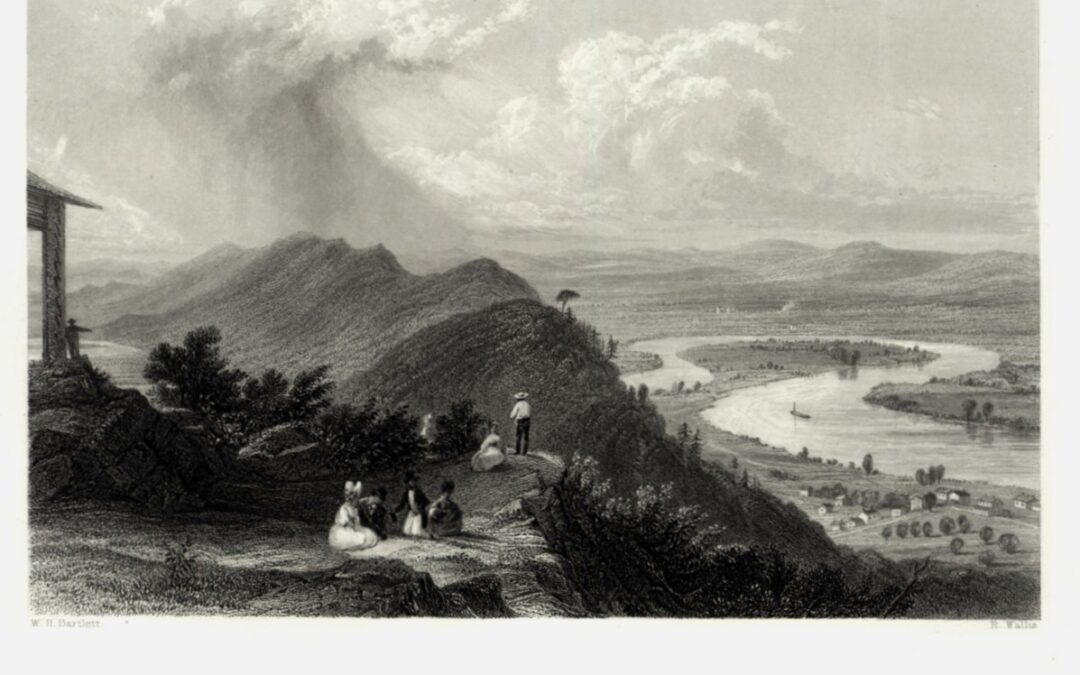
For the illustrated American Scenery, Bartlett’s View from Mount Holyoke was accompanied by a text by Nathaniel P. Willis. The view is a topographical landscape, and Willis asserted that this was “Probably the richest view in America, in point of cultivation and fertile beauty.”
It’s unknown whether or not Bartlett and Willis knew that Thomas Cole had painted the Oxbow from Mount Holyoke in 1836. Exercising his artistic license and discontented with topographical fidelity, Cole’s subject is the clash of the wild and cultivated appearances characteristic of the American landscape. Discontented with topographical fidelity, Cole invented his version of the scene as romantic turmoil and stress. Cole charged the scene with significance by painting himself in the middle distance (look for the umbrella), perched on a promontory, painting the Oxbow. His order of preference is wild, then rural. The vistors’s shed and the grassy picnic knoll are omitted.
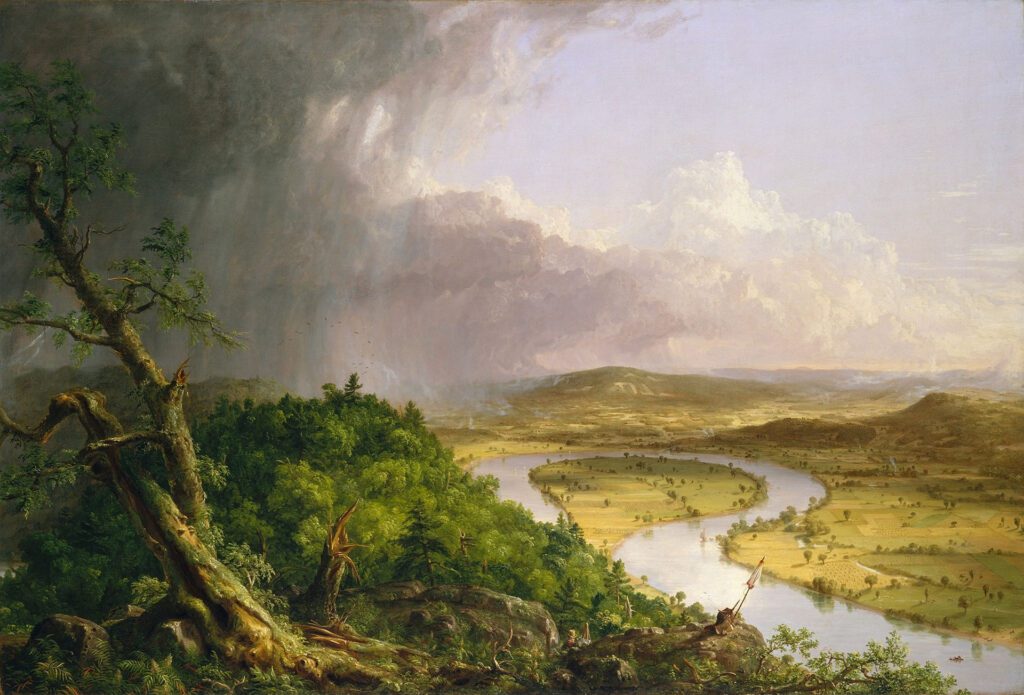
Bartlett’s intent for American Scenery, however, required an emphasis on the scene’s placid, picturesque qualities. What is easily surmised is the easy access to the summit, the grassy plateau, and the shelter for shade and protection against rain—a nice place for a picnic.
Victor de Grailly, a French artist who never visited the United States, painted a version of Bartlett’s engraving around 1845. He kept the essential details but added food and drink to the picnic.
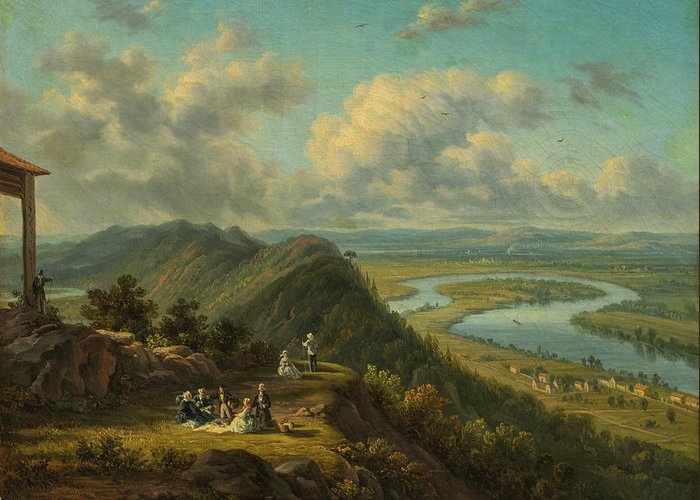
See Nathaniel P. Willis. American Scenery: or Land, Lake, and River Illustrations of Transatlantic Nature (1839-1840; Thomas Cole. View from Mount Holyoke, Northampton, Massachusetts, after a Thunderstorm– The Oxbow (1836). Metropolitan Museum of Art; Victor de Grailly. The Oxbow Seen from Mount Holyoke (1840c.). Cleveland Museum of Art
Featured Image: William Henry Bartlett. View from Mount Holyoke (1939)