
Virgil’s details of the Trojans’ first meal in Latium, translated by Dryden among others, are that they dined at a “table on the turf,” which suggests a picnic. But Virgil surely did not want this to be a pleasant gathering, but more likely a bivouac, or temporary camp, of soldiers at lunch.
Beneath a shady tree, the hero spread
His table on the turf, with cakes of bread;
And, with his chiefs, on forest fruits he fed
They sate; and, (not without the god’s command,)
Their homely fare dispatch’d, the hungry band
Invade their trenchers next, and soon devou
To mend the scanty meal, their cakes of flour. (Aeneid, VII)
By Wenceslaus Hollar’s reckoning, the visual scene of the Trojans’ first meal in Latium is obviously a picnic. Hollar illustrates the key moment in Virgil’s Aeneid when Aeneas realized that he had reached the land in which he would build a new city, in which Trojans would prosper in the future. The chosen moment is when Aeneas and his crew bivouac in a forest clearing in Latium and dine on skimpy provisions. But when Aeneas’ son Ascanius says, “See, we devour the plates (large slices of bread made from wheat) which we fed,” Aeneas realizes that a prophecy is being fulfilled, and Aeneas knows that this is where he will build a city worthy of his Trojan ancestry; what remains is to conquer Latium, which was no picnic.
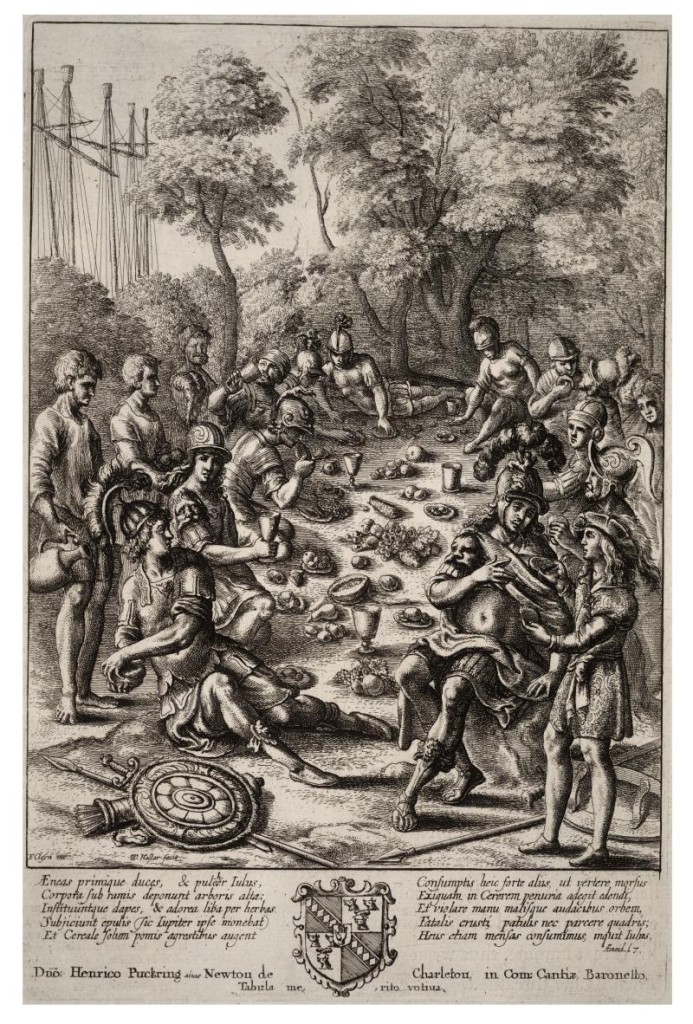
Wenceslaus Hollar and Francis Cleyn.”The Trojans’ First Meal in Latium,” in John Ogilvy, Virgil’s Works [The Works of Publius Virgilius Maro, Translated by John Ogilvy] (1654)
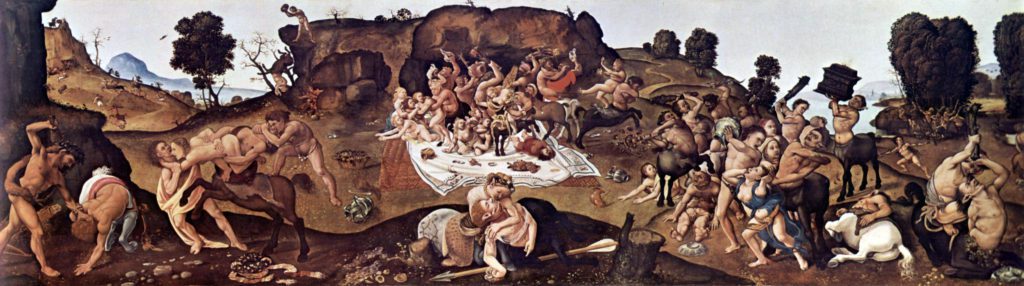
Piero di Cosimo [aka Piero di Lorenzo]. The Fight Between the Lapiths and Centaurs (1500/15c.), oil on wood. National Gallery, London
Now brave Perithous, bold Ixion’s son
The love of fair Hippodame had won.
The cloud-begotten race, half men, half beast,
Invited, came to grace the nuptial feast:
In a cool cave’s recess the treat was made,
Whose entrance, trees with spreading boughs o’er-shade
They sate. . . (XII, 210ff
It’s uncertain if Piero’s shift from cave to open space was meant to suggest what Italians familiarly name a merienda or scampagnata to defy expectations. You expect that a picnic is happy, particularly for a wedding feast, but the contrast between the picnic cloth and brutal visual imagery is intentionally dramatic. Especially dramatic are the Centaurs in the foreground, Hylonome kissing her lover Cyllarus, mortally wounded by a spear, amid bloody chaos.
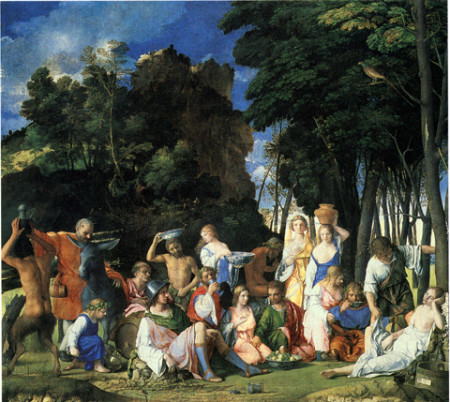
Giovanni Bellini. The Feast of the Gods (1514/1529), oil on canvas. National Gallery of Art, Washington, D.C., Dosso Dossi (1516) and Titian (1529) added symbolic details identifying the guests.
Bellini borrowed freely from Ovid and perhaps Giovanni di Bonsignore’s contemporary illustrated translation of Metamorphosis [Ovidio Metamorphoses Volgare (1497). Among Bonsignore’s woodcuts are crude and emphasize debauchery. Unidentified guests are left, particularly a man lifting a woman’s dress to reveal her pubic hair. In the center, Selinus’ donkey, tethered to a tree, has already brayed and stands contrite. Lotis, however, is in full flight, chased by Priapis, who has an obvious erection under his jerkin.
Though Ovid calls the party a convocat, it is usually translated as a feast or a banquet. Bellini calls it a feast, festin, but presents it as merenda, used by Italians as a euphemism for a picnic, suggesting a light afternoon meal or snack in an alfresco setting, but here a bacchanal, drinking party. Ovid doesn’t mention food, but Bellini provides serving plums, peaches, grapes, and quince, all of which have discreet symbolic sexual connotations rather than showing the real thing. What we see is relatively desexualized; Priapus’s erection is hidden, though nymph Lotis’ breasts are exposed. In the front row, the prominent guests of honor sit comfortably, dressed in rustic garb suitable to the informality of a picnic in the woods. Bellini’s original version left the identities of the gods ambiguous, and subsequent revisions by other artists, Dosso Dossi and Titian, significantly added details identifying each guest.)
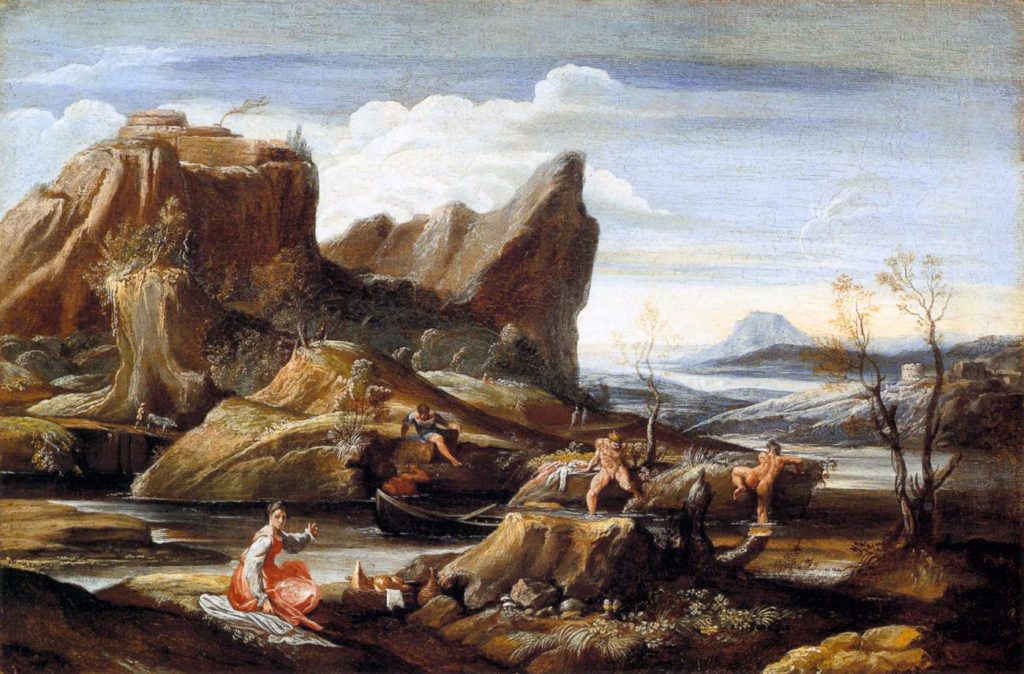 Agostino Carracci. Landscape with Bathers (1616), oil on canvas. Palazzo Pitti, Florence
Though it is unmistakably a merienda at the beach, the title given for this painting in the Pitti Palace is Landscape with Bathers. Though the seashore is a tumultuous blend of barren, jutting rocks, the scene focuses on the serene woman dressed in red, sitting on a white picnic cloth beside a basket of food and flasks of wine. Facing the viewer, the woman in red raises her left hand to wave, suggesting a welcome, perhaps to share the picnic. The woman’s identity is unknown, and her presence among the men (none of whom pays her the slightest attention) is an enigma. Perhaps Carracci is signifying some cryptic sexual connotation.
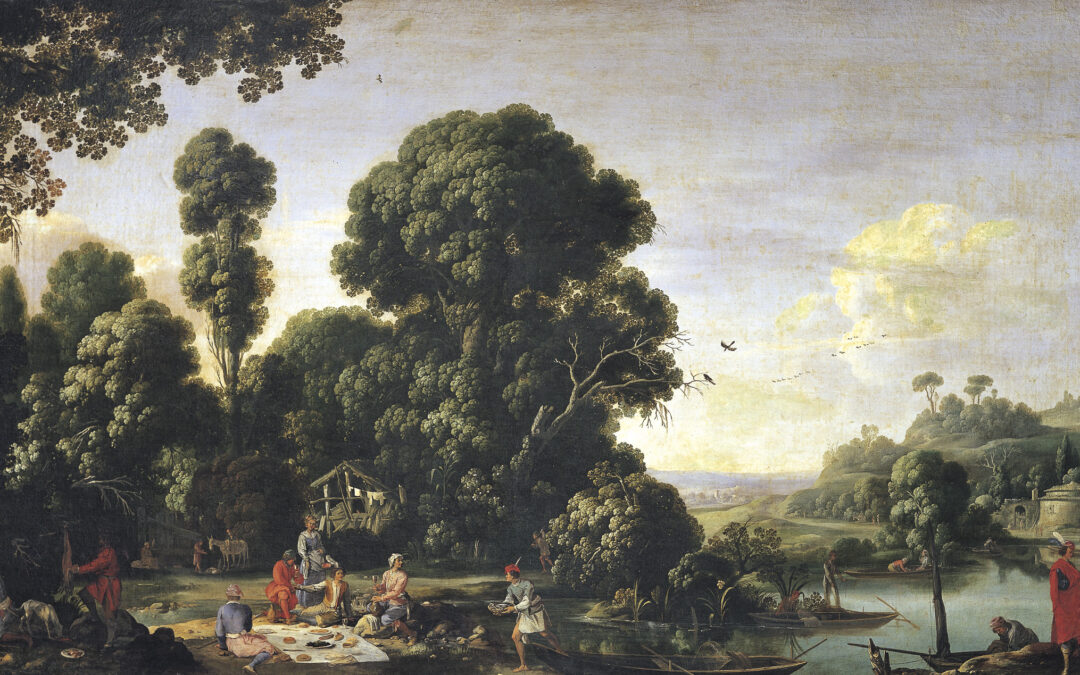
Featured Image: Filippo Napoletano’s Picnic on the Grass (1619), oil on canvas, Uffizi Gallery, Florence. Napoletano’s Merenda sull’erba is a landscape with Florentines enjoying an informal outdoor lunch by a lake. Merenda is Italian for picnic, which was not coined until 1649 in Paris. The picnickers have spread a cloth in the shade. To the left, a cook works at a fire; to the left, a servant brings fish from the river.