
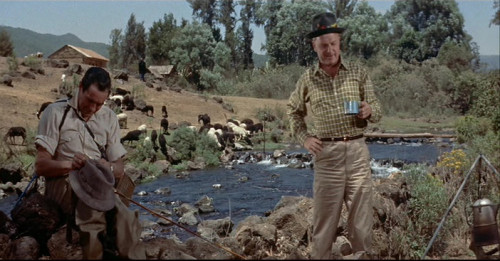
Henry King’s dramatization of Hemingway’s trout fishing on the Irati River is not a picnic but a break for lunch that looks like a picnic. It’s a setup for Bill Gorton to reveal Jake Barnes’s unhappiness with his lover Brett Ashley.*
The setting along the river shoreline is picnicky. Gorton leans over a coffee pot hanging over an open fire. Barnes sits fiddling with a trout fly. The men are bantering good-naturedly until the small talk gets personal, and Jake turns sullen. It goes like this: Say, asks Bill, who was that woman in Paris? Jake answers that it was Gertrude Stein who said that Americans there were a lost generation. Bill accepts that, but when he asks, “What about this Brett [Ashley] business?” Jake scowls. When Bill pushes, Jake answers that his on-again-off-again love affair is over. “I don’t give a damn anymore,” he snaps.
Conversation breaks off. Jake walks into the river. Bill shrugs, knowing otherwise.
*The Motion Picture Production Code (aka the Hays Code) censored films by enforcing moral guidelines, forcing King and screenwriter Peter Viertel to omit Hemingway’s discussion of Jake Barnes’ lost Catholicism and his sacrilegious banter with Bill Gorton. (Discussion of Hemingway’s episode is available in PicnicWit.com)
Featured Image: Tyrone Power as Jake Barnes and Eddie Albert as Bill Gorton
See: Henry King. The Sun Also Rises (1957). The screenplay by Pieter Viertel is based on Ernest Hemingway’s 1926 novel; Carlos Baker. Hemingway: The Writer as Artist. Princeton: Princeton University Press, 1972; Peter Viertel. Dangerous Friends (1992)