
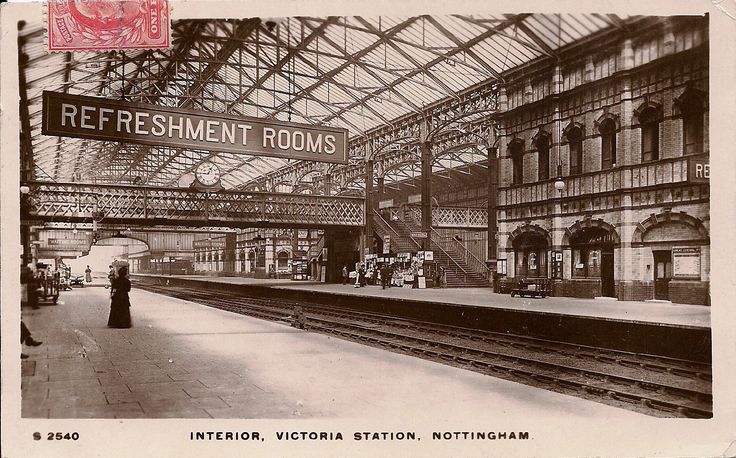
Dickens vented his distaste for English travel food, especially sandwiches served in cold, comfortless train stations. The Boy at Mugby Station working in h Refreshment Room gleefully tells anyone who will listen (or not) how awful the refreshments (if they can be called refreshments are: “You don’t know what I mean? What a pity! But I think you do. I think you must. Look here. I am the boy at what is called The Refreshment Room at Mugby Junction, and what’s proudest boast is, that it never yet refreshed a mortal being.”
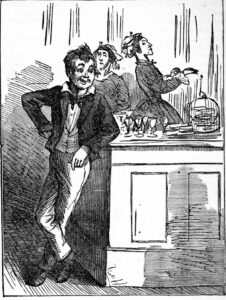
Sol Eytinge, Jr. “The Boy at Mugby” (1867)
The Boy is particularly scathing about the “universal French Refreshment sangwich,” the subject of “Our Missis,” the proprietress of a Railroad Refreshment shop, who has gone to France to see what food is sold to travellers there. Her Francophobia is an inadvertent admission of English bad taste. “Well,” says Our Missis, “Take a fresh, crisp, long, crusty, penny loaf made of the whitest and best flour. Cut it longwise through the middle. Insert a fair and nicely fitting slice of ham. Tie a smart piece of ribbon round the middle of the whole to bind it together. Add at one end a neat wrapper of clean white paper by which to hold it. And the universal French Refreshment sangwich busts on your disgusted vision.”
Featured Image: Victoria Station Refreshment Room
See Charles Dickens. “The Boy at Mugby Junction,” in Christmas Stories from Household Words and All the Year (1866); Richard Doyle’s A Raylway Statyon. Showynge ye Travellers Refreshynge Themselves (1849). Originally published in Punch.; and M.F.K. Fisher’s “Railroad Sandwich