
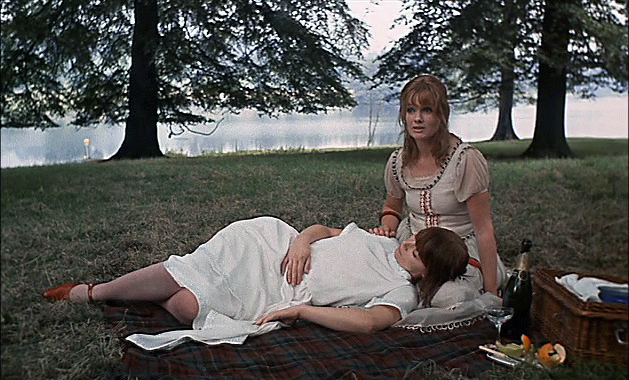
D.H. Lawrence’s euphemism for a picnic, a water party, is an event hosted by the Crich family, owners of the local coal mine. Theirs is a substantial estate with a large lake to support a small steamer.
Ursula and Gudrun Branwagen leave the hubbub and row to an island where they share a moment of idyllic perfection. Ursula begins to sing in a high thin voice, and Gudrun begins to dance: “Ursula sat on the grass, her mouth open in her singing, her eyes laughing as if she thought it was a great joke, but a yellow light flashing up in them, as she caught some of the unconscious ritualistic suggestion of the complex shuddering and waving and drifting of her sister’s white form, that was clutched in pure, mindless, tossing rhythm, and a will set powerful in a kind of hypnotic influence.” When the sisters have attracted a herd of Highland cattle, Gudrun dances for the staring herd like a Cretan maiden dancing with the bulls.
The picnicky intensity is cut off when Gerald and Rupert appear. Restored to a more ordinary picnicky attitude, the women and men pair off, and as the intimacy of each couple intensifies (though there is no overt sexuality), disaster strikes. Gerald’s sister, Diana, has fallen off the paddle steamer, and a young doctor has jumped in to save her. In the darkness, neither is visible, and a panicked search begins. The magical light now seems garish. Gerald, repeatedly diving into the cold, dark water, calls for the lanterns, but to no avail.
When the lake is drained, the bodies are found locked in a grotesque, loving embrace: Diana choking the doctor. This image of death foreshadows what is to come to the couples. Rupert and Ursula, who are empathic, console one another; Gudrun leaves without Gerald, scheming about how she should appear when he comes to her.
Featured Image: Glenda Jackson as Ursula and Jenny Linden as Gudrun relax in Kurt Russell’s Women in Love.
See D.H. Lawrence. Women in Love. (1920); Ken Russell. Women in Love (1982). The screenplay by Larry Kramer is based on D.H. Lawrence’s 1920 novel; Joyce Carol Oates. “Lawrence’s Götterdämmerung: The Apocalyptic Vision of Women in Love.”Critical Inquiry, Spring (1978)