
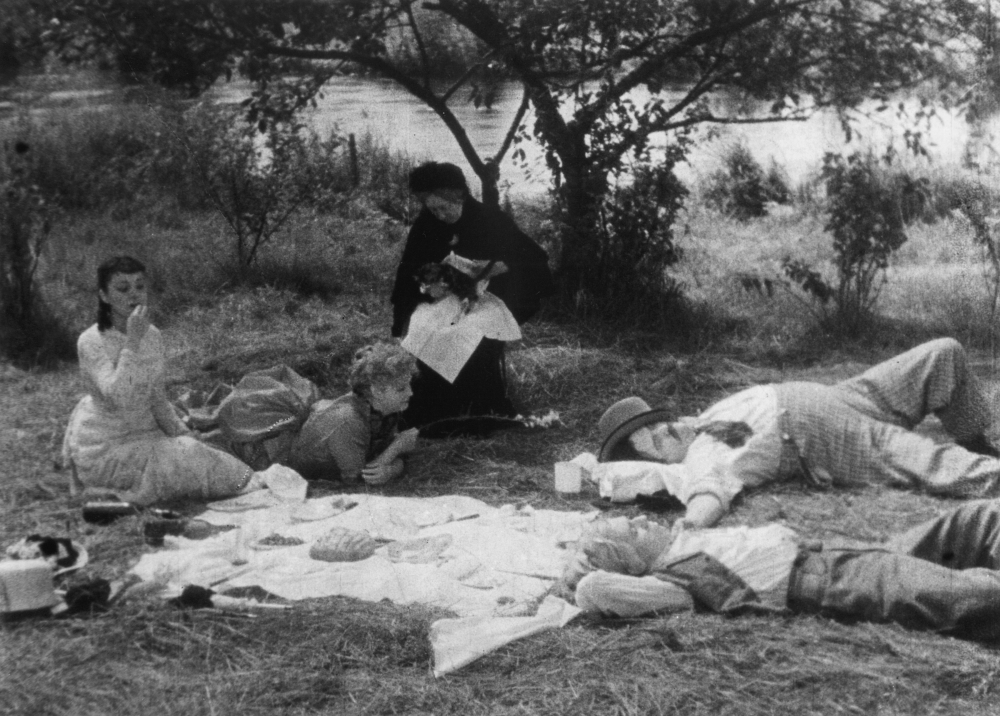
Partie de Campagne is Jean Renoir’s close adaptation of Maupassant’s story. The title is translated as “A Trip to the Country,” “The Excursion,” or “The Country Excursion,” but usually not as a picnic. This is because the French have long preferred partie de campagne to signify an outside party.
The narrative concerns the sad romantic consequences of a family picnic. Renoir’s picnic menu is Maupassant’s: fried fish, stewed rabbit [fricassee], salad, beer, claret, and coffee. Considering the meal has intense flavors of fried fish and stew, Renoir substitutes white wine for the claret.
Sated and a little drunk, Cyprian Dufour and his daughter Henriette’s fiancé fall into a stupor. But the women, Madame Dufour and the daughter, Henriette, remain alert. Slyly, they welcome the attention of two young men and accept their invitation for a Seine boat ride. Madame Dufour pairs off with Anatole, while Henriette sits with Henri. Right off, the mother is willing to be seduced. It’s her birthday, and she celebrates by making love to her boater. Henriette modestly allows Henri’s advances, and in one magical moment, they kiss. But embarrassed, they separate, and she returns to her family.
Renoir’s sensibility keeps the magic of Henriette and Henri’s lost moment of love from becoming cloying.
One year passes. Henriette is unhappily married when she and her husband return for another picnic. This time, she is distracted by her memory of an amorous adventure the year before and appalled by her husband’s vulgar eating and drinking. So while he sleeps on the grass, she wanders, and as if in a dream, she accidentally meets Henri, who is looking for her. “I often come here; it brings back my happiest memories,” he ruefully confides.
Just when something is about to happen, Henriette’s husband awakens and calls for her. Aware of their lost opportunity, they part forever.
Renoir insists that Partie de campagne, eventually released in 1946, is incomplete because he was not personally involved with the editing in 1946 or its release because he did not own the film. Renoir appears in the role of Monsieur Poulain and his companion, Marguerite, as the waitress. Their romance is portrayed in Gilles Bourdos’s Renoir (2012).
See: Jean Renoir. A Day in the Country [Partie de campagne] (1936/46). Screenplay by Jean Renoir is based on Guy De Maupassant’s “A Day in the Country, aka “Une Partie de campagne”]; Guy De Maupassant. “Une partie de campagne” (1881) Guy de Maupassant, Original Short Stories, Translated By Albert M. C. McMaster, A. E. Henderson and Others; André Bazin. Jean Renoir edited and translated by W.W. Halsey II. New York: (1973); Raymond Durgnat. Jean Renoir (1974); The Road to A Day in the Country, a documentary of outtakes for the film 1936 https://www.youtube.com/watch?v=oaRajFYJT2E interview with Christopher Faulkner (2105)