
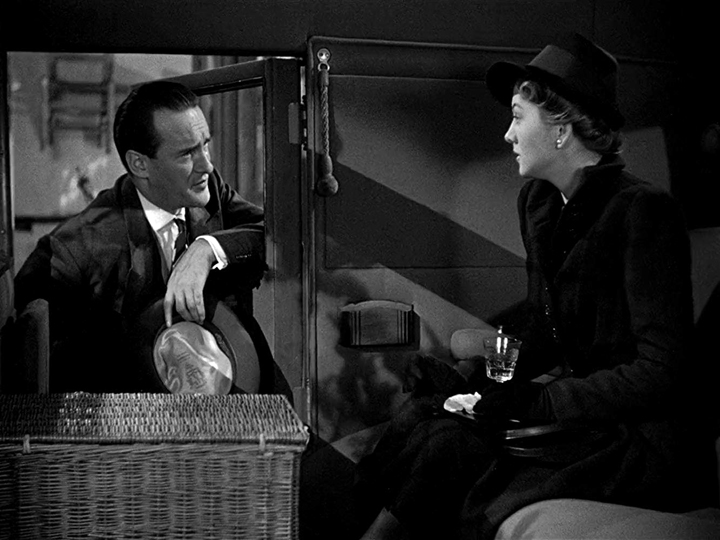
Hitchcock added a picnic to the screenplay of Rebecca to reveal Jack Flavell’s intention to blackmail Max De Winter for the murder of his deceased wife, Rebecca. Flavell’s disquieting revelation occurs on the day of the inquest regarding Rebecca’s death in de Winter’s Rolls.
Because current Mrs. De Winter has not eaten breakfast and is tired, Max orders a basket of food from Manderley delivered to the courthouse. As they eat in their Rolls Royce, Flavell joins them uninvited.
Though the Rolls is roomy, Hitchcock’s scene seems uncomfortably crowded. “Lunch, I say,” says the caddish Flavell, “what a jolly idea rather like a picnic. Isn’t it?” Then, helping himself to a roast chicken leg,* he inquires, “By the way, what do you do with old bones?” Without waiting, he throws him out of the window. Flavell’s innuendo confirms his knowledge that Max is culpable for Rebecca’s death.
“You know, Max, old boy,” Flavell says in his oily tone of voice, “I really think I ought to talk things over with you.” “Talk what things over ?” de Winter responds. “Well, those holes in the planking [of the sailboat], for one thing. Those holes were drilled from the inside.”
*Roast chicken is used as a sex prop in Hitchcock’s To Catch a Thief.
Featured Image: Joan Fontaine as Mrs. de Winter; Laurence Olivier as Maxim de Winter; George Sanders as Jack Flavel
See Alfred Hitchcock. Rebecca (1940). Screenplay by Robert E. Sherwood, Joan Harrison, Philip MacDonald, and Michael Hogan is based on du Maurier’s novel (1938). Daphne du Maurier. Rebecca. London: Victor Gollancz, 1938. Streaming at Uoutube.