
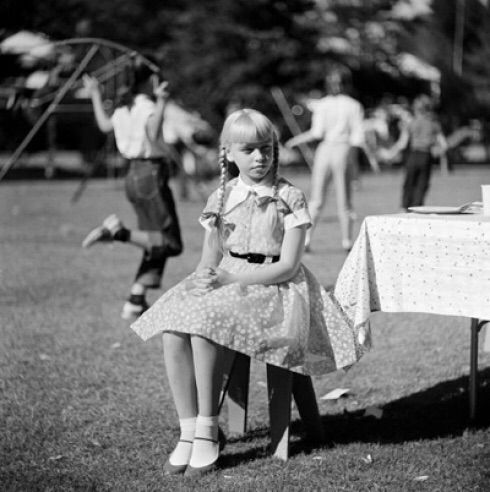
Rhoda Penmark is a successful serial killer whose career begins at a school picnic.
She looks innocent, a darling little girl with blond pigtails and blue eyes. But Rhoda’s interior is ruthless and murderous.
Wanting the penmanship medal for herself (March’s pun intended), Rhoda follows her classmate Claude around, trying to snatch it. When that fails, she lures Claude to a pier on the Little Lost River (another pun). When his bruised body is found, it is assumed these are accidental. But when the medal is not found, suspicion falls on Rhoda. Lacking anything but circumstantial evidence, Rhoda’s mother Christine suggests, “So many things could have happened quite innocently.”
Later, when Mrs. March discovers the medal in Rhoda’s room.
Featured Image: Patty McCormack as Rhoda Penmark
See William March. The Bad Seed (1954); Maxwell Anderson. The Bad Seed, the Dramatization of William March’s Novel. New York: 1954; Mervyn LeRoy. The Bad Seed (1956). The screenplay by James Lee Mahin is based on March’s novel and Maxwell Anderson’s play. There are two subsequent films: Paul Wendkos’ in 1985 and Rob Lowe’s in 2018.