
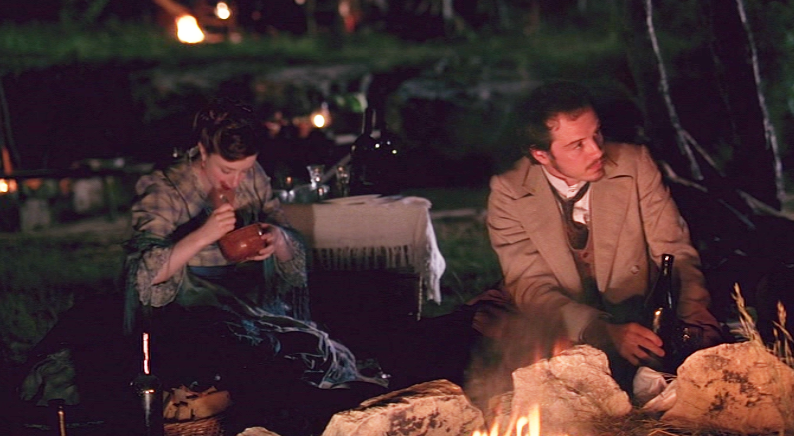
Two people regard the same picnic as if from different worlds. The Deacon, a young clergyman, thinks, “My God, how nice it is! People, rocks, the fire, the twilight, a monstrous tree—nothing more, and yet how fine it is. “Laevsky, a man on the verge of a nervous breakdown, unhappy in love, deep in debt, and at odds with friends, views the picnic with scorn: “How stupid and vulgar it is! I want to go to the North, to run away, to escape, but here I am, for some reason, going to this stupid picnic.”
There is an illusion of happiness necessary to a traditional picnic.” Samoylenko, with a copper-red face, was fussing round the fire just as though he were in his own kitchen, shouting furiously: “Where’s the salt, gentlemen? I bet you’ve forgotten it. Why are you all sitting about like lords while I do the work?”
Laevsky and Nikodim Alexandritch were sitting side by side on the fallen tree looking pensively at the fire. Marya Konstantinovna, Katya, and Kostya were taking the cups, saucers, and plates out of the baskets. Von Koren, with his arms folded and one foot on a stone, was standing on a bank at the very edge of the water, thinking about something. Patches of red light from the fire moved together with the shadows over the ground near the dark human figures, and quivered on the mountain, on the trees, on the bridge, on the drying-shed; on the other side the steep, scooped-out bank was all lighted up and glimmering in the stream, and the rushing turbid water broke its reflection into little bits.
The Deacon went for the fish which Kerbalay was cleaning and washing on the bank, but he stood still halfway and looked about him. “My God, how nice it is!” he thought. “People, rocks, the fire, the twilight, a monstrous tree—nothing more, and yet how fine it is!”
Predictably, Laevsky cannot lift his depression. “A splendid picnic, an enchanting evening,” said Laevsky, growing lively with the wine. “But I should prefer a fine winter to all this. ‘His beaver collar is silver with hoar-frost.'” “Everyone to his taste,” observed Von Koren.
Featured Image: Dining by firelight in Dover Kosashvili’s The Duel (2010). Andrew Scott as Laevsky and Fiona Glascott as Nadia
See Anton Chekhov. The Duel and Other Stories (1891). Translated by Constance Garnett. (1916); The Duel. Translated by Richard Pevear and Larissa Volokhonsky (2003); Dover Kosashvili. The Duel (2010). The screenplay by Mary Bing is based on Anton Chekhov’s The Duel (1891); Iosif Kheifits. The Bad Good Man (1973). The screenplay by Kheifits is based on Anton Chekhov’s 1891) novella