
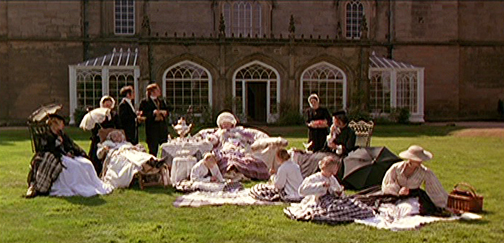
The Midsummer’s Day picnic in A.S. Byatt’s “Morpho Eugenia” is ruined when flying ants fall into the strawberries, cucumber sandwiches, and silver cream jugs. Everyone runs for cover.
Belying the humor, the dying ants in the cream jugs and teacups is Byatt’s metaphor contrasting the natural world with the social relationships among the English landed gentry. The name Eugenia Alabaster, the dutiful wife who is more interested in her incestuous relationship with her brother Edgar than her husband, is a pun on the name of the ants, Morpho Eugenia, that ruin a family picnic. William loves Eugenia, but she prefers Edgar: “I know it was bad, but you must understand it didn’t feel bad…” A reader may take this as either droll humor or horrendous sensationalism. Someone once suggested that if Byatt revised the title, she might have retitled it Angels & Incest.
Slyly. Byatt compares the ants to Icarus or falling angels meeting their end in “a creamy suffocation, or by drowning in a steaming cauldron of fragrant Mysore in the midst of our own strawberry picnic.” 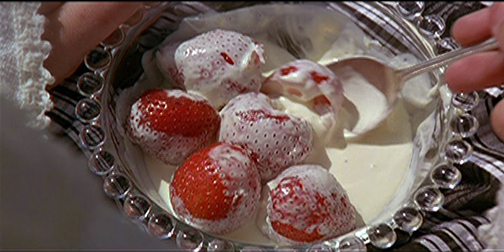
Featured Image: Philip Haas. Angels & Insects (1995). Screenplay by Philip Haas and Belinda Haas based on A.S. Byatt’s 1992 novella “Morpho Eugenia”. William Mark Rylance is William Adamson and Patsy Kensit is Eugenia Alabaster.
See A.S. Byatt. “Morpho Eugenia“ In Angels & Insects, Two Novellas (1992); Michelle Weinroth. “Morpho Eugenia” and the fictions of Victorian Englishness: A.S. Byatt’s Critique. English Studies in Canada (2005); Alexa Alfer and Michael J. Noble, eds. Essays on the Fiction of A. S. Byatt: Imagining the Real (2022)