
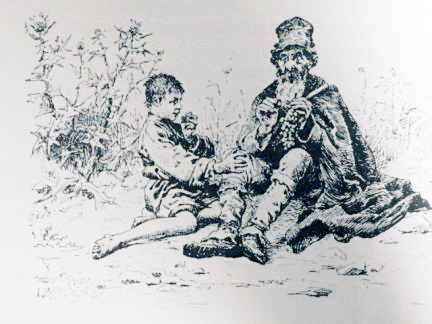
Merienda first appears in the anonymous picaresque novel The Life of Lazarillo de Tormes in 1554, * ninety-five years before the French word pique-nique in 1649. It is used to denote a snack. But when Francesco de Quevedo uses merienda in El Buscon (The Swindler), it is a luncheon in the park at which hot and cold foods are served. Unmistakably it is a picnic.
The episode takes place when Lazarillo, a street urchin apprenticed to an unnamed blind beggar, must share a bunch of grapes with his master. “Sentéme al cabo del poyo y, porque no me tuviese por glotón, callé la merienda; y comienzo a cenar y morder en mis tripas y pan, y disimuladamente miraba al desventurado señor mío, que no partía sus ojos de mis faldas, que aquella sazón servían de plato.”
Robert Rudder translates merienda as a picnic: “And it happened that as we were coming to a place called Almorox when they were gathering the grapes, a grape picker gave him a bunch as alms. And since the baskets are usually handled pretty roughly, and the grapes were very ripe at the time, the bunch started to fall apart in his hand. If we had thrown it in the sack, it and everything it touched would have spoiled. He decided that we’d have a picnic so that it wouldn’t go to waste— and he did it to please me, too, since he’d kicked and beat me quite a bit that day. So, we sat down on a low wall, and he said: “Now I want to be generous with you: we’ll share this bunch of grapes, and you can eat as many as I do. We’ll divide it like this: you take one, then I’ll take one. But you have to promise me that you won’t take more than one at a time. I’ll do the same until we finish, and that way, there won’t be any cheating.”
Of course, both cheat!
Though Spaniards now use picnic in common parlance, they prefer such phrases as comida al aire libre [luncheon on the grass], comida campestre [eat in the country], or fueron de merienda al campo [go for a picnic in the country].
Featured Image: Maurice Leloir. “In agreement, we began [to eat the grapes]” [Hecho asi el concierto, comenzamos] (1886)
*Though popular and widely read, its critical description of Spanish society and the Catholic Church resulted in its listing on the Index of Prohibited Books. The story seems contemporary to 1554. But who wrote it and when are unknown.
See The Life of Lazarillo de Tormes and of His Fortunes and Adversities. Translated by Robert Rudder. New York: Frederick Ungar Publishing Co., Inc. 1973