
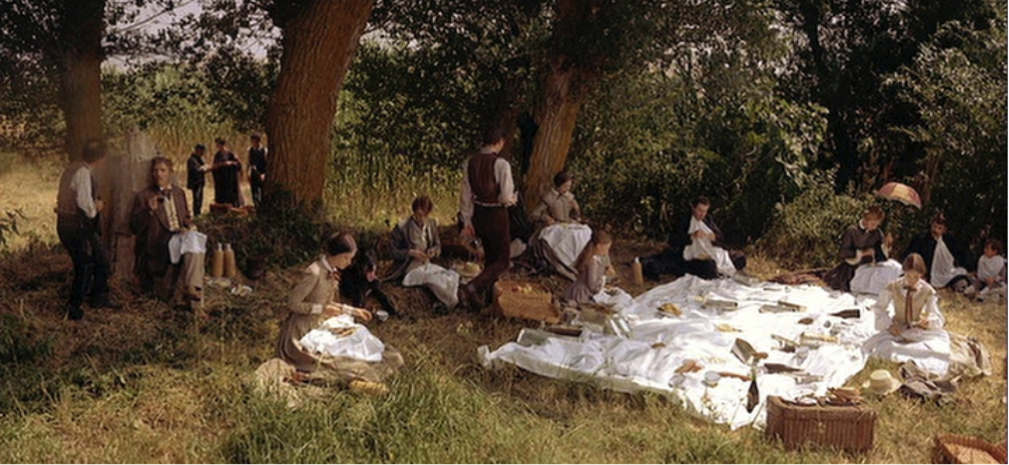
The picnic in Giuseppe Lampedusa’s novel Il Gattopardo, The Leopard, is a metaphor suggesting the disillusionment of Don Fabrizio, the novel’s central character. To the contrary, Luchino Visconti wished it to be a restful, leisurely respite on a long, dusty ride, and he added a classic picnic scene. Lampedusa describes a “funereal countryside, yellow with stubble, black with burned patches; the lament of cicadas filled the sky. It was like a death rattle of parched Sicily at the end of August vainly awaiting rain.” Visconti provides ample heat, dust, and harshness of the hilly terrain but the picnic is comfortable and congenial; a classic luncheon needs a white cloth spread on the grass shaded by great oaks. It’s what you expect for a picnic on a hot summer day. Don Fabrizio dines at ease in a chair back against a tree, with a white linen napkin across his knees. Lunch is unpacked from large picnic wicker baskets (cestini da picnic ), and chicken, bread, and fruit are served on plates. There’s glassware for wine, and the bottles are arranged to secure the cloth’s edges.
They set “tablecloths out on the straw left over from the threshing in the oblong shade of the building” of what remains of a decrepit Corbèra estate. Visconti misses the symbolism of a derelict house with a massive sagging courtyard door. Most of all, he omits the carved figure of a Gattopardo (or civet cat) with a broken leg.
See: Giuseppe. Lampedusa. The Leopard, aka Gattopardo. Translated by Archibald Colquhoun (1958); The Leopard. (2015). Photographs by Giovanni Battista Poletto are from 1963; Luchino Visconti. The Leopard (1963). Screenplay by Pasquale Festa, Campanile, Enrico Medoli, Massimo Franciosa, Luchino Visconti, and Suso Cecchi d’Amico is based on Giuseppe Lampedusa’s 1958 novel