
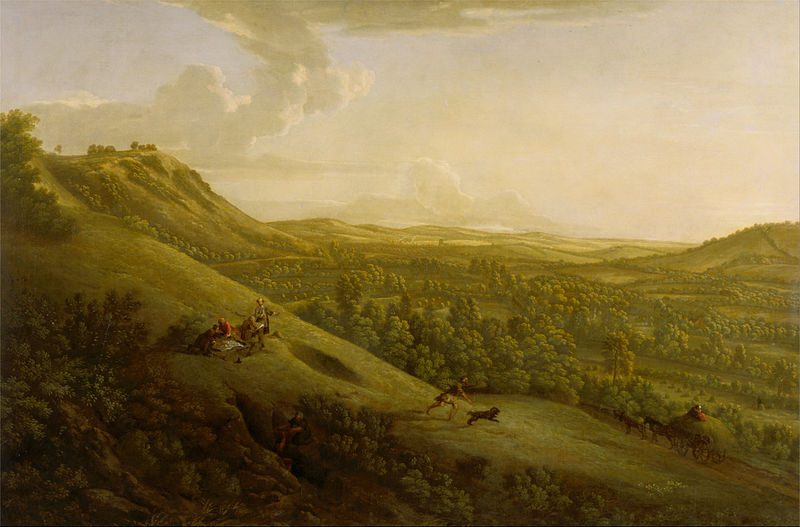
Even if George Lambert knew the French word pique-nique, he would not describe an outing on the grass a picnic because it was not used in this context. By French custom, it was an indoor meal. Moreover, there is no evidence that the English word pique-nique was used in writing or vocabulary in 1733. So when Lambert embellished A View of Box Hill, Surrey, with Dorking in the Distance and A View of Box Hill, Surrey with people lunching on the grass, he did not have a name for it.
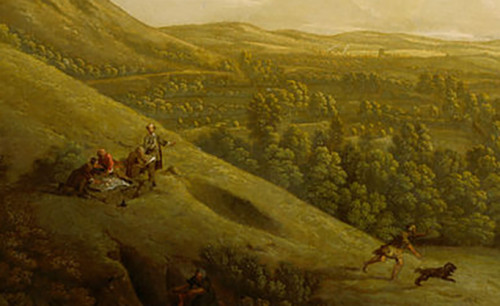
Certainly, his patrons and viewers recognized Lambert’s tactful contrast of play and agricultural work. A View of Box Hill, Surrey, with Dorking in the Distance, for example, depicts a social group gathered around a white cloth attended by two women setting out food and drink. Nearby, two men stand; one is sitting and sketching while the other points to the prospect.
George Lambert. A View of Box Hill, Surrey, with Dorking in the Distance (1733). Oil on canvas. (1733). J.M.W. Turner’s watercolor sketch Box Hill, Surrey (1796) is topographical and unembellished.
Eighty-three years after Lambert painted his views, Jane Austen visited Box Hill vicariously. Though she had lived at Chawton, a town forty-one miles from Box Hill, she never made the journey. Instead, Emma Woodhouse, the heroine of Emma, attends a “picnic parade” on its summit. According to Austen, Emma and her friends ate a “cold collation,” quickly scanned the prospect, chatted, played a game, and departed two hours later. As far as we know, Emma never returned (or picnicked for that matter).
The first usage of picnic in English appears in 1748 in Lord Chesterfield’s letters, which were unpublished until 1774. “Pic-nic,” as Chesterfield spells the word, describes a salon gathering in Leipzig.
See Jane Austen. Emma. London: John Murray, 1816; Philip Dormer Stanhope. The Letters Written by the Late Right Honourable Philip Dormer Stanhope, Earl of Chesterfield to His Son, Philip Stanhope, Esq. London: J. Dodsley, 1774.