
Birthdays and Name Days, celebrations of the name of a saint associated with an individual, are often a cause for picnicking. Originally, Name Days were linked to Catholic tradition, but the celebration has been largely secularized. Not everyone has a Name Day, but everyone does have a birthday.
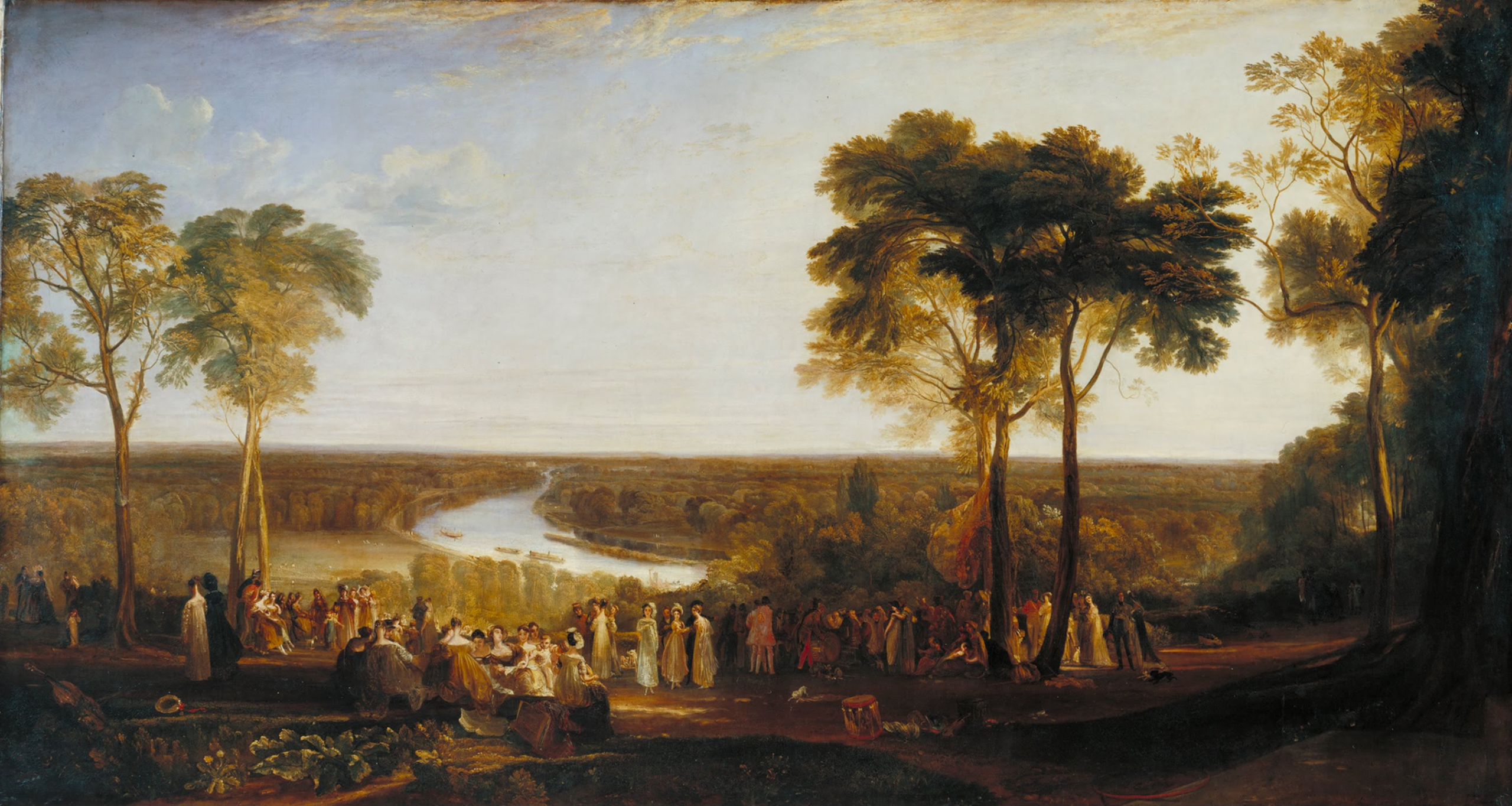
Notably, J.M.W. Turner used picnics in two major paintings, England: Richmond Hill, on the Prince Regent’s Birthday (1819) and Childe Harold’s Pilgrimage-Italy (1832). The former includes a picnic garden party that was celebrated on April 23rd, St George’s Day, which was also Turner’s birthday.
“Blissful” is Charles Dickens’s word describing David Copperfield’s tenderest memories of Dora Spenlow’s picnic birthday party. He’s about nineteen and obsessed, getting up before 6:00 AM to buy flowers, so they are fresh. The picnic is near Guildford, Surrey, which David thinks might have been conjured by an “Arabian Night-magician.” He rides horseback behind Dora’s carriage to look at Dora, who sits in a seat looking back at him. He does not mind the dust.
James Jacque Tissot’s Picnic on the Grass (1882) is a children’s birthday party. The painting is a memento mori for Kathleen Newton, facing the viewer. She is the mother of the birthday child. Newton was Tissot’s mistress, and she lived with him and her two children in his house in St. John’s Wood, London. At the time of this picnic, she was already dying of tuberculosis, something her smiling face hides.
Elizabeth Bowen’s “Pocock’s Picnic,” in The Little Girls (1946), recounts a birthday party at the beach in Kent on July 23, 1914, the day that the Austrians delivered an ultimatum to the Serbs. The children are oblivious to the impending war but are far more interested in games and food: tea, milk, lemonade, scones, butter, jam, potted-meat sandwiches, gingerbread, and a birthday cake with white icing and twelve candles. There is an enigmatic encounter between two of the parents attending, Major Burken-Jones and Mrs. Piggott, who talk in coded language that suggests a goodbye to a longstanding intimate relationship. Dicey, one of “the little girls” in the title, observes without understanding.
Eudora Welty’s Losing Battles (1970) is about the ninetieth birthday of Granny Vaughn, matriarch of the family, and the death of her husband, Grandpa Vaughn, exactly a year before. It’s also a family reunion held on the first Sunday in August, Granny’s birthday regardless of the date. The timing is also appropriate for Dinner on the Grounds. Granny, dressed in black, sits at the head of the table in her rocking chair. The elders sit at the tables, and the rest spread out on the grassless ground on cloths and quilts so that the yard looks like it is spread with diamonds. The tables are set in the front yard shaded by the great bois d’arc tree, aka Osage orange. When the table is filled, Uncle Webster says, “This table looks too pretty to be molested!” Brother Bethune says that this reminds him of Belshazzar’s Feast without the handwriting on the wall. The foods are fried chicken, chicken pie, sausage, pickled peaches, pear relish, fried and boiled ham, hard-boiled eggs, five kinds of salad, milk, buttermilk, butter, five kinds of bread, coconut cake, watermelons, and gallons of lemonade with ice. The grand moment occurs when a birthday cake is delivered, and they all sing the hymn “Gathering home! Gathering home!”
Peter Mayle’s “Passing 50 Without Breaking the Speed Limit,” in Toujours Province (1991), is a contrast of English picnics and French piqueniques: Rain, damp bottoms, tepid wine, and ants on the one hand, and sun, blue sky, tables and chairs on the other. He says that when it rains at a picnic, he playfully calls it a “le pique-nique Anglais.” Mayle celebrated his 50th birthday by riding to his picnic in a restored 19th-century calèche, a large open coach drawn by four horses: “To travel this way is to make you regret the invention of the car. . . . In a carriage, you’re part of it.” The food and wines, however, are shipped by car and are ready when the picnickers arrive. The meal is served on a flat, grassy clearing; a table for ten had been set in the shade with a white cloth and napkins, ice buckets, bowls of fresh flowers, dishes, cutlery and chairs. Mayle says that at this sight “All my misgivings about picnics vanished. This was far away from a damp bottom and ant sandwiches as one could possibly imagine.” It is a four hour lunch that begins with peach champagne and then moves on to melon, quails’ eggs, creamy brandade of cod [cod and potato puree a province dish], game pate, stuffed tomatoes, marinated mushrooms, birthday cake and gâteau..
Anton Chekhov’s “The Party” (1888), in The Tales of Chekhov: The Party and Other Tales (1917), is the bittersweet story of a name day party that ends with the birth of a stillborn child the evening of a name day party.
Vladimir Nabokov’s picnic in “A Bad Day “ (1931), The Stories of Vladimir Nabokov (1996), is the story of Peter Shiskov’s tenth birthday party at which everything goes wrong, and he “dreads the day knowing that it will be repulsive and oppressive.” Peter’s catalog of woes that make the picnic an ordeal includes riding on the box of the open carriage, wearing pants that are too tight and chafe, not getting along with the children’s counselor, throwing a bull’s eye when no one is looking, and getting lost so that when they start the picnic meal no one remembers that he is missing. There is a simple meal of baked potatoes, bilberry (or blueberry) tarts, and iced tea in thermos bottles served by a campfire in a clearing of the forest.
Nabokov’s picnic in Ada, or Ardor: A Family Chronicle (1969) celebrates Ada’s twelfth birthday party, and it marks sexual awakening and the beginning of her lifelong incestuous relationship with her brother Van Veen (fifteen). Ada wears a gypsy dress called a lolita, and no underclothes. Guests arrive in a charabanc, caléches, a red motor car, and bicycles to a picnic site in an old pine forest. Food, delivered beforehand by servants, consists of crustless sandwiches, roasted turkey, Russian black bread, Gray Bead Beluga caviar (the most expensive), candied violets, raspberry tarts, white and ruby port, watered claret for the children, and cold sweet tea. It’s unclear if the meal is served at a table or spread out on a rug, but food is served on Sèvres, probably sterling flatware. Ada dances to a tune on a music box, and Van walks on his hands. On the ride home, Ada sits on Van’s hard lap, and he can scarcely keep from having an orgasm.
Featured Image: J.M.W. Turner. England: Richmond Hill, on the Prince Regent’s Birthday (1819), oil on canvas. Tate Britain, London